⚠️ As of: February 19, 2026 – FT2 is experimental/beta. All specifications are based on initial tests and may change.
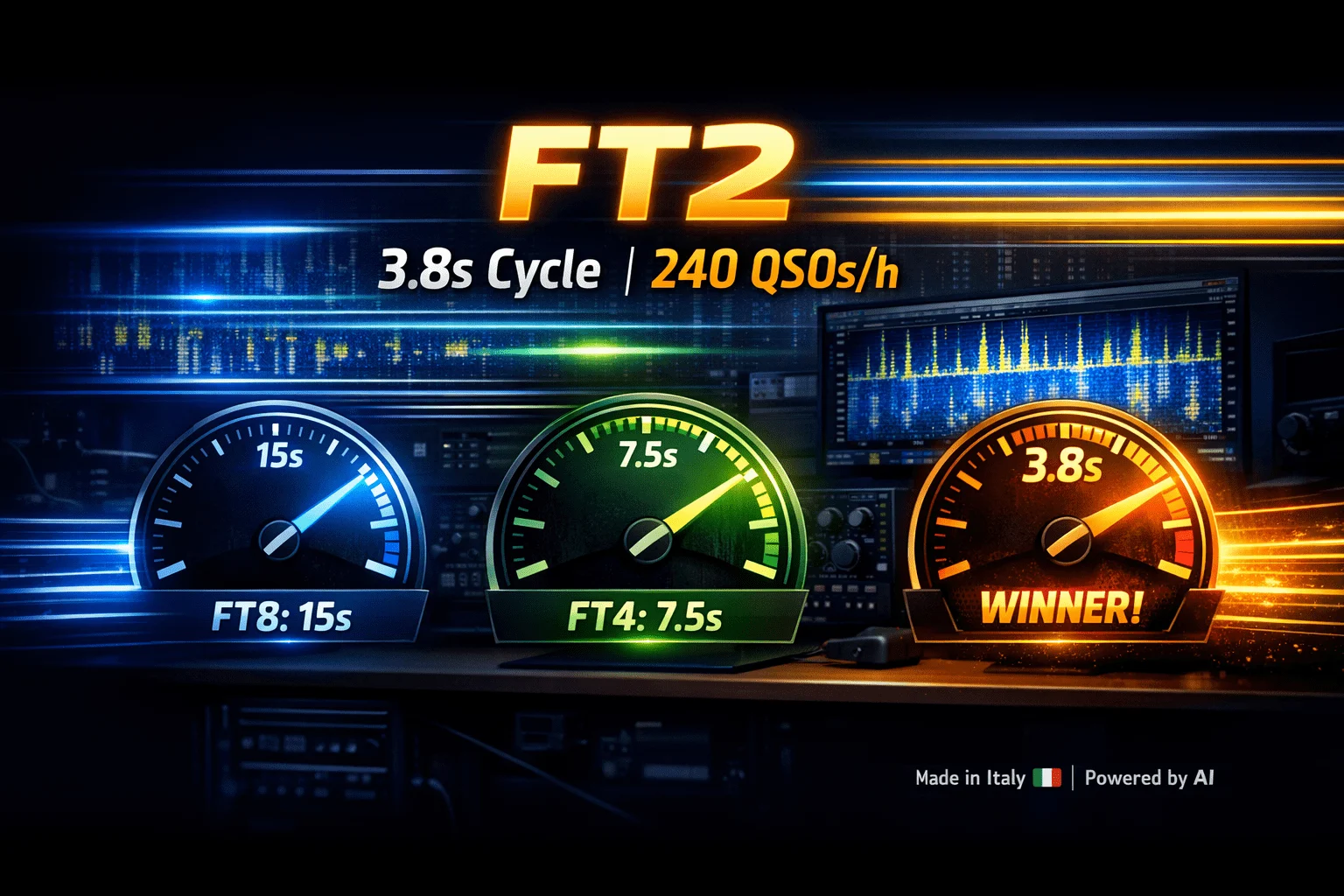
Every radio amateur knows FT8 – the digital mode that revolutionized shortwave. But since February 16, 2026, there’s a new player: FT2, an ultra-fast digital mode with only 3.8 seconds per TX cycle. That’s four times faster than FT8! FT2 was developed in Italy by Martino Merola, IU8LMC, together with the ARI Caserta Team – and remarkably, AI assistance from Claude (Anthropic) was used in the software development.
Comparison: FT8 vs. FT4 vs. FT2
What sets FT2 apart from its predecessors? Here’s a direct comparison:
What is FT2?
FT2 uses the same codec as FT8 and FT4 – the same 77-bit payload, the same LDPC error correction, the same 8-GFSK modulation. The crucial difference: everything is time-compressed. What FT8 does in 15 seconds, FT2 achieves in 3.8 seconds.
FT2 is not intended to replace FT8 – it’s a specialized tool for situations where speed matters:
- DXpeditions & Pile-Ups: Process more QSOs in less time
- Contests: Maximum QSO rate with good signals
- Local Nets: Fast exchange under good conditions
- High-Speed Scenarios: When conditions are right and speed is essential
The trade-off is clear: FT2 requires more bandwidth (~150 Hz vs. 50 Hz), is less sensitive (–12 to –14 dB vs. –21 dB) and demands tighter time synchronization (±50 ms). For weak signals and DX at the edge of hearing, FT8 remains the better choice.
First Successful On-Air Test
On February 16, 2026 at 22:47 UTC, the starting signal was given: the first FT2 QSOs were successfully completed on air. Participating stations included IZ8VYF, IZ8XXE, and IC8TEM – all from the Italian amateur radio community.
Tests took place at locations in Campania, on Capri, Sardinia, and Turin, on the 40m and 80m bands. Result: Dozens of QSOs were successfully completed – FT2 works in practice!
Software & Installation: Decodium 3.0
FT2 runs on Decodium 3.0, a fork of WSJT-X. Installation is straightforward – and works with existing FT8 hardware, no upgrade needed:
- Install WSJT-X (if not already installed)
- Download Decodium 3.0 – the RAR archive is available at hampass.com/ft2
- Extract files into the WSJT-X installation folder (overwrite existing files)
- Load frequency file: Download ft2-bands.qrg
- In Decodium: File → Open Frequencies File → ft2-bands.qrg
- IMPORTANT: Synchronize your PC clock! FT2 requires accuracy of ±50 ms. Meinberg NTP is recommended.
- Select Mode → FT2, e.g. 7.052 MHz USB on 40m
Decodium 3 Features: Auto CQ and Auto Log functionality are already integrated – ideal for contest operation.
Technical Documentation (PDF):
FT2 Already Visible on PSKReporter
FT2 is already listed on PSKReporter. As of February 19, 2026, statistics show 389 FT2 spots in the last 2 hours – and rising. The software is listed as “Decodium 3 FT2 v3.0.0-rc1 (mod by WM8Q)”. Community interest is growing rapidly.
AI in the Development Process
A remarkable aspect: Claude (Anthropic) was used as an AI development tool in modifying the WSJT-X source code. An interesting example of how AI-assisted software development is making its way into the amateur radio world – from code analysis to modifying existing protocol implementations and optimizing signal processing.
Conclusion & Outlook
FT2 arrives at the right time – during the peak phase of Solar Cycle 25 with still very good propagation conditions. The high speed makes this mode an exciting tool for DXpeditions and contests. At the same time, it’s clear: the trade-off in sensitivity and bandwidth means that FT8 keeps its place.
The software is ready to use, the community is growing, and the first hundreds of spots on PSKReporter show: FT2 is not just theory – it works.
Beta testers wanted! If you’d like to try FT2 and contribute to its development, join the WhatsApp group for beta testers. Further details and stable releases are expected in the coming weeks.