
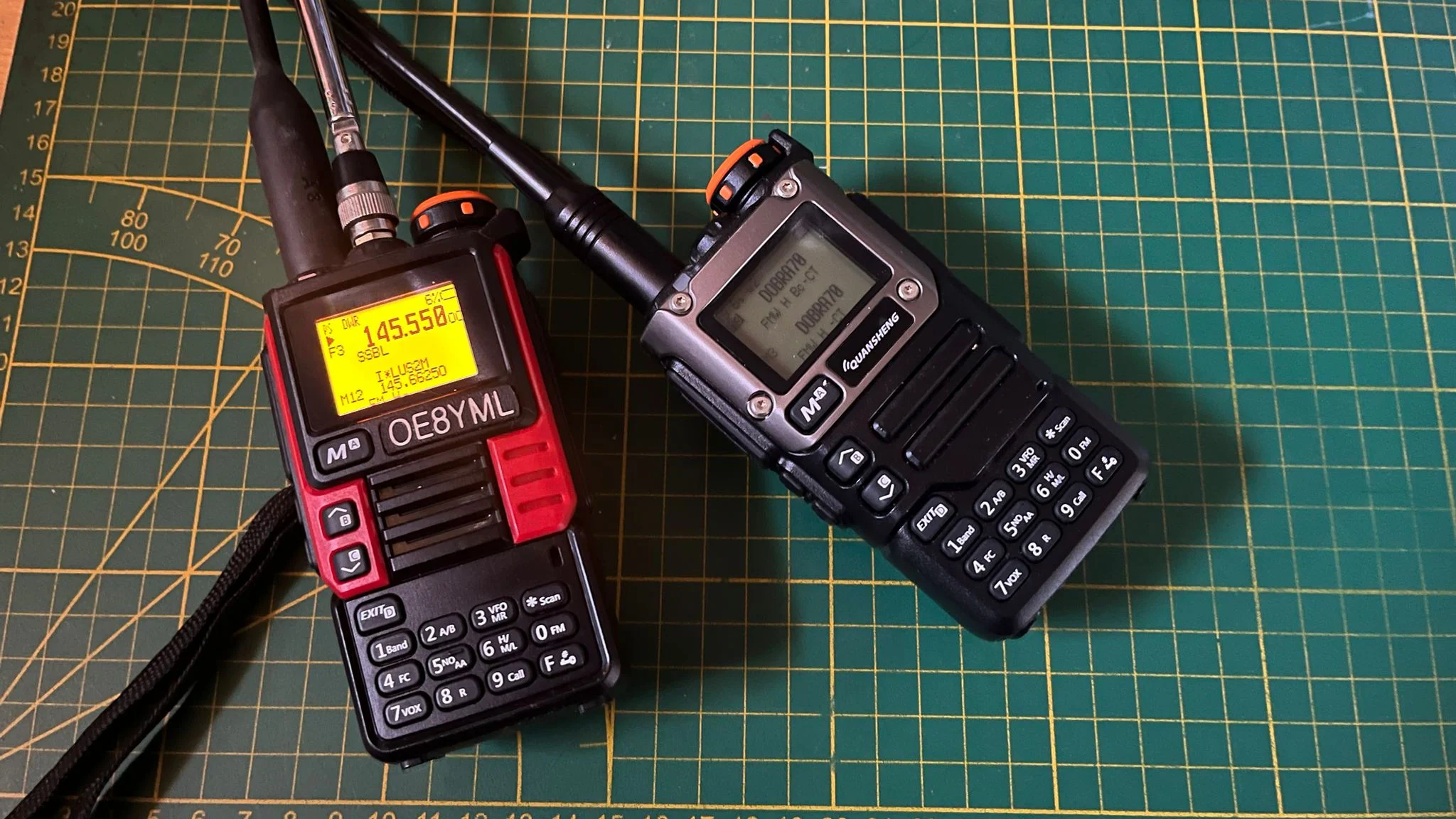
Buy a handheld radio for around 25 euros and then transform it with open-source firmware into a device offering features normally found only in the 200-euro class? That is exactly what is happening with the Quansheng UV-K5 — and the amateur radio community is thrilled.
What is the Quansheng UV-K5?
The UV-K5 is an inexpensive Chinese dual-band handheld radio for the 2 m and 70 cm bands (VHF/UHF). Hardware-wise, it offers a solid receiver built around the BK4819 chip, a decent display and USB-C for programming. Nothing unusual so far — there are dozens of similar radios on the market.
What makes the UV-K5 special: its firmware flash memory can be written over USB. And an active community has exploited exactly that.
Egzumer firmware: the upgrade that changes everything
The best-known custom firmware comes from developer Egzumer and is based on the original reverse-engineering project by Dual Tachyon. It extends the UV-K5 with features the stock firmware does not even remotely offer:
- Spectrum Analyser: A real-time spectrum analyser directly on the device. It lets you visualise the radio spectrum and spot active frequencies instantly.
- Extended frequency range: Reception from 18 MHz to 1300 MHz (receive only outside the amateur bands). This turns the UV-K5 into a wideband receiver for airband, PMR, marine and more.
- AM reception: Aviation communication on the airband (118-136 MHz) in AM — not possible with the stock firmware.
- SSB reception: Some firmware variants enable rudimentary SSB reception on HF. Not HF quality, but astonishing for a 25-euro device.
- Messenger function: Send and receive text messages over radio — a kind of peer-to-peer messaging without the internet.
- Improved squelch: Finer squelch settings than the stock firmware.
- NOAA weather channels: Direct access to NOAA frequencies (relevant in North America).
Flashing firmware: how it works
Flashing the custom firmware is surprisingly simple:
- Download firmware: The current Egzumer firmware is available on GitHub. There are several variants — with and without spectrum analyser, with or without messenger.
- Connect USB cable: The UV-K5 connects to the computer via USB-C (or on older versions via a Kenwood-style plug with USB adapter).
- Launch the flash tool: There are web-based flash tools that run directly in the browser — no drivers needed, no installation hassle.
- Transfer firmware: One click, wait 30 seconds, done.
Important: the stock firmware can be restored at any time. The risk of bricking the device is minimal — the bootloader is preserved with every flash.
Hardware variants
There are now several versions of the UV-K5:
- UV-K5: The original with a Kenwood-compatible antenna connector (SMA female).
- UV-K5(8): With more memory channels (out of the box).
- UV-K6: Slightly modified version, same chipset.
- UV-5R Plus: Similar platform, also firmware-compatible.
All variants are based on the BK4819 transceiver chip and are compatible with the custom firmware. The community generally recommends the UV-K5(8) as the best starting point.
The spectrum analyser in detail
The killer feature for many radio amateurs is the spectrum analyser. It shows a real-time view of the radio spectrum on the small display — similar to an SDR, but directly on the handheld. You can see instantly where there is activity, identify interference sources and observe band activity without hauling a computer along.
Naturally, this analyser does not replace a professional measurement receiver. Dynamic range is limited and resolution is low. But for a quick overview in the field it is invaluable — especially for SOTA and POTA activators who want to know what is happening on the band.
Legal considerations
An important point: transmitting is permitted only on the authorised amateur radio bands with a valid licence. The extended receive range of the custom firmware is legal in most countries, as long as you only listen. Transmitting outside the amateur bands is of course prohibited.
In Austria, the provisions of the Telecommunications Act apply. Monitoring certain frequencies (such as police or emergency services) may be restricted depending on the jurisdiction. The rule of thumb: inform yourself about local regulations.
Strengths and weaknesses
Strengths:
- Unbeatable price (20-30 euros)
- Active community and regular firmware updates
- Spectrum analyser as a unique selling point
- Wideband reception after firmware mod
- USB-C and simple flashing
Weaknesses:
- Transmit power only 4-5 watts (typical for the price class)
- Transmit audio quality mediocre
- Receiver large-signal handling limited
- Build quality matching the price
- No official type approval for all markets
Who is the UV-K5 for?
The UV-K5 is not a replacement for a high-quality handheld like a Yaesu FT-70D or Icom ID-52. If you want a reliable everyday radio with a good receiver and strong transmitter, stick with established brands.
But as a second radio, an experimentation platform or an entry-level device, the UV-K5 is hard to beat. If you enjoy tinkering, modifying firmware and experimenting with radio technology, you get an astonishingly versatile tool for 25 euros. And if the radio tumbles into the rocks on your next SOTA summit — at that price it is no disaster.
The community as the driving force
What truly makes the UV-K5 special is not the hardware — it is the community. Hundreds of developers and tinkerers work on firmware variants, hardware mods and documentation. On Reddit, GitHub and in Telegram groups there is intense exchange and development. There are 3D-printing models for cases, guides for hardware mods and even firmware variants with special features for specific use cases.
This community approach recalls the early days of amateur radio, when hams built and modified their own equipment. The UV-K5 is, in a sense, the Arduino of handheld radios — cheap, open and endlessly expandable.
73 – your oeradio.at editorial team
Transparency Notice
This article was researched and written with the assistance of AI (Claude, Anthropic). The editorial team has reviewed and edited all content. Despite careful review, occasional inaccuracies may occur — we welcome corrections via email to [email protected].
