You know the feeling? Standing in the garden, 42 metres of wire in one hand, coffee in the other, wondering: where is all this supposed to go? That is exactly how my adventure with the MFJ-1982MP started. An end-fed antenna that promises to cover everything from 80 to 6 metres. I set it up, measured it and used it extensively – here is my report.
What you get
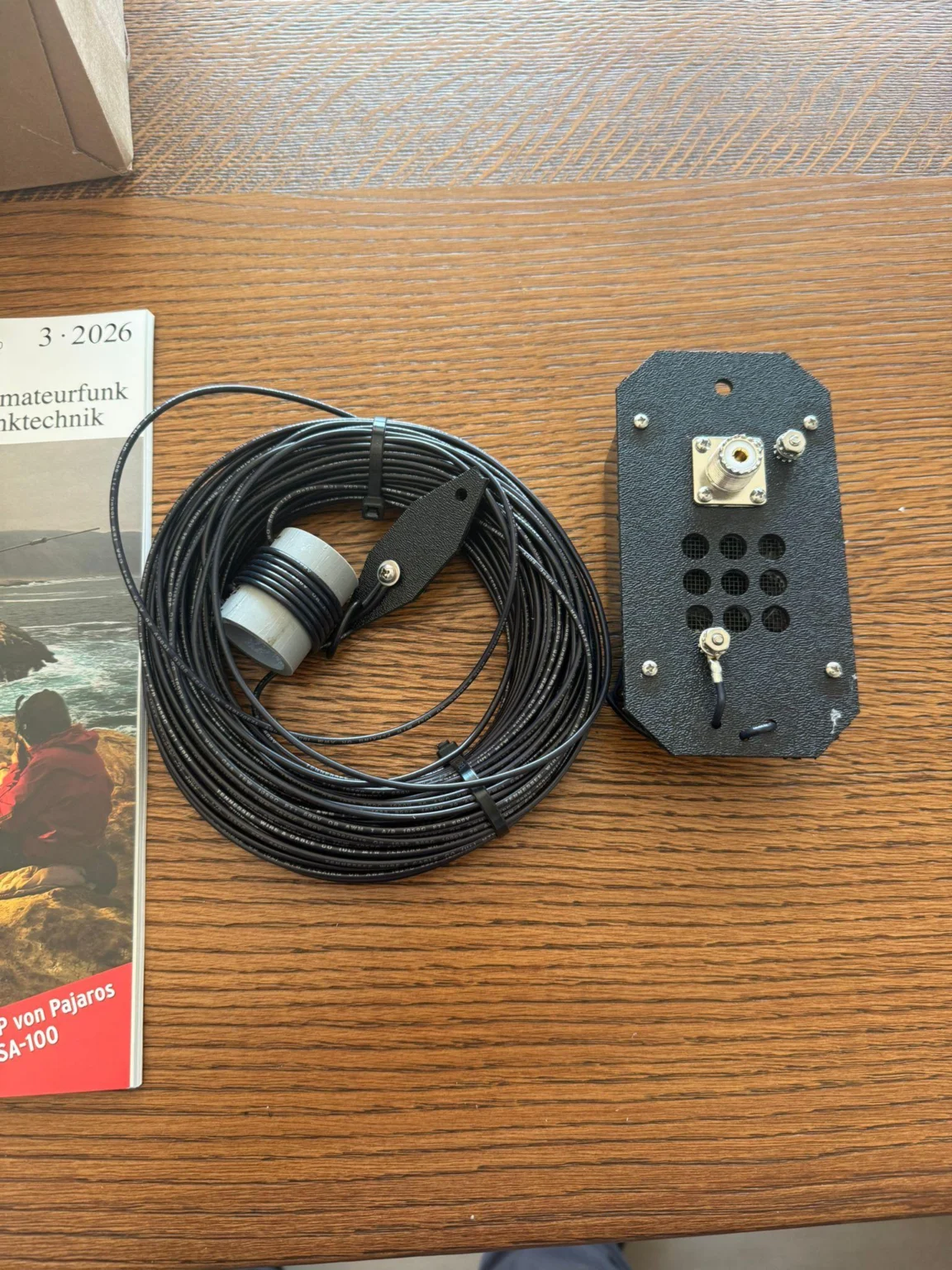
The MFJ-1982MP is an end-fed half-wave wire antenna from MFJ Enterprises. 42 metres of wire, an integrated matching unit, a coil in the lower wire section for the low frequencies – done. Rated for approx. 300 watts PEP. Unbox, hang up, connect coax, get on the air. At least in theory.
Setup: Inverted-L and a bit of creativity
Unfortunately I do not have a 42-metre mast in my garden. So it became an Inverted-L – the wire goes up a bit first and then bends horizontally. The feed point sits at about 2.5 metres above ground, the highest point of the wire is roughly 9 to 10 metres. Plus 50-ohm coaxial cable and – very important – a common mode choke right at the feed point.
I can warmly recommend the choke. Without it, RF likes to travel back along the cable shield into the shack. Then the monitor flickers, the mouse develops a mind of its own, and the XYL asks whether stamp collecting might be a better hobby after all. With the choke: peace and quiet.
What do the measurements say?
Now it gets interesting. I measured the antenna band by band:
On 80 metres (3.5–3.8 MHz) resonance sits in the lower part of the band. SWR between 1.3 and 1.8 – a tuner is recommended for the full range. But let us be honest: anyone operating on 80 metres without a tuner also believes you can fell a tree with a Swiss Army knife.
40 metres (7 MHz) is the star of the show. SWR below 1.5 in the main operating range, direct operation without a tuner is possible. Just plug in and go. On the bread-and-butter band, the antenna delivers flawlessly.
On 30 metres (10 MHz) things get a bit higher – SWR around 1.8 to 2.2. No problem with the internal tuner. 30 metres is the band for individualists and digital operators anyway, and they usually have a tuner at hand.
20 metres (14 MHz) shows a clean resonance again. SWR mostly below 1.5, and with decent installation height you get solid DX results here. The DX band par excellence – and the MFJ does a solid job.
The upper bands – 17, 15, 12 and 10 metres – are all usable. SWR mostly between 1.5 and 2.0. Fine-tuning is worthwhile in places, but nothing dramatic. The higher the wire hangs, the better the radiation angle for DX, naturally.
And 6 metres (50 MHz)? It actually works too! The SWR is not perfect, but absolutely doable with a tuner. A nice bonus band that lets you suddenly work all of Europe during good Sporadic-E conditions.
How does it perform on the air?
In daily operation: unobtrusive. And I mean that positively. No RF in the shack, no interference with PC or peripherals. The choke does its job, the antenna does its job, and I can just get on the air without dealing with problems.
Whether regional nets on 80 and 40 metres or DX on 20 metres and up – the MFJ-1982MP is a reliable companion. Of course always dependent on propagation conditions, but that applies to any antenna, whether it cost 50 euros or 5,000.
My conclusion
The MFJ-1982MP is no miracle antenna – but it never claims to be. What it is: a solid, uncomplicated multi-band end-fed that works from 80 to 6 metres and causes little trouble.
What I like: easy installation even at modest heights, good multi-band capability, decent SWR values without major gymnastics, and portability – 42 metres of wire fits in any backpack. What you need to know: on 30 and 6 metres you need a tuner – but who does not have one? I can live with that just fine.
If you are looking for a pragmatic HF antenna that you can hang up in an afternoon and that just works – no building permit, no rotator, no second mortgage – you should have a look at the MFJ-1982MP. At the end of the day, what matters is what is in the log. And mine has quite a bit in it.
73 de Christian, OE8CNI