
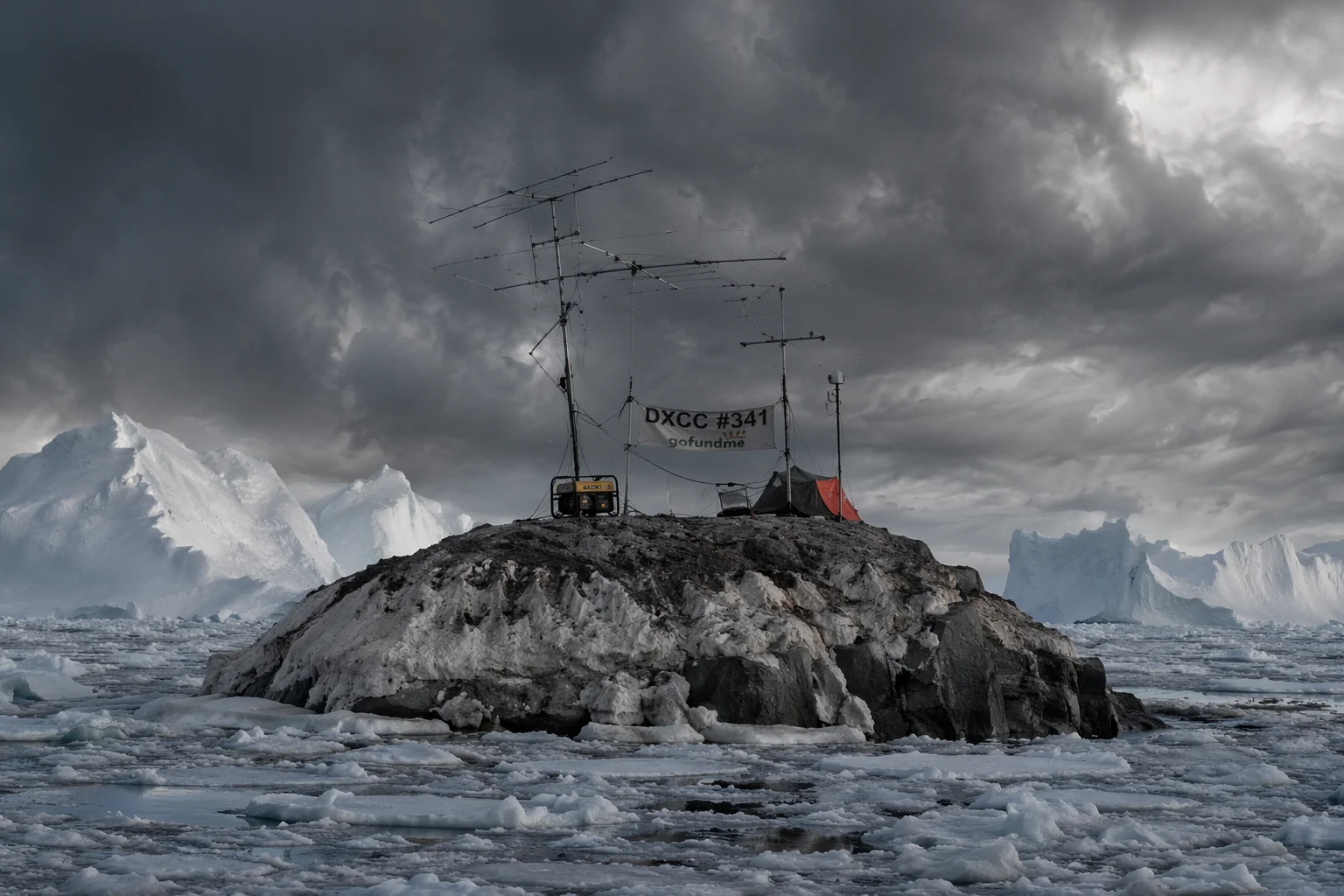
A dirty iceberg, 130 metres long, 50 metres wide and 16 metres tall. And half the amateur radio world is losing its mind.
The crew of the Polarstern – Germany’s floating pride, a research icebreaker from the Alfred Wegener Institute in Bremerhaven – has found something in the Weddell Sea that the world didn’t need: an island. Unnamed, not on any nautical chart, previously marked only as a “hazard zone.” 130 metres long. 50 metres wide. A rock in the pack ice that looks like a dirty iceberg.
The scientists surveyed it by drone, scanned it with echo sounders and documented everything. Very professional. Very German. Then they sailed on.
What they didn’t know: the moment the press release went online, all hell broke loose in the DX clusters.
DXCC Entity #341: The Madness Begins
Within three hours of the news breaking, the ARRL DXCC Committee had seventeen emails, four registered letters and one handwritten application for recognition as a new DXCC entity on its desk. One came from a local club chapter in Franconia. With an official stamp.
The reasoning was as creative as it was predictable: the island lies within the Antarctic Treaty area. No country can claim sovereignty. No country assigns a callsign prefix. Ergo: new entity. “It is de facto an ungoverned territory with an independent geographical identity,” wrote one applicant, presumably on his third glass of red wine.
The fact that the island is smaller than the car park in front of a hardware store bothers no one. Sealand is only 550 square metres, and people have been trying to do amateur radio from there too.
Compared to This, Bouvet Was a Children’s Party
Bouvet Island. Number 10 on the DXCC Most Wanted List. 3Y0J burned through about $715,000 in 2023 to operate from there for a few days. The new 3Y0K expedition for 2026 comes in at $1.7 million. One point seven. Million. Dollars.
But at least Bouvet has a name. A callsign prefix. A history. And a coastline where you can theoretically land, as long as there isn’t a storm blowing at 200 km/h – which happens about as often as a civil conversation on 3.740.
The new island has: nothing. No name, no prefix, no landing area, no shelter from the elements and zero infrastructure. But that doesn’t matter. Because where others see obstacles, DXpeditioners see a fundraising opportunity.
Sponsors Sound the Alarm
Before the island even has a name, there are already three competing GoFundMe campaigns, a Patreon page and a donation form that looks suspiciously like it was built in 2006. Total volume after 48 hours: $43,000. Where the money goes? Good question. “Logistics and planning,” says one page. Another: “We need an Antarctic landing craft, a generator and 14 monobanders.”
The Northern California DX Foundation – which already put $100,000 on the table for 3Y0J – has pre-emptively issued a statement: “We are monitoring the situation.” Translation: “Please stop emailing us.”
A DX cluster regular has already calculated that a serious DXpedition to the island – with ship, helicopter backup, 20 operators and four containers of equipment – would cost around three million dollars. Compared to that, Bouvet is a company outing.
The Prefix War
And then there’s the callsign question. Who assigns a callsign for an island that belongs to no country? Normally the Antarctic Treaty handles this – but it doesn’t explicitly regulate radio operations. The island lies near Joinville Island, which is claimed by the British Antarctic Territory. Argentina also claims the area. And Chile too. Three countries, zero jurisdiction, one rock.
In the DX forums, prefixes are already being traded like cryptocurrency:
- VP8/ANT – because the British claim everything anyway
- LU/Z – because Argentina thinks the Weddell Sea is basically a bay of Buenos Aires
- CE9/X – because Chile always shows up for Antarctic debates
- DP0 – because the Germans found the island and the Polarstern is cooler than any cruiser anyway
- XX9ICE – a suggestion from a Discord server that was probably not serious but got 47 upvotes
The IARU has said nothing yet. The ITU has said nothing yet. The ARRL has said it will “evaluate the situation.” Translation: a subcommittee will be formed that will publish a white paper in two years that no one will read.
The Expedition Casting Call
Three DXpedition teams have already expressed interest. One consists of experienced Antarctic veterans with proven logistics expertise. The other two consist of one OM each with an IC-705, a wishlist and an Instagram account with 200 followers.
In an amateur radio forum, someone has already discussed whether you could simply drop a balloon with an FT8 transceiver over the island. “Counts as an activation,” the author argued. “If the balloon touches the rock, the station is on the island.” The thread ran 14 pages before a moderator shut it down.
Another suggested simply buying the island. When told that you can’t buy Antarctic territory, he replied: “Then lease it.”
The Uncomfortable Truth
Nobody says it out loud, so I will: the island won’t be there in twenty years. Permafrost is thawing, Antarctica is losing ice at a rate that surprises even climate scientists, and a 130-metre rock in the Weddell Sea is not exactly Gibraltar. It is literally a dirty iceberg that melts too slowly to qualify as one.
But nobody cares. Because the DXCC programme doesn’t have expiry dates. If the island is recognised as an entity within the next three years, it counts forever. Even if by 2045 it’s a coral reef at two metres depth.
And that’s exactly the point where hobby turns into madness: three and a half million dollars to blow a few thousand CQ calls into the ether from a melting rock in the worst weather on Earth – so that some OM can change a number from 339 to 340 in his spreadsheet.
Is that crazy? Yes.
Will they do it anyway? Of course.
Welcome to amateur radio.
73 de Hansl Hohlleiter, OE0HHL
Sources
- Der Standard: Expedition team discovers island not on any nautical chart (German)
- Alfred Wegener Institute (AWI) – Polarstern Expedition
- ARRL DXCC Program
- Club Log DXCC Most Wanted List
- 3Y0K Bouvet Island DXpedition
Transparency Notice
This article is satire. The discovery of the island by the Polarstern expedition in the Weddell Sea is real (source: Alfred Wegener Institute, February 2026). Everything else – DXpedition plans, GoFundMe campaigns, prefix proposals, balloon activations and the idea of leasing an Antarctic island – is entirely fictional. Any resemblance to living persons, DX foundations or subcommittees is purely coincidental, but statistically probable. This article was researched and written with the assistance of AI (Claude, Anthropic). All content has been editorially reviewed.
