A Jammer satire by Hansl Hohlleiter
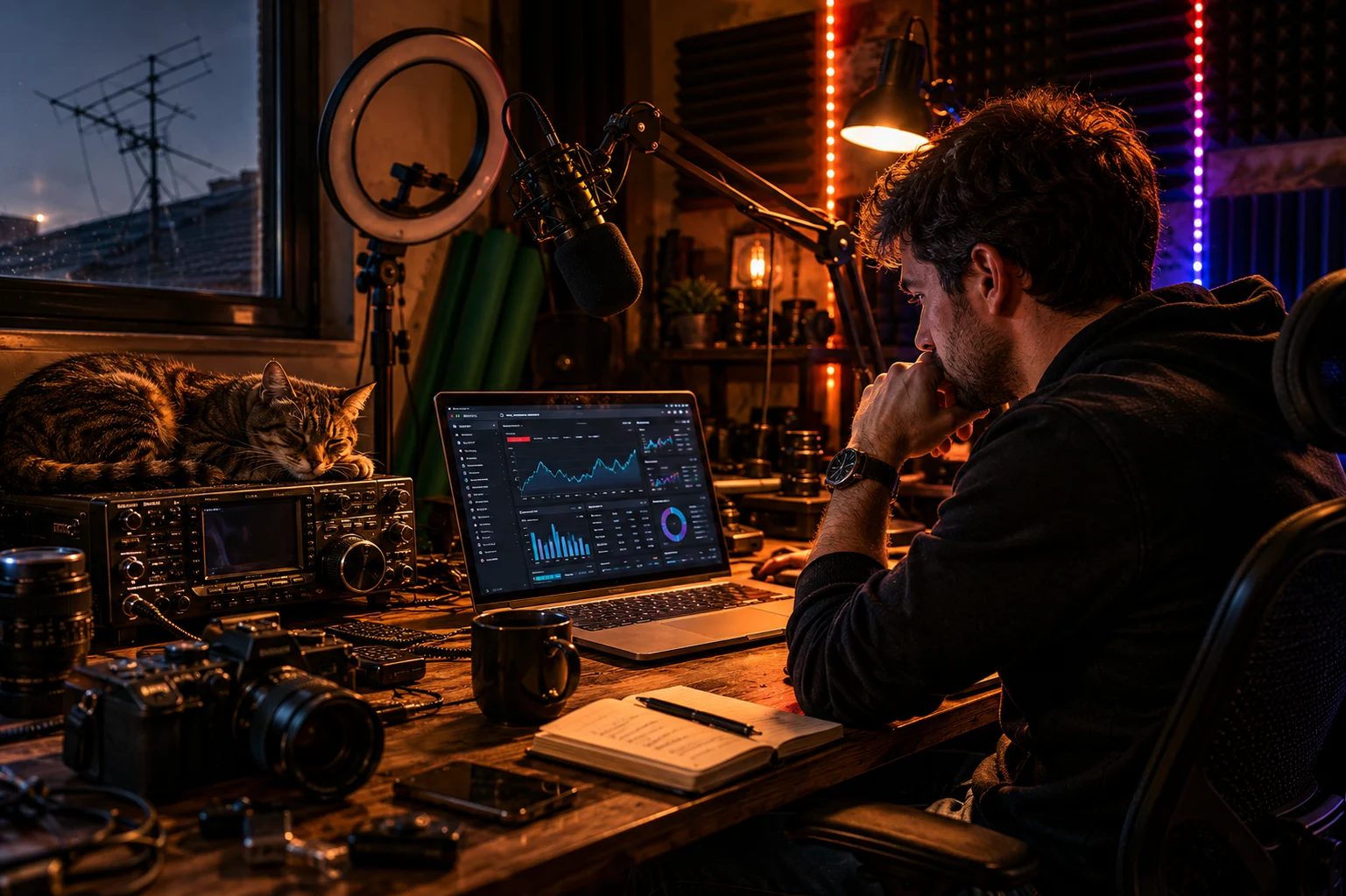
Kevin Klickzahl, OE0KKZ, is an amateur radio operator. It says so in his QRZ bio. Right below “Content Creator | Ham Radio Enthusiast | Tech Reviewer“. Above the callsign sits a professional banner photo: Kevin in front of his shack, ring light in his face, microphone on a boom arm, three monitors in the background. The transceiver is also in the shot. Decoratively. It hasn’t been switched on in eight months.
Kevin’s YouTube channel is called “OE0KKZ – Ham Radio & Beyond“. The “Beyond” is important because it covers the part that has nothing to do with amateur radio — roughly ninety per cent of the content. Kevin has forty-seven subscribers. Three of them are his mother, his work colleague and a bot from Indonesia. He earned the other forty-four over three years, video by video, thumbnail by thumbnail.
The Unboxing Empire
Kevin’s speciality is unboxing videos. Ninety minutes for a handheld transceiver. Ninety. Minutes. He films the box from all angles. He comments on the packaging quality. He praises the included USB cable. He reads the manual out loud — all of it. Page one to eighty-seven. Including the Japanese safety warnings. “Guys, this is super important, most people skip this!” Most people also skip Kevin’s videos. Average watch time: two minutes twenty-three. Out of ninety minutes.
But Kevin isn’t discouraged. “Quality takes time,” he says in every other video. Which is true: he spends six hours editing an unboxing. Four of those on colour-correcting the intro. The intro is eighteen seconds long and shows his callsign with an animation he spent three weeks building in After Effects. Eighteen seconds. Three weeks. That’s dedication.
The Greenscreen Shack
Kevin’s shack is a masterpiece of staging. Acoustic foam on the walls, LED strips behind the desk (RGB, of course, app-controlled), a studio microphone that cost three hundred euros and a camera that cost more than his transceiver. The transceiver itself is angled slightly so it looks good on camera. Ergonomically optimised for filming, not for operating.
The antenna? A wire dipole in the attic. Kevin hung it two years ago. Since then he was briefly on forty metres once, called CQ, got no reply, and decided the bands were “totally dead right now“. That was at an SFI of one hundred and fifty. Kevin hasn’t operated since. But he has made twenty-three videos about operating since then.
The Algorithm OM
Kevin thinks in thumbnails. Every experience is evaluated for whether it’s “content“. A field day? Content. A new transceiver in the shop? Content. A sunset over the antenna? Content. An actual QSO? Not really — hard to film and doesn’t get clicks.
His most-viewed video has four hundred and twelve views. It’s called “My Cat Sits on My ICOM” and shows exactly that: a cat sitting on an IC-7300. No radio technology is involved. Neither is the cat any more — she got spooked when Kevin accidentally turned on the transceiver. She didn’t recognise the sound of CW. Neither did Kevin.
His least-viewed video has three views. It’s called “How I Made My First HF QSO“. He never uploaded it. Because he never made it. The title has been sitting in his content calendar under “Coming Soon” for eight months.
The Equipment Spiral
Kevin buys radios like other people buy camera gear: not to use, but to discuss. He owns four handhelds, two mobiles and one HF transceiver. None of them is programmed correctly. But each has a review on his channel. “I’ve been using this rig for three weeks now and I can say…” — he can say how it feels, how heavy it is, how the display looks and how the menu works. What he can’t say is how it performs on the air. Because he’s never listened to a frequency long enough for someone to reply.
Kevin also owns a NanoVNA. There’s a forty-minute video about it. He shows how to calibrate it. He shows how to read an SWR plot. He doesn’t show his own antenna’s performance, because he has never connected the NanoVNA to his antenna. “I’ll do that in a follow-up video.” The follow-up has been in the pipeline for fourteen months.
The Community
Kevin is in seven Facebook groups, four Discord servers and two Telegram channels about amateur radio. He posts regularly. Photos of his shack (filtered), screenshots of his video analytics (“Thanks for 50 views, guys, you’re amazing!“) and polls: “Which transceiver should I review next?” The answer is always irrelevant because Kevin buys whatever is on sale and reviews whatever is easiest to film.
What Kevin never posts: logbook entries. Because there aren’t any.
At the last field day, Kevin was there for three hours. He filmed for one hour, edited for one hour (on site, on his laptop, with headphones) and talked about his channel for one hour. He didn’t operate. “I was more in an observer role today,” he said afterwards. The video is called “FIELDDAY 2026 — EPIC HAM RADIO EVENT” and mostly shows Kevin talking to camera while people operate in the background.
The Truth Behind the Greenscreen
Kevin isn’t a bad person. He’s also not a bad radio amateur — he’s actually not really a radio amateur at all. He’s a tech YouTuber who happens to hold an amateur radio licence. The callsign is a niche for him. A unique selling point in a sea of tech channels. “Ham Radio” in the title brings an audience that’s loyal, that comments, that knows gear. That this audience also actually operates is a detail Kevin hasn’t pursued further.
In the evenings, when the camera is off, the ring light dark and the greenscreen rolled up, Kevin sometimes sits in front of his IC-7300. He turns the VFO. He hears voices on forty metres. A CQ from Brazil. A pile-up on twenty. A faint station from Japan, barely above the noise. Kevin listens. And for a brief moment he thinks: Maybe I should just pick up the microphone. Not the studio mic. The other one.
Then he remembers he still needs to set the white balance for tomorrow. And the moment passes.
Hansl’s verdict: The YouTube ham is a symptom of an era where talking about a hobby has replaced the hobby itself. There’s nothing wrong with making videos about amateur radio — some are actually quite good. But when filming becomes the main occupation and operating becomes a prop, the order has been reversed. The best ham radio video is still a QSO. And for that you don’t need a camera. Just a microphone. The other one.
All persons and callsigns in this article are entirely fictitious. Similarities with real content creators are purely algorithmic. The author accepts no liability for spontaneous channel renamings, suddenly powered-on transceivers, or cats jumping off IC-7300s.
Transparency Notice
This article was researched and written with the assistance of AI (Claude, Anthropic). Editorial responsibility and content review lie with the oeradio.at editorial team. Feedback welcome at [email protected].