
Week 22 / 2026 | May 25 – 31 | SFI 124 | SSN 86 | A 6 | K 0 | X-Ray C1.3
Summary
Recovery is here: Solar Flux climbs to 124 — a jump of 23 points from week 21 (SFI 101). The Sunspot Number rises to 86, with several active regions visible on the solar disc. After the quiet phase of recent weeks, Cycle 25 is showing its more productive side again.
Geomagnetic conditions are currently exceptionally quiet — Kp 0, A-index 6. No significant CMEs, no proton storms. The only caveat: on Tuesday, May 27, a weak coronal hole high-speed stream is expected, which could briefly push Kp to 3–4. Otherwise, the week offers first-class DX conditions.
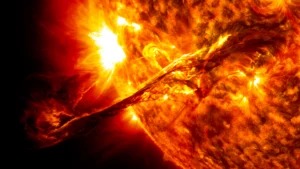
Flare activity is low to moderate. A C3.6 flare was recorded on May 23. Region AR 4441 (N08W65, beta-gamma configuration) shows the greatest complexity — isolated M-class flares are possible but unlikely. Newly numbered AR 4445 (N07E59) and AR 4444 (S19E45, beta) are being monitored.
Band Forecast
SFI 124 brings the upper bands back into play. 15 metres delivers reliably again, 12 metres becomes usable, and combined with the ongoing Sporadic E season, 10 and 6 metres can surprise at any time. The NOAA outlook predicts a further rise to SFI 130–135 by end of week.
| Band | Day | Night | Notes |
|---|---|---|---|
| 160m | Poor | Poor | Season over — nights too short, high QRN |
| 80m | Fair | Good | Intra-EU good evenings, DX unlikely |
| 40m | Good | Good | Solid as always — good NA/JA paths from 20 UTC |
| 30m | Good | Good | Stable, FT8 delivers around the clock |
| 20m | Very good | Good | Worldwide openings daytime, still usable evenings |
| 17m | Good to very good | Fair | Much better than last week — DX to JA and W possible |
| 15m | Good | Poor | Back in business! Usable F2 openings daytime |
| 12m | Fair to good | Poor | F2 slowly returning, Es support possible |
| 10m | Fair (F2) / Good (Es) | Poor | Es season in full swing — worth lurking on 28 MHz |
Geomagnetic Forecast
A remarkably quiet week. Only Tuesday may see slight disturbance from a weak CH HSS.
| Day | Kp expected | SFI Forecast | Assessment |
|---|---|---|---|
| Sun, May 25 | 1–2 | 115 | Quiet — good DX conditions |
| Mon, May 26 | 1–2 | 115 | Quiet — excellent for weak signals |
| Tue, May 27 | 3–4 | 120 | CH HSS expected — slightly unsettled, minor HF impact |
| Wed, May 28 | 2–3 | 120 | Settling after CH HSS |
| Thu, May 29 | 2–3 | 125 | Flux rising — upper bands benefit |
| Fri, May 30 | 2–3 | 130 | Stable — increasingly good conditions |
| Sat, May 31 | 2–3 | 135 | Best conditions at week’s end |
Recommendations for the Coming Week
- 20 metres remains the main band: With rising SFI, openings grow longer and stronger. Morning long paths to VK/ZL, worldwide daytime, W/NA evenings.
- 17 metres is back: At SFI 120+, 17m delivers reliably during daytime. Particularly rewarding Thu–Sat with rising flux. Good alternative when 20m is crowded.
- Don’t write off 15 metres: The recovery to SFI 125–135 brings 15m back. Usable openings especially afternoons towards south and west.
- Sporadic E peak season! Late May is prime time for the Es season. Spectacular openings on 10m and 6m can occur. FT8 on 50.313 MHz and 28.074 MHz, watch DX Cluster and FM band (88–108 MHz).
- Skip Tuesday briefly: The CH HSS on May 27 could bring mild disturbance (Kp 3–4). No drama, but sensitive DX on the lower bands could be affected.
- Sat/Sun best weekend: SFI 130–135 forecast — use for DX on 20m, 17m and 15m.
Review: Flux Recovery After the Trough
After the marked SFI decline from 159 (week 19) to 101 (week 21), the recovery to 124 shows the expected rebound. The NOAA 27-day outlook forecasts a further rise to SFI 130–135 by end of May. This confirms: the quiet phase of recent weeks was a temporary dip, not the start of a long-term decline. Cycle 25 remains on track.
Currently, region AR 4441 with its beta-gamma configuration shows the most activity — though it is already rotating towards the western limb and will disappear early in the week. More interesting are the new regions at the eastern limb, rotating onto the disc in the coming days and potentially boosting flux further.
For VHF enthusiasts: the combination of rising flux and Es season makes late May the best time of the year for 6 metres. Anyone with a transverter or all-mode transceiver with a 6m option should monitor 50.313 MHz (FT8) and 50.150 MHz (SSB). Multi-hour openings with strong signals over 2,000 km are not unusual at this time of year.
Live Data
| Band | Tag ☀ | Nacht ☾ |
|---|---|---|
| 160m | Schlecht | Mäßig |
| 80–40m | Mäßig | Gut |
| 30–20m | Gut | Gut |
| 17–15m | Mäßig | Mäßig |
| 12–10m | Schlecht | Schlecht |
Further Reading
- MUF Maps (prop.kc2g.com)
- NOAA Space Weather Prediction Center
- HamQSL Solar Dashboard
- DXHeat DX Cluster
- SolarHam
Transparency Notice
This weather report was created with the assistance of AI (Claude, Anthropic) based on current data from NOAA/SWPC, HamQSL and SolarHam. All content has been reviewed by the oeradio.at editorial team. Corrections or additions to [email protected].