On 19 February 2026, the International Telecommunication Union (ITU) adopted Recommendation ITU-R M.1042-4 — Disaster communications in the amateur and amateur-satellite services. It is the first revision since 2007. Nineteen years of silence, then an update: the timing is no coincidence. Three concrete incidents in recent years have demonstrated that regular communications networks are more vulnerable than assumed.
Thanks to Josef, OE3FJS, for flagging the new recommendation.
What It Says
The recommendation is brief — four pages. The operative section contains four points under recommends:
Point 1 addresses telecommunications administrations: they should encourage the development of amateur radio networks capable of providing communications in natural disasters or other emergencies — “available when called upon by appropriate authorities.”
Point 2 defines the requirements for these networks: they must operate without other communications infrastructure, from temporary locations, using local generators or batteries when public grid power is unavailable.
Point 3.1 calls on amateur organisations to develop robust organisational structures and technology systems for reliable disaster communications.
Point 3.2 is new: regular training so that the necessary skills for emergency deployment are developed and maintained. This was absent from previous versions. The ITU has recognised that equipment alone is not enough — it requires practice.
Why Now — Three Incidents as Background
The recommendation names no specific incidents. But the new paragraph g) under recognizing makes the concern explicit: “during emergency situations, regular communications systems and networks may be unavailable because of physical damage to communications infrastructure or loss of public grid power supplies.” This is not an abstract warning. It describes what has actually happened.
Viasat/KA-SAT, 24 February 2022
On the day of Russia’s invasion of Ukraine, Viasat’s KA-SAT satellite network was attacked with AcidRain wiper malware. The attack vector was a compromised VPN appliance at Skylogic in Turin, a Eutelsat subsidiary managing ground operations. Within 45 minutes, tens of thousands of satellite modems across Europe went offline. In Germany, 5,800 Enercon wind turbines lost remote monitoring — the turbines continued operating but could no longer be controlled remotely. Around 30,000 replacement modems had to be shipped. The EU, US and UK attributed the attack to Russia’s GRU military intelligence in May 2022.
Salt Typhoon, from 2024
Salt Typhoon is a cyber espionage campaign attributed to China’s Ministry of State Security (MSS) that infiltrated at least nine major US telecommunications companies, including Verizon, AT&T and T-Mobile. In August 2025, the FBI confirmed targets in over 80 countries. In October 2025, European telecoms were confirmed as affected. At a US Senate hearing in December 2025, the affected companies could not demonstrate that the attackers had been fully removed from their networks. Salt Typhoon shows that even the largest commercial networks cannot be treated as reliable constants.
Berlin, 3 January 2026
An arson attack on a cable bridge over the Teltow Canal in Berlin-Lichterfelde destroyed five 110 kV high-voltage cables and ten 10 kV medium-voltage cables. Around 45,000 households and over 2,200 businesses lost power — the longest power outage in Berlin since 1945. Mobile base stations failed (39 at Vodafone, 29 at Telekom, 18 at O2), landline via DSLAMs was affected, and emergency numbers 112 and 110 were impaired in parts of the area. Full power was restored on 7 January. The Federal Academy for Security Policy (BAKS) analysed the incident in a working paper titled “Conditionally Resilient.”
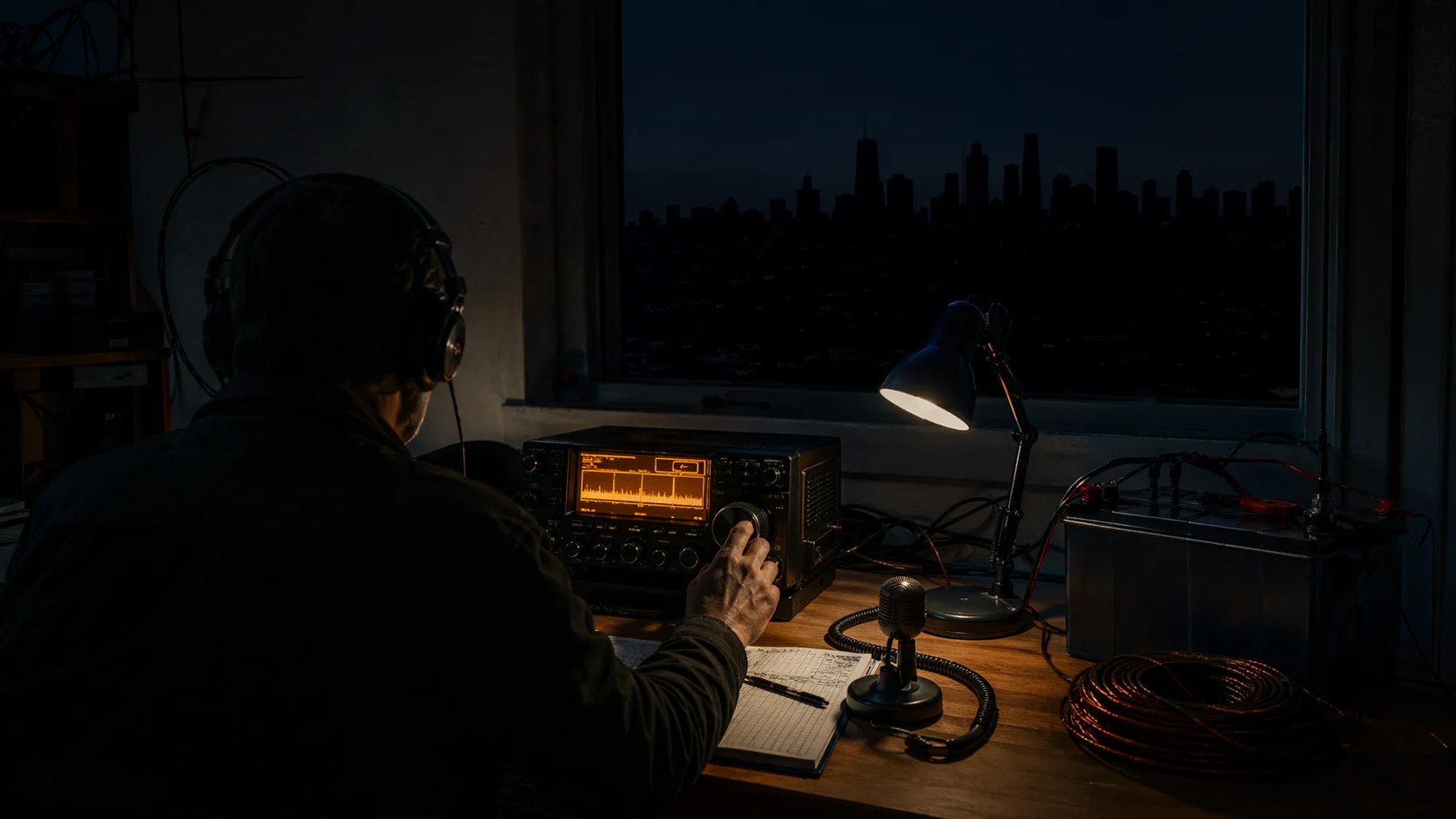
For the amateur radio context, the Berlin case is the most relevant: not a cyberattack on a distant satellite network, but physical destruction of infrastructure in a European capital, directly affecting mobile communications and emergency calls. In alpine valleys with limited mobile coverage and few redundant cable routes, a comparable incident would be considerably harder to manage.
What This Means Regulatorily
The recommendation addresses telecommunications administrations, not individual radio amateurs. ITU recommendations are not laws — they are guidelines. But they carry weight: when amateur radio organisations approach authorities regarding disaster preparedness exercises, frequency coordination or integration into emergency plans, M.1042-4 is a document to reference. The ITU explicitly states that administrations should encourage amateur radio networks for disaster response.
In Germany, the KRITIS umbrella law was passed by the Bundestag on 29 January 2026, creating the first nationwide uniform minimum standards for physical protection of critical infrastructure. Austria’s implementation of the underlying EU Directive 2022/2557 (CER Directive) is still pending.
What This Means Practically
Grid-Independent Power
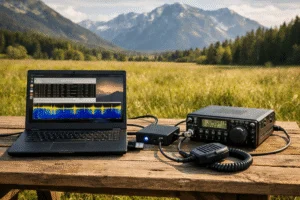
Point 2 describes what amateur radio networks should be capable of — not what individual operators must do. But for those who want to be ready when it matters, this realistically means a 12V LiFePO4 battery (50–100 Ah), regularly charged, plus a small solar panel for maintenance. This can power an HF transceiver at QRP to medium power (5–50 W) for several days. It doesn’t need to be perfect — it needs to work when it matters.
Infrastructure-Independent Antennas
An antenna mounted on an apartment building roof, powered by the building’s mains for the rotator — that is precisely the kind of dependency Point 2 addresses. For emergency contexts, simple wire antennas (dipole, EFHW, random wire with tuner) are the more robust choice: quick to deploy, infrastructure-independent, sufficient for HF operation.
Digital Modes Without Internet
The internet as a single point of failure affects amateur radio too: Winlink via HF (VARA HF, ARDOP or PACTOR) is the grid-independent alternative to Telnet access. PACTOR modems cost four figures; VARA HF is a viable software alternative with a much lower entry barrier. JS8Call offers keyboard-to-keyboard HF communication with store-and-forward capability — completely network-independent.
Training — the New Point 3.2
A concrete example of Point 3.2 in practice is BOS-ARSA (BOS Amateur Radio Society Austria, ADL 820 within the OEVSV) — the Austrian amateur radio association of authorities and organisations with security tasks. BOS-ARSA runs a crisis communication exercise every Sunday at 18:45 local time, starting on the Carinthian repeater OE8XNK (145.7625 MHz) and extending Austria-wide via the OE-Link network. Around 70 stations participate regularly. Additionally, the Austrian emergency radio net meets every first Wednesday of the month at 17:15 UTC on 3643 kHz (80 m, LSB). Their crisis communication page offers emergency radio concepts, intake forms and the structured 7-W reporting schema for download.
But Point 3.2 goes beyond organised exercises. It also means individual competence: Can you deploy your portable station in 30 minutes and establish a reliable HF contact? Does your battery setup actually last several hours? Can you use Winlink over HF if you don’t practise regularly? These questions are answered through regular individual training — a SOTA activation, a field day, an afternoon in the garden with the go-bag.
What This Is Not
No obligation. No new laws. No operational authority. M.1042-4 does not change the regulatory framework for amateur radio, nor does it grant operators any authority beyond existing provisions (Articles 25.3 and 25.9A of the Radio Regulations). What changes is the expectation level. The ITU for the first time explicitly states that regular training should be part of preparedness. That is not a deployment order — but it legitimises those who take their emergency communication capabilities seriously.
Equally important: amateur radio is a supplement, not a replacement for professional emergency services. The recommendation speaks of “available when called upon” — standing ready when requested. Not operating autonomously.
Outlook
Three developments are worth watching: Austria’s implementation of the CER Directive (Germany has already passed its KRITIS umbrella law); the question of how and under what conditions radio amateurs cooperate with authorities in emergencies; and the updated ITU-R Report M.2085, which together with the new ITU Handbook on Amateur Services (2026) provides the framework for negotiations between amateur radio organisations and administrations.
M.1042-4 is not a revolution. It is a signal. After 19 years of silence, the ITU has recognised that threats to communications infrastructure are real and diverse — and that amateur radio can be part of the response.
Sources
- ITU-R M.1042-4 (02/2026) — Disaster communications in the amateur and amateur-satellite services (PDF, free download)
- ITU Handbook on Amateur and Amateur-Satellite Services (2026)
- DARC: ITU updates recommendation on disaster communications in amateur radio
- Viasat: KA-SAT Network Cyber Attack Overview
- SentinelOne: AcidRain — A Modem Wiper Rains Down on Europe
- US Senate Commerce Committee: Salt Typhoon Hearing, December 2025
- CISA Advisory: Salt Typhoon
- BAKS: Conditionally Resilient — Berlin Blackout 2026 Analysis
- Bundestag: KRITIS umbrella law, 29 January 2026
- OEVSV: Emergency Communications