Guest article by Jürgen, OE8RMJ
If you want to skip the backstory, jump straight to “The Experiment”.
Prologue
I got my licence in April 2025. Fresh and full of curiosity about the vast field that lay ahead of me, spurred on by conversations on OE8XNK, I soon wanted to know what this ominous shortwave was all about — the one that, unreachable from the FT-70D, must be doing deeply mystical and mysterious things somewhere out there in the ether. Or so I thought.
The easiest shortwave antenna to build is a wire dipole, or so they say, and so I hung a few homemade ones from the roof purlin. Although they all did their job dutifully, they were simply too low to reach beyond Europe — except on rare occasions. 6.5 metres was the absolute maximum height I could manage.
One day, the Rybakov came up in a roundtable conversation — a vertical antenna with an impedance transformer that covers everything from 40 to 10 metres with an ATU. My curiosity was piqued, it was quickly built, and the first tests went surprisingly well. Unfortunately, fully extended it was too tall (and wobbly) for my garden purposes, but the prejudices against vertical groundplanes had been put to rest.
So I delved into the subject a bit — a kind of fan dipole with resonant wires, but strung up vertically, was the idea. Soon I stumbled upon the DX-Commander concept by M0MCX, and from there the journey began…
The Experiment
The requirements were quickly defined: 20/17/15/12/10 m without a tuner, with the option to add a wire for 40 or 80 m as an inverted L when needed, while keeping the height as low as possible. Space in my garden is rather limited.
And: costs should be kept as low as possible — I wanted to test the concept at my QTH without burning money unnecessarily.
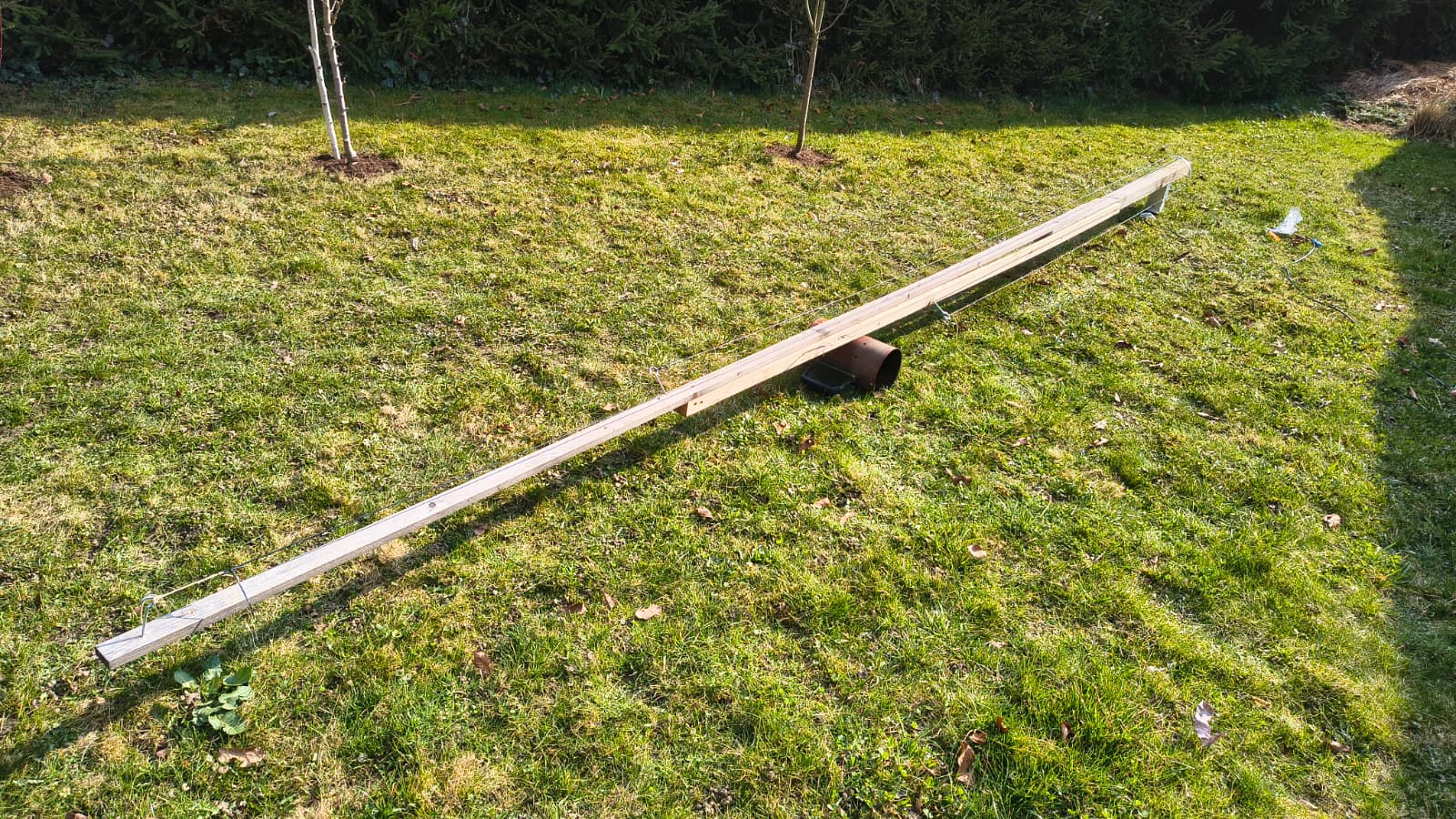
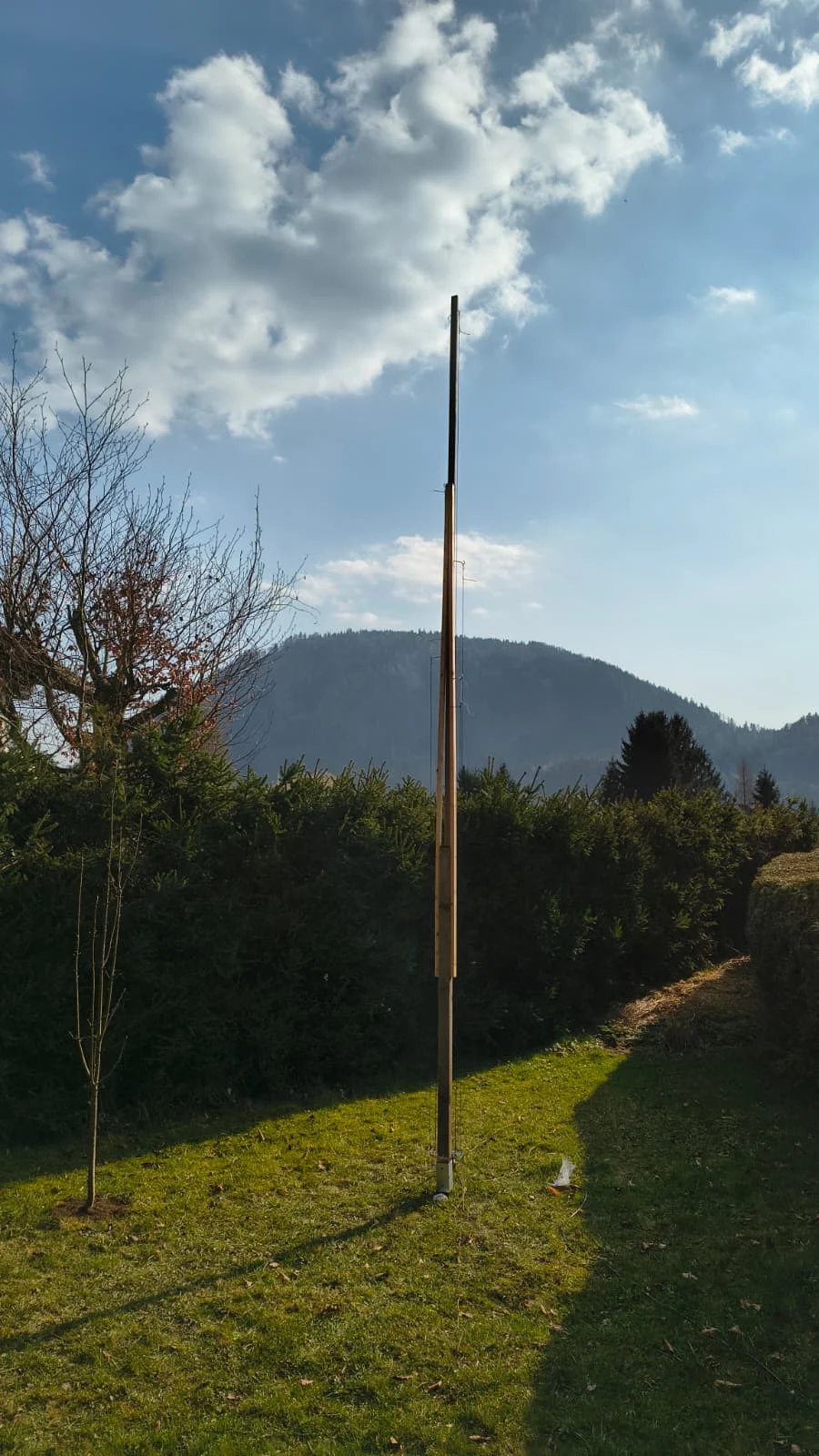
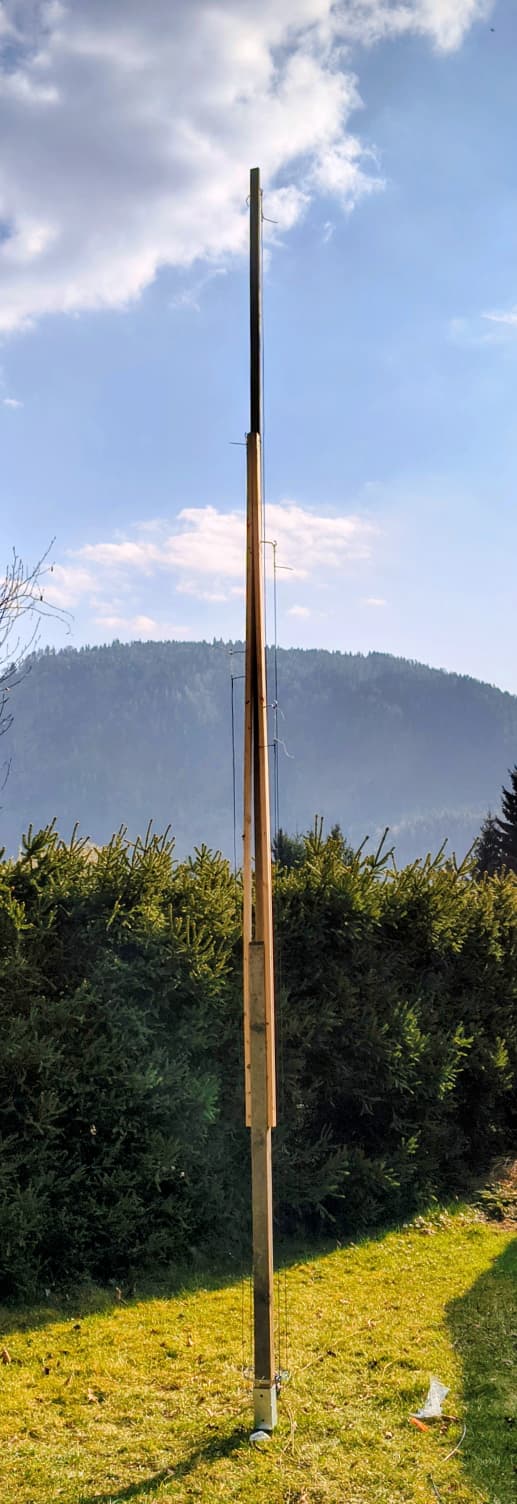
A ground sleeve and a 2 m fence post (7×7 cm) were left over from last year’s fence repair (and had already served as an anchor point for the dipoles), plus a few wooden planks were lying around. These were quickly screwed together into a mast about 5.5 m tall, around the base of which a ring of stainless steel perforated strip was attached with four screws; diameter roughly between 20 and 25 cm. This would serve as the feed for the radiators.
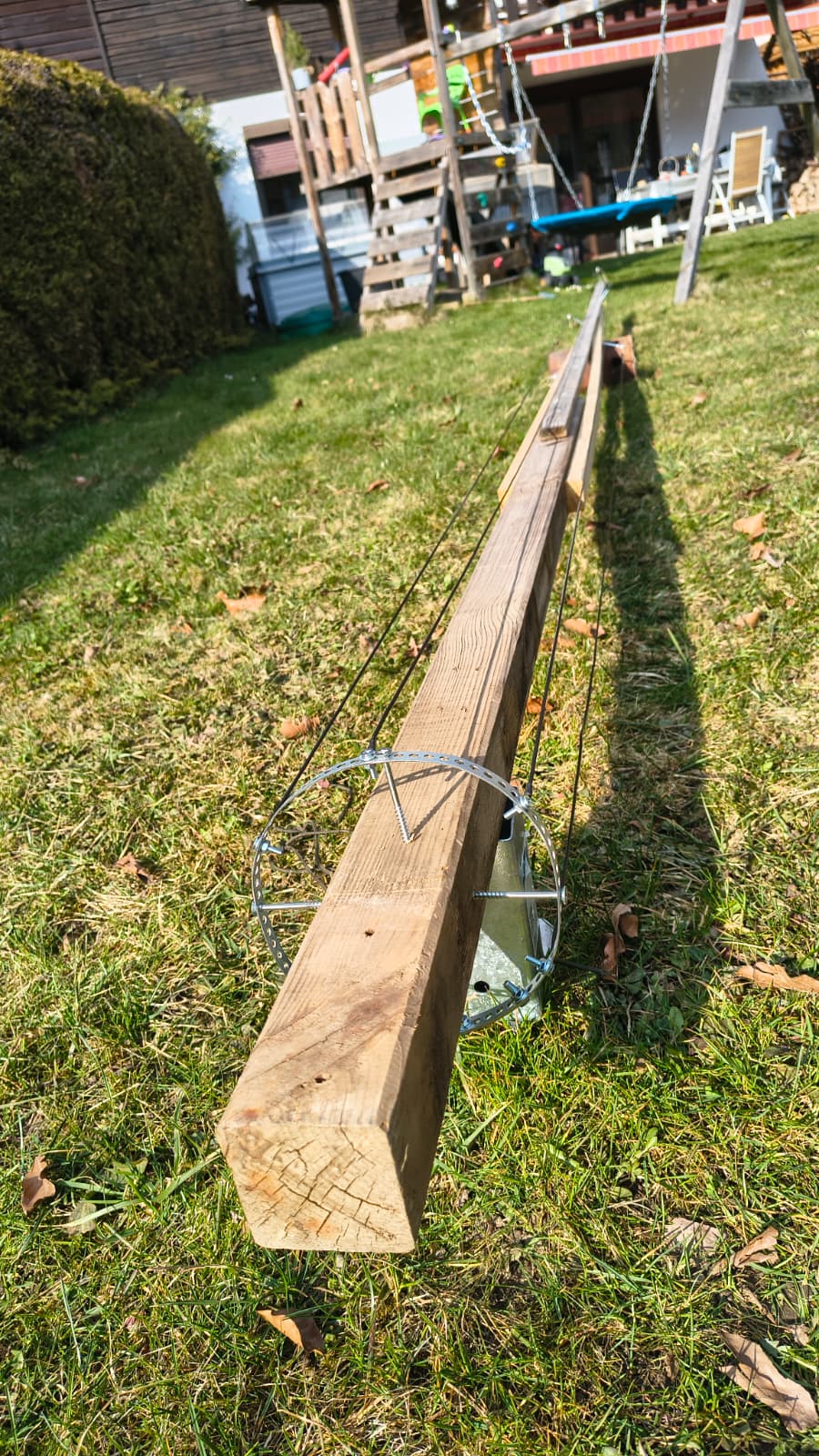
The radiators themselves were cut from 0.75 mm² installation wire and provisionally strung onto hooks screwed into the mast at approximately 60-degree intervals. The same 60-degree spacing was maintained on the feed ring, leaving one position free where the aforementioned 40/80 m wire could be connected if needed.
For the common-mode choke, a 1:1 current balun was wound on a proven FT240-43 toroid core and fitted into a waterproof plastic housing with two screw terminals.
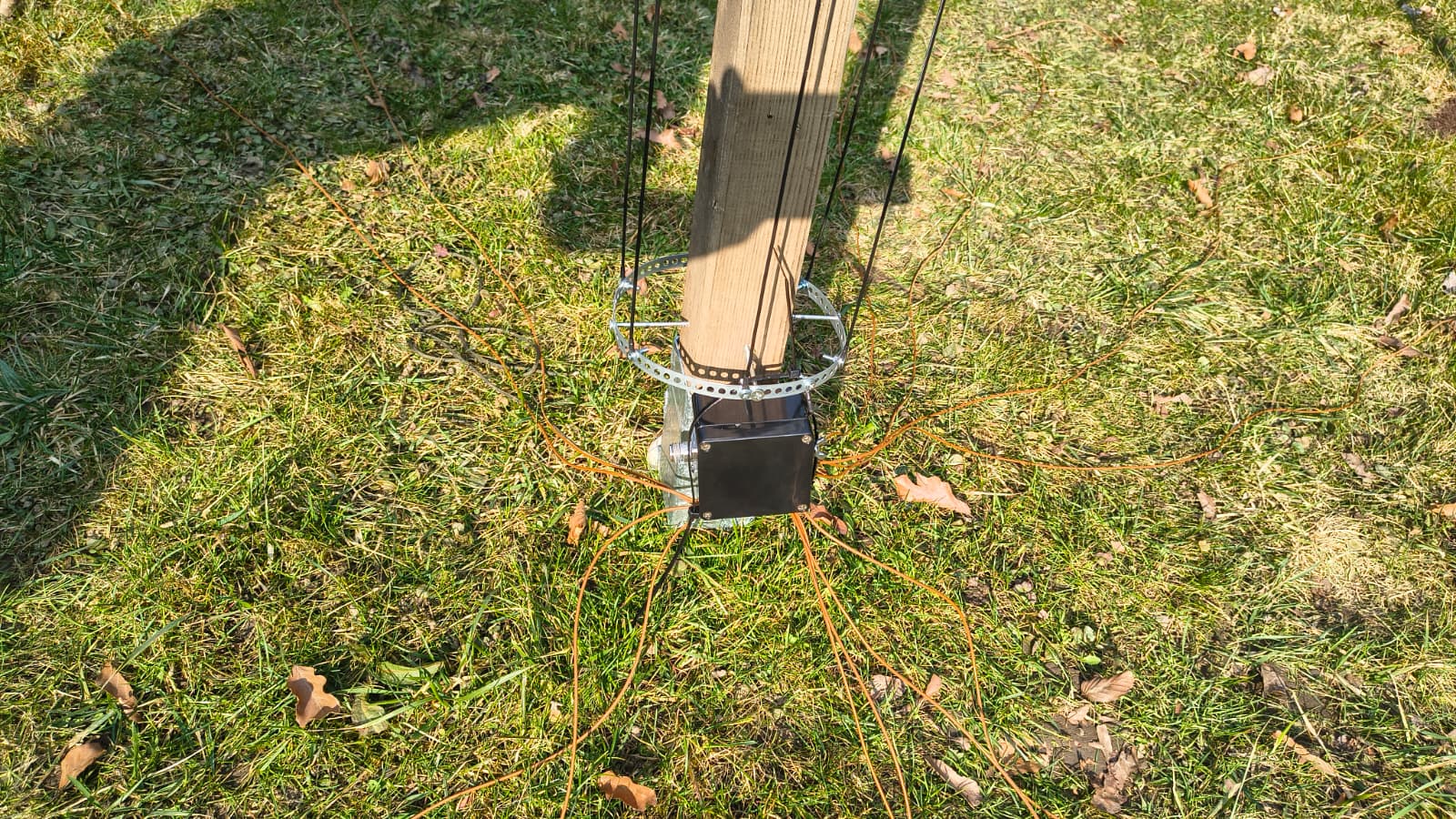
Then the radial net was built. Again, 0.75 mm² installation wire was used. Due to space constraints, the radials could only be 2 m long, but there were 20 of them in groups of four, laid out around the ground sleeve. The ground sleeve itself was also connected to the shield contact.
Finally, the whole thing was raised on a trial basis, the radials and feed ring connected to the current balun, and the wire lengths adjusted until the SWR on all bands was 1:2 or lower. That was good enough for a first test. It should be noted that the wire lengths all came out significantly shorter than calculated — probably an effect of the wires influencing each other.
The Test
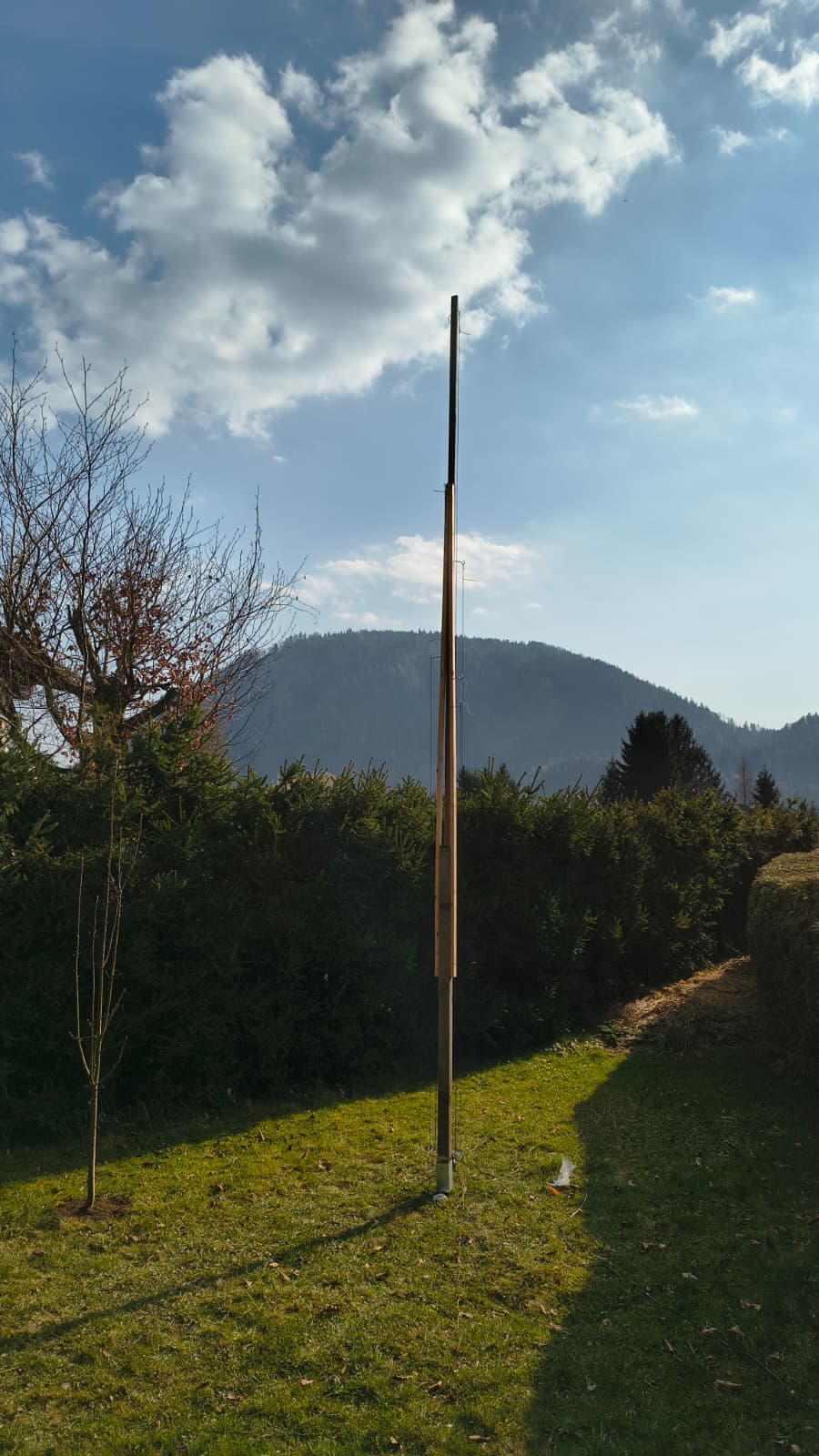
The antenna has been up since 21 March. Due to work commitments, operation wasn’t always possible at the best times. Nevertheless, within the first week QSOs were made with all continents except Oceania and Antarctica — and that with an antenna essentially made from hardware store planks and installation wire.
DX Contacts
A selection of stations worked in the first week via the homemade vertical groundplane:
Highlights:
- North America: AB1F, AD9DU, W2GLH (USA) — on 15 m and 17 m
- South America: PP5KE (Brazil) — on 20 m
- Africa: ZS1WC (South Africa) on 10 m, TY5AD (Benin) on 15 m
- Asia: 7Z1IS (Saudi Arabia) on 10 m
- Caribbean: J88IH (St. Vincent) on 17 m
- Europe: Spain, Greece, Italy, France, Ireland, Scotland, England, Kosovo, Russia — mainly 20 m
All five bands (20, 17, 15, 12, 10 m) were used. Particularly pleasing: the DX contacts to South Africa and Saudi Arabia on 10 m, as well as Brazil on 20 m, show that despite its modest construction, the antenna has serious DX potential.
Bill of Materials
I already had some of the materials on hand and simply used them; nevertheless, unless we’re talking about pennies, I’ve listed a representative new price.
Antenna
| Material | Price (approx.) |
|---|---|
| 20 m Installationslitze 0,75 mm² for the radials | 12,– |
| 20 m Installationslitze 0,75 mm² for the radiators | 12,– |
| 5 wire rope clamps | 5,– |
| 5 hooks (120 mm) for guying the radiators | 10,– |
| Some cord/string for guying | pilfered from the kitchen |
| 4 mm cable lugs for connections | 4,– |
| Einschlaghülse 70×70 | 5,– |
| Steher 7×7×200 | 15,– |
| 3 wooden planks | 20,– |
| Leftover stainless steel perforated strip | 2,– |
| 4 screws for the perforated strip | pilfered from the basement |
Common-Mode Choke
| Material | Price (approx.) |
|---|---|
| Ringkern FT240-43 | 16,– |
| Enclosure | 5,– |
| N-Buchse | 5,– |
| 1 m Lautsprecherkabel | already had it |
| 2 × 4 mm Schrauben und Flügelmuttern | pilfered from the basement |
Total cost if buying all components new: approx. 111 euros. If you already have some bits lying around like I did, it’ll be considerably cheaper.
Conclusion
Four planks, a post, a few metres of wire and a toroid core — that’s all you need to work DX on five bands. The antenna is not a high-end product and never will be, but it impressively proves that with the simplest means, a small budget and a bit of experimental spirit, you can get surprisingly far. If you don’t dare to put your first wire in the air: just do it. The worst that can happen is an SWR above 3 — and even that can be fixed.
73 de Jürgen, OE8RMJ
Replication of the antenna described here is at your own risk. Please see our disclaimer.