When the aurora reaches down to Central Europe, one of the most spectacular propagation modes of all opens up for VHF operators: aurora. Suddenly, contacts of 1,000 km and more become possible on 2 m – with an unmistakable raspy, hissing sound. This article explains how aurora propagation works, how to work it, and how to spot an event in time.
How aurora propagation works
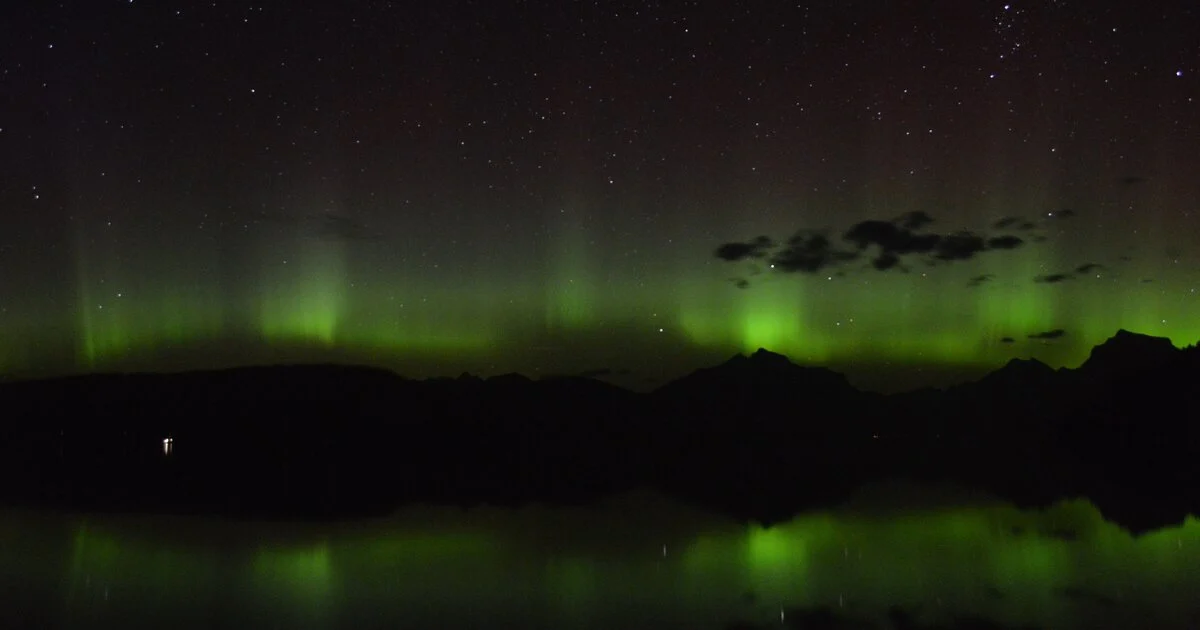
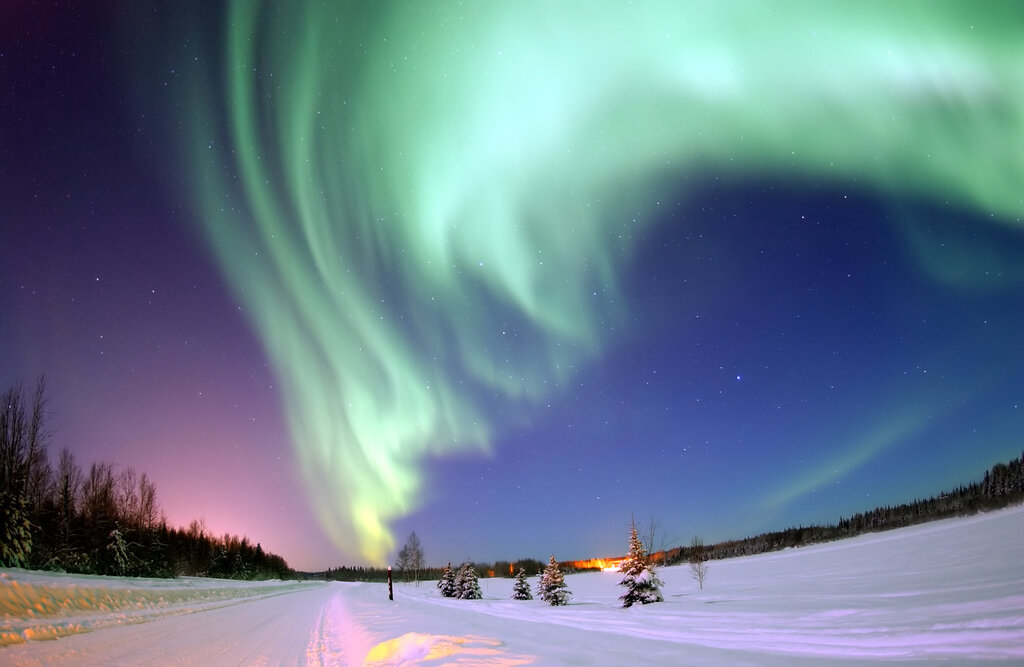
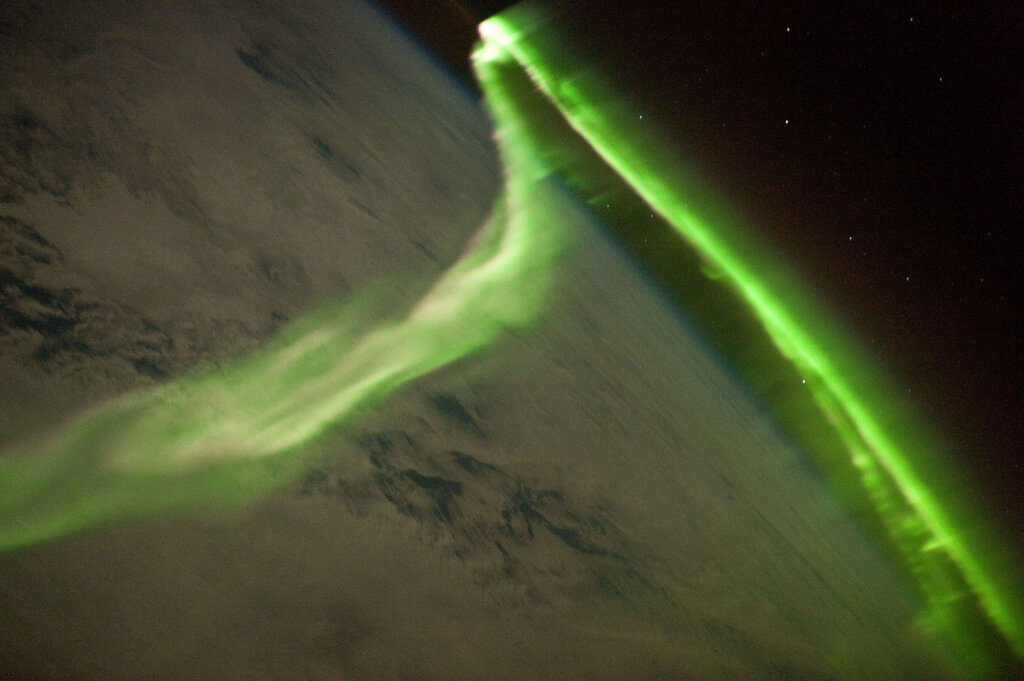
During a geomagnetic storm, energetic electrons stream along the Earth’s magnetic field lines into the ionosphere and ionize the E-region at around 100–120 km altitude. There, field-aligned plasma „curtains” form – the same structure we see as the aurora.
The key point: VHF signals are not reflected like off a mirror, but back-scattered off these curtains. That is why aurora is highly directional. Why mainly 6 m and 2 m? Scattering favours structures about half a wavelength in size – the higher the frequency, the smaller the structure needed and the weaker the echo: strongest on 6 m (50 MHz), good on 2 m (144 MHz), only rare and weak on 70 cm, and practically never above. And visible aurora is a strong hint but no guarantee – radio aurora can occur without any visible glow.
Beam north – not at your partner
The most important operating rule: both stations point their antennas at the auroral curtain to the north – not directly at each other. Turn the Yagi roughly north and then swing around north (northwest to northeast) until the signal peaks. From Austria the best heading is practically always between northwest and northeast. The optimal heading shifts during the event as the auroral oval moves, so keep re-adjusting. A rotatable Yagi is a clear advantage here.
The raspy aurora sound
Aurora signals sound unmistakable. The fast-moving ionization smears the signal through Doppler broadening: SSB turns hoarse and „whooshy”, on 2 m often just a rough whisper. CW loses its clean tone and becomes a hissing „PFFFT” instead of a clean „BEEP”. That is why CW is practically mandatory above 144 MHz – narrow and robust. Send rather slowly and space the characters out a little. By convention you append an „A” to the report (e.g. „59A”) to mark the auroral distortion; the tone value effectively drops out.
This is what auroral backscatter sounds like on 6 m in SSB and CW:
Triggers: Kp index, storms, solar cycle
Aurora is driven by geomagnetic storms. As a rough threshold: things get interesting from about Kp 5, while reliable 2-m aurora usually needs Kp 6 or more. The NOAA storm scale runs in parallel (G1 = Kp 5 to G5 = Kp 9) – the higher it is, the further south the oval reaches.
The strongest storms come from coronal mass ejections (CMEs) arriving one to three days after the event on the Sun; fast solar-wind streams from coronal holes often bring weaker but recurring storms (~27-day rhythm). What matters is a southward magnetic field in the solar wind (Bz negative). We are well placed right now: Solar Cycle 25 reached its maximum around October 2024, with elevated activity continuing through 2025–2026. Statistically, aurorae cluster around the equinoxes (spring and autumn). Best times of day: late afternoon/early evening (strong but heavily distorted) and a second window around or after midnight (weaker but cleaner).
Aurora DX from Austria
The further north, the better: Scandinavia, Scotland, the Baltics and northern Germany work aurora regularly, Central Europe more rarely and only in stronger storms. Within Austria the north is inherently better placed than the south. Typical ranges on 2 m are about 800 to 2,300 km; typical partners are stations in Scandinavia (SM, LA, OH, OZ), northern Germany (DL), the Netherlands (PA) and Poland (SP). Even a modest station – a 4-element Yagi and 50 W – can make contacts in a good event.
Where in the band? Aurora lives at the low, weak-signal end of the band: CW around 144.050–144.100 MHz, SSB traditionally just above; on 6 m CW around 50.09–50.12 and SSB 50.13–50.20 MHz. Call „CQ AURORA” (or „CQ AUR”). Keep QSOs short – the antennas stay pointed north. A good early indicator: 6 m goes aurora before 2 m. If you see „AU” spots on 50 MHz, watch 2 m.
Auroral-E: the faster sibling
In very strong storms, classic (distorted) aurora can turn into Auroral-E. The tone is then clean, SSB and even FT8 are usable, and distances grow considerably (over 5,000 km). It shows up in the DX cluster as „AUE” – a separate, „faster” mode that resembles an auroral Sporadic-E rather than classic backscatter.
How to spot an event – and useful tools
Four signs: (1) 6 m opens first, (2) visible aurora to the north, (3) rising Kp and a sharp magnetometer deflection, (4) the unmistakable raspy sound itself. Useful tools:
- DXMaps – real-time VHF map with an aurora filter
- NOAA SWPC aurora 30-minute forecast and planetary Kp index
- SpaceWeatherLive – Kp/aurora with alerts
- AuroraWatch UK – magnetometer alerts
- ON4KST – VHF/UHF chat for skeds
- German-language: DARC space-weather glossary
This video sums up how the mechanism works:
Conclusion
Aurora is one of the most exciting VHF experiences: rare, long distances, a unique sound and a direct line to space weather. You don’t need a super-station – a rotatable Yagi, some CW practice and an eye on the Kp index are enough. For how mountains and valleys otherwise shape VHF propagation, see our article on alpine propagation. When the next big storm hits: antenna north, CW key ready – and listen for that hiss from the north.
73 – your oeradio.at editorial team
Image credits
Title image: US National Park Service (public domain). Aurora curtains: U.S. Air Force / Joshua Strang (public domain). Aurora from the ISS: NASA (public domain).
Transparency notice
This article was researched and written with the help of AI (Claude, Anthropic). The technical statements were checked against several independent sources (space-weather services, amateur-radio references). Errors can never be ruled out; please verify frequencies and band segments against the current IARU R1 band plan before operating. Questions or corrections? Write to us at [email protected].