Table of Contents
- Why Learn CW?
- Best Learning Methods
- Koch Method (recommended!)
- Farnsworth Method
- Video: Step-by-Step Guide for Beginners
- Apps and Online Tools
- 1. LCWO – Learn CW Online
- 2. MorseFleet – oeradio.at CW Trainer
- 3. More Recommended Tools
- Hardware: Keys and Practice Devices
- Your First CW QSO
- 3-Month Training Plan
- Transparency Notice
Morse code is the oldest digital mode in amateur radio – and one of the most fascinating. CW (Continuous Wave) works with minimal power, gets through where other modes fail, and has a worldwide community that’s more active than ever. Whether you’re preparing for your licence exam or simply want to learn a new skill: 2026 offers more learning resources than ever before.
Why Learn CW?
- Extreme range: CW with 5 watts outperforms SSB with 100 watts – the narrow bandwidth makes it possible
- Penetration: CW remains readable in heavy QRM and QSB when voice is lost in noise
- Simple equipment: A basic QRP transceiver, a key and an antenna – ideal for portable ops, SOTA, POTA
- International: CW abbreviations and Q-codes are universal – no language barrier
- Mental fitness: Learning Morse trains your brain like learning a new language
- Community: The CW community is incredibly supportive of newcomers
Best Learning Methods
Koch Method (recommended!)
The Koch Method is scientifically proven and considered the most effective approach:
- Start with only 2 characters at full speed (e.g. 20 WPM)
- When you reach 90% accuracy, add a new character
- Within weeks, you know all characters – at operating speed!
Farnsworth Method
Characters are sent at full speed (e.g. 18 WPM) but with longer pauses between them (e.g. 10 WPM effective). This way you learn the correct sound patterns while having more time to process.
Video: Step-by-Step Guide for Beginners
Apps and Online Tools
1. LCWO – Learn CW Online
lcwo.net is the most popular online CW learning platform, featuring Koch Method training, various exercises, detailed statistics, and a global community of thousands.
2. MorseFleet – oeradio.at CW Trainer
Our own CW trainer is available at morsefleet.oeradio.at! No registration needed – just open and practice. Features Koch Method training, adjustable speed (5–40+ WPM), Farnsworth spacing, and multiple exercise modes. Free and ad-free.
3. More Recommended Tools
- MorseCode.World: Comprehensive web trainer
- IZ2UUF Morse Koch CW (Android) / Ham Morse (iOS): Mobile Koch training
- G4FON Koch CW Trainer: Classic Windows software
- vband.space: Virtual CW QSOs online with real operators
- Long Island CW Club (longislandcwclub.org): Free online courses for all levels
Hardware: Keys and Practice Devices
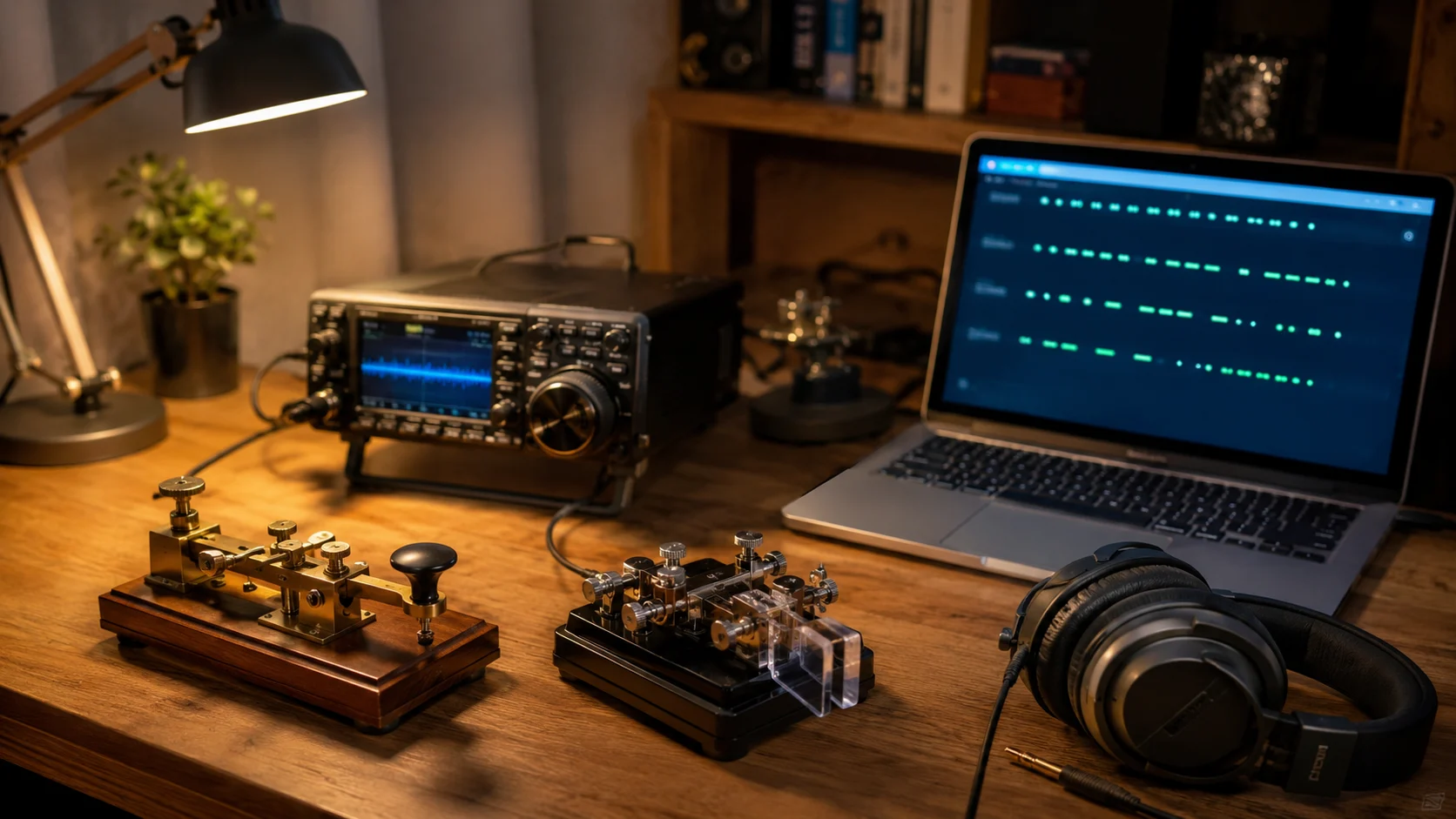
- Straight Key: Ideal for beginners – feel every dit and dah. Comfortable up to 15–20 WPM
- Iambic Paddle: For faster CW (25–40+ WPM). One lever for dits, one for dahs
- Morserino-32: Dedicated CW trainer with ESP32, built-in decoder, WiFi QSOs, touch paddles (~60–80 EUR kit)
Your First CW QSO
A typical first QSO is simpler than you think. Start by listening on CW segments of 40m (7.000–7.040 MHz) or 20m (14.000–14.070 MHz). Look for QRS (slow speed) stations. Use the Reverse Beacon Network to find active CW stations. Don’t be afraid of mistakes – the CW community is incredibly patient with newcomers!
3-Month Training Plan
- Weeks 1–4: Learn characters with Koch Method on MorseFleet or LCWO (15 min/day)
- Weeks 5–8: Words, abbreviations, callsign training. Start listening on-air
- Weeks 9–12: Practice QSO texts, virtual QSOs on vband.space, first real on-air QSO!
Start now: Open morsefleet.oeradio.at and begin your CW journey – 15 minutes a day and you’ll be QSO-ready in weeks!
73 – your oeradio.at editorial team
Transparency Notice
This article was researched and written with AI support (Claude, Anthropic). The editorial team reviewed and edited all content. Despite careful review, occasional inaccuracies may occur — we welcome feedback via email at [email protected].