Table of Contents
- What is WSPR?
- Setting up WSPR with WSJT-X
- Step 1: Basic Configuration
- Step 2: Activate WSPR Mode
- Step 3: Set Frequency and Power
- Step 4: TX Percentage and Band Hopping
- Dedicated WSPR Beacon Hardware
- QRP Labs Ultimate3S (U3S) – The Classic (~30 USD)
- QRP Labs QDX – Digital QRP Transceiver (69 USD)
- QRP Labs QMX+ – All-in-One with WSPR Standalone (125 USD)
- ZachTek WSPR Desktop Transmitter (~139 USD)
- ZachTek WSPR Pico (~58 USD)
- SOTAbeams WSPRlite Classic & Flexi
- WSPRnet.org and wspr.live – Analyzing the Data
- The Best Bands for WSPR
- Transmit Power: Less is More
- Legal Aspects in Austria (OE)
- Conclusion: WSPR – Science with Minimal Effort
- Useful Links
Imagine sending a signal with less power than a flashlight – and stations around the world receive it. That’s exactly what WSPR (pronounced “Whisper”) makes possible. The Weak Signal Propagation Reporter network is one of the most fascinating tools in amateur radio: It maps ionospheric propagation conditions in real-time, around the clock, with minimal effort.
Whether you want to know which band is currently open, if your new antenna works, or simply marvel at how far 200 milliwatts can travel – WSPR provides the answers. In this article, you’ll learn everything about the protocol, setting it up with WSJT-X, dedicated beacon hardware, and the legal situation in Austria.
What is WSPR?
WSPR was developed in 2008 by Joe Taylor, K1JT (Nobel Prize winner in Physics!) – the same man who also gave us FT8 and JT65. The protocol is specifically designed for propagation research and works with extremely weak signals.
The technical specifications are impressive:
- Modulation: 4-FSK (4-Frequency Shift Keying) with only 4 tones
- Bandwidth: Just ~6 Hz – for comparison: an SSB signal occupies about 2,400 Hz
- Transmission duration: Exactly 110.6 seconds per cycle, synchronized to even minutes (UTC)
- Decoding threshold: Down to -28 dB below the noise floor – the signal is completely inaudible to human ears!
- Transmitted data: Callsign, grid locator (4-digit), and transmit power in dBm
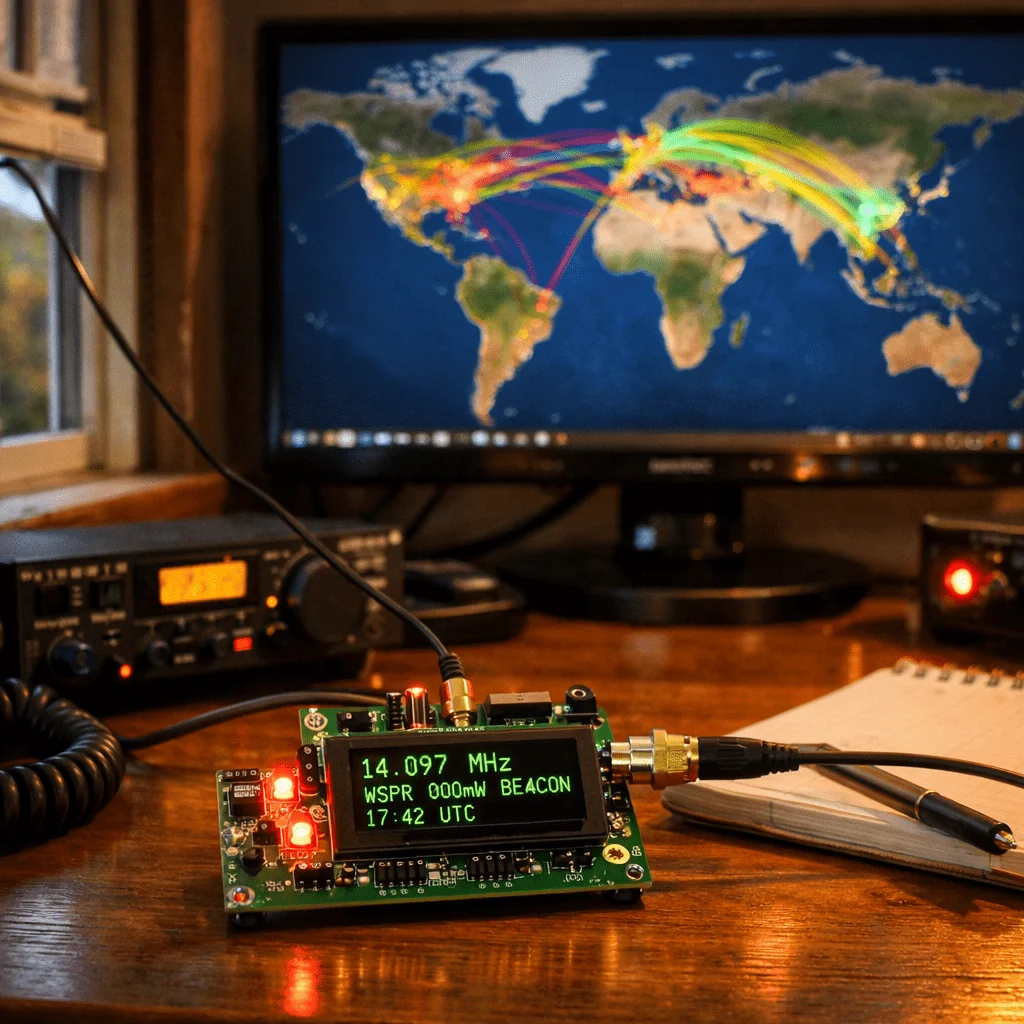
The brilliant part: WSPR is not a QSO in the traditional sense. You transmit your signal, and every station worldwide that receives it automatically reports the reception to the central database WSPRnet.org. This creates a comprehensive map of propagation conditions – 24 hours a day, 365 days a year.
Setting up WSPR with WSJT-X
The fastest way to WSPR is through the WSJT-X software, which you’ve probably already installed for FT8. The setup is straightforward:
Step 1: Basic Configuration
Under File → Settings → General, enter your callsign and grid locator (e.g., JN66 for Carinthia). The audio and CAT settings are identical to your FT8 setup – if FT8 works, WSPR will work too.
Step 2: Activate WSPR Mode
In the WSJT-X main window, select “WSPR” from the Mode menu. The interface changes: Instead of the FT8 waterfall, you’ll see the WSPR spectrum with its characteristically narrow bandwidth.
Step 3: Set Frequency and Power
WSPR has fixed dial frequencies for each band. The most important ones:
- 160m: 1,836.6 kHz
- 80m: 3,568.6 kHz
- 40m: 7,038.6 kHz
- 30m: 10,138.7 kHz (the most active WSPR band!)
- 20m: 14,095.6 kHz
- 15m: 21,094.6 kHz
- 10m: 28,124.6 kHz
- 6m: 50,293.0 kHz
- 2m: 144,489.0 kHz
Set the transmit power to your desired value – the standard is 200 mW (23 dBm). WSJT-X needs the correct dBm value so that receiving stations get meaningful data.
Step 4: TX Percentage and Band Hopping
Under TX Pct, you set how often your station transmits. A value of 20% means: In 20% of the 2-minute intervals you transmit, in 80% you only receive. This is a good compromise – you contribute spots while simultaneously receiving other stations.
The Band Hopping feature is particularly clever: WSJT-X automatically switches between different bands, testing propagation on multiple frequencies simultaneously. You simply configure which bands should be used in which time slots.
Dedicated WSPR Beacon Hardware
If you want to operate WSPR seriously and permanently, there’s specialized hardware that works as an autonomous beacon independent of a PC. Here are the most interesting options:
QRP Labs Ultimate3S (U3S) – The Classic (~30 USD)
The U3S from Hans Summers, G0UPL, is the undisputed classic among WSPR beacons. As a kit for around 30 USD, it’s unbeatable value. With an Si5351A synthesizer, it generates the WSPR signal directly, and GPS connectivity ensures the necessary time accuracy. The U3S delivers about 200 mW on one band depending on the low-pass filter – perfect as a permanent beacon. Those wanting to cover multiple bands can add relay-switched band filters.
QRP Labs QDX – Digital QRP Transceiver (69 USD)
The QDX is actually a full-featured 5-watt digital transceiver for FT8, FT4, JS8Call, and WSPR. It requires a PC with WSJT-X, but offers the full flexibility of a transceiver. An excellent choice for WSPR operation because you can also receive between beacon cycles and switch to FT8. As a kit for 69 USD, it’s excellent value for money.
QRP Labs QMX+ – All-in-One with WSPR Standalone (125 USD)
The QMX+ is the flagship from QRP Labs: A 5-watt multiband transceiver (80m–10m) that has a built-in standalone WSPR beacon mode. With a GPS module, it runs completely without a PC as a WSPR beacon – simply connect antenna and power supply and let it run. The QMX+ can even automatically switch between bands. As a kit for 125 USD, it’s the ultimate Swiss Army knife for digital QRP modes.
ZachTek WSPR Desktop Transmitter (~139 USD)
The Swedish manufacturer ZachTek offers the WSPR Desktop Transmitter as a fully assembled, turnkey WSPR beacon. GPS receiver integrated, USB configuration, operation on all HF bands. The output power is about 200 mW. Simply connect, configure callsign, attach antenna – done. Ideal for anyone who doesn’t want to solder.
ZachTek WSPR Pico (~58 USD)
The Pico is a miniature WSPR beacon originally developed for stratospheric balloon flights. Tiny, extremely power-efficient, operable with a solar cell. The Pico transmits with just a few milliwatts and has already been flown around the world – literally. For ground-based use more of a novelty, but absolutely fascinating as a technical masterpiece.
SOTAbeams WSPRlite Classic & Flexi
The WSPRlite transmitters from SOTAbeams have a special focus: They’re designed as an antenna comparison tool. You connect different antennas successively and compare using WSPR spots which antenna radiates better in which direction. The Classic version works on one fixed band, the Flexi version on multiple. Both deliver 200 mW and are configured via smartphone app. An indispensable measurement tool for antenna builders.
WSPRnet.org and wspr.live – Analyzing the Data
The heart of the WSPR ecosystem is the spot database. Two platforms are central here:
WSPRnet.org is the original database that has been collecting all WSPR spots since 2008. Here you can see on a world map who received whom, when, and on which band. The data volume is enormous: Around 6 to 7 million spots are reported daily – from thousands of stations worldwide.
wspr.live is a more modern alternative with faster search, better filtering options, and interactive maps. The data is imported from WSPRnet and stored in a high-performance database (ClickHouse). The heatmaps and time-series analyses are particularly excellent.
With both platforms, you can for example:
- Check on which bands your signal is currently being heard
- Objectively compare the range of different antennas
- Analyze long-term trends in propagation conditions
- Document rare propagation events (TEP, Gray-Line, Long Path)
The Best Bands for WSPR
Basically, you can operate WSPR on all amateur radio bands from 2200m to 23cm. In practice, however, activity concentrates on a few core bands:
30 meters (10 MHz) is by far the most active WSPR band. It’s a pure CW/Digital band without voice operation, has excellent propagation characteristics day and night, and is active around the clock. If you can only choose one band for WSPR: Take 30m.
20 meters (14 MHz) is excellent during daytime for DX spots at medium and long distances. Propagation follows the daylight pattern – in the morning the path to the east opens, in the evening to the west.
40 meters (7 MHz) shows its strengths especially at night and during twilight hours with ranges of several thousand kilometers. During the day, the range is limited to a few hundred kilometers – but that’s also interesting to observe.
Tip: With Band Hopping in WSJT-X or a multiband transmitter like the QMX+, you can automatically use multiple bands alternately and thus gain a comprehensive picture of propagation conditions.
Transmit Power: Less is More
WSPR is the epitome of QRP – minimal power with maximum results. The most common power levels:
- 200 mW (23 dBm): The de facto standard. Most dedicated WSPR transmitters operate at this level.
- 1 Watt (30 dBm): For more robust spots when conditions are difficult.
- 5 Watts (37 dBm): Maximum for sensible WSPR operation. More brings hardly any additional range but stresses the transmitter.
- 1–10 mW: For extremists and balloon flights. Even with 1 mW, transcontinental spots have been reported!
Why does WSPR work with so little power? The key lies in the coding gain: Through the extremely narrow bandwidth of 6 Hz and the long transmission duration of almost 2 minutes, energy is concentrated highly efficiently. When you factor in the coding gain, 200 mW WSPR roughly equals the sensitivity of an SSB signal with over 50 watts. That’s the magic of digital signal processing.
Legal Aspects in Austria (OE)
Finally, an important topic that often raises questions: May I operate a WSPR beacon unattended?
The short answer: It depends.
- Attended operation: If you’re sitting at the station (or at least nearby and can intervene at any time), WSPR operation is permitted with any valid amateur radio license. This also includes operation with WSJT-X on a PC – as long as you’re supervising the station.
- Unattended continuous operation as a beacon: This is where it gets more complicated. In Austria, a special permit from the telecommunications authority may be required for operating an unattended transmitting system (beacon). The amateur radio regulations distinguish between normal radio operation and the operation of automatic transmitting systems.
- Practice: Many hams operate their WSPR transmitters in “attended” mode – meaning they can switch off the beacon at any time via remote access. Whether this qualifies as “attended” within the meaning of the regulations is a gray area. When in doubt, it’s advisable to inquire with the responsible telecommunications authority.
Important: Regardless of the supervision requirement, the usual rules naturally apply: Only transmit on frequencies authorized for your license class, provide correct power specifications, and the callsign must be contained in the WSPR signal.
Conclusion: WSPR – Science with Minimal Effort
WSPR may not be the most exciting mode in amateur radio – there are no pile-ups, no DX hunting, no adrenaline. Instead, it offers something that hardly any other mode can: an objective, continuous measurement of the ionosphere in which anyone can participate with minimal effort.
With a simple U3S kit for 30 dollars and a wire antenna, you’re part of a worldwide scientific network. The data collected by WSPR stations is used by scientists, space weather services, and the entire amateur radio community.
So: Turn down the power, connect the antenna, start WSJT-X – and marvel at how far your whisper carries. 🎙️
Useful Links
- WSPRnet.org – The central WSPR spot database
- wspr.live – Modern WSPR data analysis
- WSJT-X Download – The standard software for WSPR and FT8
- QRP Labs – U3S, QDX and QMX+ kits
- ZachTek – WSPR Desktop and Pico transmitters
- SOTAbeams WSPRlite – Antenna comparison tool
- WSPR Protocol (K1JT) – Technical documentation
73 – your oeradio.at editorial team
Transparency Notice
This article was researched and written with the assistance of AI (Claude, Anthropic). All facts have been verified to the best of our knowledge — for current technical details, we recommend consulting the linked original sources.