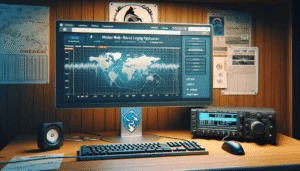
Let’s be honest: who among us hasn’t asked ChatGPT how long a half-wave dipole for 20 meters needs to be? Or asked Claude to write an Arduino sketch for a CW keyer? Artificial intelligence has long since arrived in the shack — sometimes obviously, sometimes working in the background. And that’s a good thing, because used properly, AI doesn’t make amateur radio less exciting — it makes it more accessible, more efficient, and sometimes simply more convenient.
In this article, we’ll look at where AI is actually being used in amateur radio today — with real examples, real tools, and an honest assessment of where the limits are. Spoiler: AI doesn’t replace a radio amateur. But it can be a damn good assistant.
Exam Preparation: Your Personal Elmer in the Cloud
Remember studying for your licence exam? Hours of poring over question banks, memorizing formulas, and when you didn’t understand something, you had to hope someone at the local club meeting had time to explain it. Today, you can just ask.
Example: You type into ChatGPT: “Explain the difference between a balun and an UnUn. I’m preparing for the Austrian amateur radio licence exam (Class 1) and need a clear explanation with examples.” — and you get an answer pitched at your level. Too simple? Ask for more depth. Too complex? Ask for an analogy. You can’t do that with a textbook.
On ChatGPT, there’s even a dedicated “Radio Mentor” — a Custom GPT specifically designed for preparing for US amateur radio exams. For the Austrian exam administered by the Fernmeldebehörde, nothing like that exists (yet), but the general-purpose models are surprisingly good at electrical engineering, wave propagation, and operating procedures. KD2WLL has documented that ChatGPT-4 models can even run locally on a Raspberry Pi 5 — completely offline, which is particularly interesting for emergency communications scenarios.
Practical tip: Give the model context. “I’m a beginner” or “I already have my entry-level licence and want to upgrade to the full licence” yields better results than a bare technical question. And: always verify the answers against the official question catalogue from the Fernmeldebehörde — AI can get things wrong, especially with country-specific regulations.
Technical Questions in the Shack: “Hey Claude, how do I hook this up?”
Probably the most common everyday use case: you’re sitting in your shack, you have a specific problem, and Google returns either nothing or a forum thread from 2009 with the answer “RTFM”. This is where LLMs shine.
Example 1 — Cable issues: “I want to connect my Icom IC-7300 to WSJT-X via a Digirig Mobile. What cables do I need, and how do I configure the sound card settings on Linux?” — The answer includes specific cable designations, audio device settings, and even the correct CAT baud rate parameters. Not perfect, but a solid starting point that saves you an hour of searching through forums.
Example 2 — Antenna calculations: “Calculate the wire length for an EFHW antenna with a 49:1 transformer for 40m, 20m, and 10m. Use a velocity factor of 0.95.” — LLMs can do this. They reliably handle the basic formulas (wavelength = c/f, half-wavelength x velocity factor). For more complex calculations like impedance matching or radiation patterns, things get shaky — that’s what specialized software like 4NEC2 or xnec2c is for.
Example 3 — Net questions: The Nashua Area Radio Society (N1FD) in the US uses ChatGPT in a very practical way: the net control operator has the AI generate discussion questions for the weekly repeater net. Sounds trivial, but anyone who’s done net control knows: after the fifth net, you run out of good questions.
AI Noise Reduction: Silencing the Static
This is where it gets really exciting — because AI-based noise reduction is probably the area where artificial intelligence makes the biggest practical difference in amateur radio. And it’s happening right now, not some day in the future.
RM Noise: Cloud-Based Game Changer
RM Noise is a cloud-based service developed specifically for amateur radio. You route the noisy audio signal from your transceiver through a virtual audio cable to the RM Noise software, which sends it to a server on the internet. There, a neural network cleans it up and sends it back in real time. Setup takes about 10 minutes.
The result? Radio amateurs report genuine jaw-dropping moments. One user with a FlexRadio setup wrote that he heard signals that weren’t even visible on the panoramic display — buried that deep in the noise. And the “listening fatigue” from hours of monitoring noisy bands? Completely gone.
The crucial difference from NVIDIA Broadcast or other generic NR solutions: RM Noise was specifically trained on amateur radio signals — SSB voice and CW Morse code, with the typical interference we encounter on HF (QRN, QRM, mains hum, switch-mode power supply noise). It knows our world.
Limitations: Latency runs at 200-300 ms — barely noticeable during QSOs, but perceptible during contest operation. And: weak signals at the noise floor sometimes get filtered out too, which is a fundamental issue with any noise reduction. Also: your audio data travels over the internet — if that’s a concern, there’s a local alternative.
DeepFilterNet: The Open-Source Alternative
If you’d rather process your audio data locally, DeepFilterNet3 is an excellent open-source alternative. Hendrik Schroeter’s project runs entirely on your own machine — no cloud, no latency issues, no privacy concerns.
DeepFilterNet3 achieves impressive PESQ scores of 3.17 (a standardized measure of audio quality) with a latency of just 10-20 ms. It’s available under a permissive open-source licence on GitHub and runs on Windows, Linux, and macOS. The software was originally developed for speech enhancement in video conferencing but works brilliantly for amateur radio too — especially in combination with SDR software.
SDR-Console has also integrated an AI-based noise reduction (NR5) in newer versions, based on RNNoise code. And if you have an NVIDIA graphics card, you can use NVIDIA Broadcast as a virtual microphone in the chain — the AI filters background noise in real time, though it’s not specifically optimized for radio signals.
Comparison: Which AI NR is right for you?
| Tool | Local/Cloud | Latency | Ham-optimized | Cost | Platform |
|---|---|---|---|---|---|
| RM Noise | Cloud | 200-300 ms | Yes (SSB + CW) | Free (as of 2026) | Windows |
| DeepFilterNet3 | Local | 10-20 ms | No (general speech) | Open Source | Win/Linux/Mac |
| NVIDIA Broadcast | Local (GPU) | ~20 ms | No (general) | Free | Windows |
| SDR-Console NR5 | Local | Minimal | Partially | Included in software | Windows |
AI-Powered CW Decoding: When the Machine Hears Better
Decoding Morse code is an art — and one that neural networks have gotten surprisingly good at. Classic CW decoders like Fldigi or CW Skimmer use fixed thresholds and timing algorithms. They work well with clean signals but struggle with irregular hand-key sending, varying speed, or when the signal is fighting against the noise.
AI-based CW decoders take a different approach: they learn to recognize individual sending styles. Every operator has their own rhythm, their own quirks — some stretch their dashes a bit long, others leave too-short pauses between characters. A neural network can adapt to this, much like an experienced CW operator who knows their counterpart’s “fist”.
Example: In a scientific paper (Sanchez, 2024), it was demonstrated that machine learning algorithms can significantly improve both signal classification and noise reduction efficiency and robustness in amateur radio — especially under the challenging conditions we encounter on HF.
In practical terms, this means AI CW decoders become most useful where traditional decoders give up — with weak DX signals in a contest pile-up, during fading conditions, or with operators who have unusual timing. Most projects are still experimental, but the direction is clear.
Propagation: AI Predicts Band Openings
When is 10 meters open? Is it worth trying a grey-line attempt to Japan this evening? Traditionally, we answer these questions with VOACAP, a glance at the SFI index, and a good amount of gut feeling. AI can help here — not with gut feeling, but with pattern recognition across massive datasets.
NASA DAGGER: The most exciting project in this space comes from NASA. DAGGER (Deep Learning Geomagnetic Perturbation) is an AI model that can predict geomagnetic disturbances worldwide 30 minutes before they occur. For us radio amateurs, that’s pure gold: geomagnetic disturbances directly affect the ionosphere and thus our HF propagation. When DAGGER warns of a geomagnetic storm, you know the higher bands are about to shut down — or that an auroral enhancement on VHF is on its way.
The best part: DAGGER is open source and available on GitHub. The software was developed by Vishal Upendran and a team of NASA researchers and published in the journal Space Weather. In theory, any radio amateur with Python skills could run the model locally and integrate it into their propagation monitoring setup.
Real-world example: Imagine you’re planning a SOTA outing for the weekend and want to know if propagation on 20m will cooperate. Instead of just checking the SFI and K-index, you could ask an AI: “Based on current solar wind data and geomagnetic conditions — how likely is a good 20m opening to North America on Saturday afternoon around 14 UTC?” — We’re not quite there yet, but the building blocks already exist.
Antenna Optimization: When AI Trims Your Yagi
Antenna design is physics, mathematics, and often enough: trial and error. Especially with multi-band antennas or Yagis with many elements, the parameter space explodes — every millimetre of element length, every centimetre of element spacing affects gain, impedance, and bandwidth. This is where AI can offer real advantages.
xnec2c-optimize: Eric Wheeler (KJ7LNW) has developed an open-source framework that combines the popular antenna simulator xnec2c with a simplex optimizer. The software automatically varies antenna geometries and searches for the configuration with maximum gain at minimum SWR. In testing, the gain of a Yagi antenna was increased from 10.2 dBi (single run) to 11.3 dBi after five optimization runs — including significantly improved SWR.
The “antenna-optimizer” project by Ralf Schlatterbeck goes a step further and uses genetic algorithms for antenna optimization — an approach inspired by biological evolution. The software essentially “breeds” the best antenna from a population of designs.
Can ChatGPT calculate antennas? Yes and no. Simple calculations (dipole length, wavelength, SWR from forward and reflected power) work reliably. For complex tasks like impedance matching networks, gamma match dimensioning, or radiation pattern calculations, you shouldn’t blindly trust the results. The right approach: use AI for initial orientation and quick back-of-the-envelope calculations, then run the precise simulation with specialized NEC tools.
TALOS: An AI Goes on the Air — from Austria!
And then there’s perhaps the most fascinating application of all: an AI that conducts QSOs by itself. Gerald Artner (OE1GAQ) from the Radio Amateur Club of TU Wien developed TALOS, an AI that operates SSB on HF — under the callsign OE1XTU.
During the EUDX Contest 2025, TALOS worked 20 meters under Gerald’s supervision. The AI receives the audio signal, converts it to text via speech recognition, generates an appropriate response, and outputs it as synthetic speech through the transceiver. Gerald manually controlled frequency, modulation, and transmit power — the software only had access to the PTT function of the Icom transceiver via CAT command.
The result: approximately 59+ QSOs where the speech was clearly understandable and the AI gave meaningful responses. Twelve complete QSOs on 20m were conducted under supervision. Gerald is refreshingly honest about it: manual intervention is still frequently needed, and there’s a lot of development left to do.
What makes this project truly special: it comes from Austria. OE1GAQ is also experimenting with blockchain-based QSL confirmations (NFT-QSLs) — another example of how innovation and amateur radio go hand in hand. The article about TALOS was published in the OVSV journal QSP.
Writing Code: AI as Your Programming Assistant
For many radio amateurs, this is the most pragmatic use of AI: having it generate code. Whether it’s an Arduino sketch, a Python script, or a Bash command — LLMs are surprisingly good at writing functional code for amateur radio projects.
Example 1 — ESP32 APRS tracker: “Write me an ESP32 sketch that sends GPS coordinates as APRS packets on 144.800 MHz via an SA818 module transceiver. Use the TinyGPS++ library and AX.25 protocol.” — Claude or ChatGPT will deliver working code that usually needs only minimal tweaking.
Example 2 — Log analysis: “I have an ADIF log file with 500 QSOs. Write me a Python script that analyses: Which band had the most DX contacts? What time of day am I most active? Which DXCC entities am I still missing for the DXCC award?” — The AI generates a script that parses your log file and outputs the statistics.
Example 3 — Codeplug help: “I have an AnyTone AT-D878UVII Plus and want to program all Austrian DMR repeaters with TalkGroups 232, 2320-2329, and 91. Walk me through step by step how to configure the CPS software.” — Instead of slogging through a 40-page PDF manual, you get instructions tailored to your specific radio.
Important: Generated code should always be tested and understood before going on the air with it. Especially for projects involving RF output, faulty code could at worst violate regulations or damage hardware.
QSL Cards and Graphics: AI as Designer
An application that might surprise you: more and more hams are using DALL-E, Midjourney, or Stable Diffusion to create unique QSL cards. Instead of using a stock photo or learning Photoshop yourself, you simply describe what you have in mind.
Example prompt: “A watercolour illustration of Mount Dobratsch (2166m) in Carinthia with an amateur radio antenna on the summit, sunset in the background, warm autumn colours, in the style of a classic postcard.” — The result is a unique QSL card that no other OM has.
Also interesting for SOTA and POTA activators: have an individual digital QSL card generated for each activation showing the respective summit or park. It takes minutes and costs nothing (or just a few cents per image).
Signal Classification: AI Identifies Unknown Signals
Who hasn’t experienced this: you’re scrolling through the waterfall display and spot a strange signal — but what is it? Loran-C? A weather satellite? Or just interference from your switch-mode power supply?
Artemis (version 4.0.5) by AresValley is an open-source application with over 500 recognized signal types in its database. You enter the frequency, bandwidth, and modulation type and get possible matches displayed — complete with audio samples and waterfall reference images. Artemis also offers space weather tracking with 5-minute updates.
In the research world, deep learning models for automatic modulation recognition (AMR) already exist. These models analyse the raw signal and automatically classify whether it’s AM, FM, SSB, PSK, QAM, or another modulation type. For SDR applications, this is a game changer — imagine your SDR receiver automatically identifying every signal in the band and labelling it on the waterfall display.
Off-Grid AI: LLMs via LoRa and Mesh Networks
A fascinating niche project: off-grid LLM via radio. The concept: a small language model runs on a local server (e.g., Raspberry Pi 5 with a compact LLM like Llama), and queries are sent over a LoRa mesh network. In disaster areas where internet and mobile networks are down, people could use Meshtastic or MeshCom to ask an AI questions — about first aid, emergency protocols, or evacuation routes.
KD2WLL reports running RASA (an open-source chatbot framework) completely offline on a Raspberry Pi 4 — including training models. LoRa bandwidth is of course extremely limited (a few hundred bytes per message), but for short question-answer pairs, it’s enough.
What AI CANNOT Do: Limits and Hallucinations
Now comes the part that’s at least as important as everything before it. Because AI makes mistakes — just different kinds of mistakes than humans make. And they’re more dangerous because they sound so convincing.
Typical LLM mistakes in amateur radio:
- Country-specific regulations: Ask ChatGPT about the permitted frequencies for the Austrian entry-level licence, and you might get US band plans served up. The AI doesn’t always reliably distinguish between FCC Part 97, CEPT recommendations, and the Austrian AFV (Amateurfunkverordnung).
- Made-up products: “The Icom IC-7600X with built-in AI noise reduction…” — doesn’t exist. LLMs sometimes invent model numbers, software names, or features that sound plausible but aren’t real. This is called a hallucination.
- Outdated information: Repeater frequencies, talkgroup assignments, and software versions change constantly. An LLM with a knowledge cutoff of 2024 might not know about the newest repeater in your area.
- Complex calculations: Ask an AI for the radiation resistance of a shortened vertical antenna over a non-ideal ground radial system — and the answer will probably be wrong. LLMs are not physics simulations.
- Circuit design: AI can explain simple circuits, but you shouldn’t expect ChatGPT to produce a working PA design for 144 MHz. The risk: a circuit that “looks plausible” but fails at RF power levels, or worse, generates harmonics on frequencies you’re not allowed to transmit on.
The golden rule: Use AI as a starting point, not an endpoint. Every answer deserves a second check — whether against the OVSV band plan, the manufacturer’s documentation, or the good old multimeter.
Privacy and GDPR: What Goes Over the Wire?
A topic that’s particularly relevant in Austria and the EU: when you use an LLM via the cloud (ChatGPT, Claude, Gemini), your inputs are transmitted to servers — typically in the US. What does that mean for radio amateurs?
- Callsigns are not sensitive data per se — they’re public (QRZ.com, the Fernmeldebehörde’s callsign database). However: when you send a log file with callsigns, times, and locations to an LLM, you’re potentially handing over personal data to a US-based service.
- RM Noise sends your transceiver’s audio signals to a cloud server. In theory, conversations could be listened in on — even if the provider doesn’t do this, you should be aware of the principle.
- Local alternatives like DeepFilterNet, locally-running LLMs (Ollama, llama.cpp), or RASA on a Raspberry Pi avoid this issue entirely.
Practically speaking: For most use cases (asking technical questions, generating code, exam preparation), the privacy risk is minimal. For sensitive data like complete log files with location information or cloud-based audio processing, a conscious approach is worthwhile.
The Community Debate: Curse or Blessing?
Opinions in the amateur radio community are — as you’d expect — divided. On one side are the pragmatists: “Whether I calculate the antenna length with a pocket calculator or with ChatGPT doesn’t matter — as long as the result is correct.”
On the other side are the traditionalists, who argue: “If an AI handles my QSOs, analyses my log, and designs my antenna — where’s the amateur radio in that? The whole point of this hobby is that WE do it.”
The truth, as often, lies somewhere in between. Nobody complains that we’ve been using antenna simulators for 40 years instead of calculating everything with pencil and paper. Nobody finds it problematic that WSJT-X handles FT8 decoding automatically. AI is the next step in a long line of tools that support us in what we love — getting on the air.
The crucial boundary: Use AI as a tool, not a replacement. If you study for the exam with AI help but end up knowing the answers yourself — fair enough. If AI pulls a CW signal out of the noise that you otherwise wouldn’t have heard — brilliant. But if an AI conducts your QSOs completely automatically without you intervening… then you have to ask whether that’s still amateur radio.
Getting Started: How to Use AI in Your Shack
Ready to dive in? Here are the easiest ways to get started:
- Ask technical questions: Open ChatGPT, Claude, or Gemini and phrase your question as specifically as possible. Provide context (your radio, your operating system, your experience level). Free and available right now.
- Try AI noise reduction: Install DeepFilterNet3 from GitHub on your computer and route your transceiver’s audio through it. First results in 30 minutes.
- Generate code: Describe your next ESP32 or Arduino project in plain language and have it write starter code for you. Then adapt, test, and understand it.
- Design QSL cards: Use DALL-E (in ChatGPT Plus) or the free Bing Image Creator to create a unique QSL card for your next SOTA activation.
- Log analysis: Export your log as ADIF and ask an LLM to write an analysis script. Which band gives you the most new DXCC entities? What time of day do you make the most QSOs?
Conclusion: AI as Elmer 2.0
Artificial intelligence in amateur radio is no longer a future scenario — it’s reality. From AI-powered noise reduction that pulls weak signals out of the murk, to the LLM assistant that answers your antenna question at midnight, to TALOS conducting SSB QSOs autonomously from Vienna — the range of applications is impressive.
AI is at its best when it does what a good Elmer has always done: make knowledge accessible, help with difficult problems, and lower the barrier to entry. You still have to put up the antenna yourself, still have to make the CQ call yourself — but for everything else around it, AI can lighten the load. And that, despite all justified scepticism, is a good thing.
73 and stay curious — that’s the core of our hobby, after all. With or without AI.
Sources and Further Reading
- Gerald Artner, OE1GAQ: “Artificial Intelligence Voice Station in the EU DX Contest” — QSP article (PDF, English)
- OE1XTU: AI Station TALOS — Blog of the Radio Amateur Club of TU Wien
- RM Noise — AI-based noise reduction for amateur radio
- DeepFilterNet3 — Open-source speech enhancement on GitHub
- NASA DAGGER — Open-source code for geomagnetic prediction on GitHub
- xnec2c-optimize — Antenna optimization with simplex algorithm on GitHub
- antenna-optimizer — Antenna optimization with genetic algorithms
- Artemis — Open-source signal identification (AresValley)
- Sanchez (2024): “Utilizing Machine Learning for Signal Classification and Noise Reduction in Amateur Radio” — arXiv
- NexTechWorld: “Artificial Intelligence in Modern Amateur Radio Technologies”
- KD2WLL: AI LLMs and Amateur Radio Use Cases
- N1FD: Using AI for Ham Radio Repeater Net — Nashua Area Radio Society
- KB6NU: “Artificial Intelligence and Machine Learning for Amateur Radio”
- RandomWire: “Does Artificial Intelligence Have a Place in Amateur Radio?”
Transparency notice: This article was researched and written with the assistance of AI tools (Claude). The content has been editorially reviewed and cross-referenced with the cited sources. The irony isn’t lost on us: an article about AI in amateur radio, written with AI assistance. Meta, but honest.
Not a radio amateur yet? Our article Becoming a Radio Amateur – Getting Started Is Easier Than You Think shows you how to get your licence.