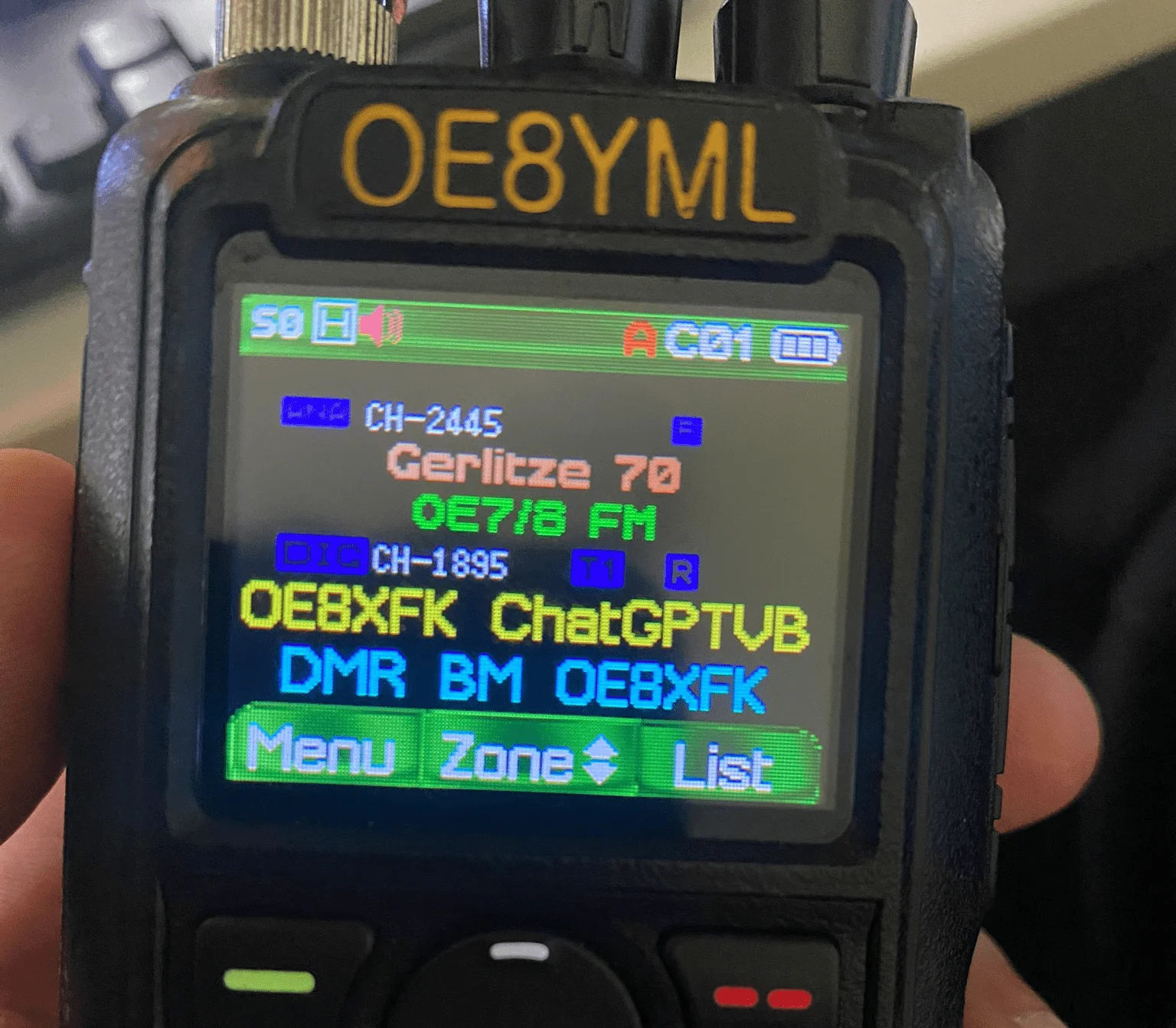
In a groundbreaking development, amateur radio operator Michael DC9VQ has made Nunu NARSPT‘s DMRBot available to the general public made. This exciting news was successfully tested using the Dobratsch repeater (OE8XFK). But what exactly makes this bot so remarkable?
The DMRBot allows radio amateurs to ask questions via a specific talk group and receive answers directly via the radio network. The unique selling point, however, lies in its integration of artificial intelligence. This is where ChatGPT comes into play – one of the leading AI platforms that makes it possible to understand natural language and react accordingly.
The process is very simple: By selecting the right talk group (262691), radio amateurs can ask questions over the radio. The DMRBot forwards these requests to the AI, which then generates the answers. These answers are in turn returned via the respective digital network.
For the testers, the test run via DMR on the Dobratsch repeater was a fascinating experience. “It was impressive to see how smoothly interacting with the AI over the radio went,” said one member. “It opens up completely new possibilities for communication within the amateur radio community.”
Another notable feature of the DMRBot is its versatility. In addition to DMR, YSF (Yaesu System Fusion) and D-Star are also supported. This means that radio amateurs using various digital radio standards can easily access the bot, regardless of which digital network they use.
The documentation for installing the DMRBot and further information about the project are available at https://dc9vq.de/chatgpt-voice-bot-for-dmr/. The DMRBot that enables this innovation can be found on GitHub at https://github.com/narspt/DMRBot.
Michael DC9VQ and Nunu from NARSPT deserve recognition for their pioneering work in introducing this technology. Their efforts are not only modernizing amateur radio, but also opening it up to a wider range of applications. From assisting with technical questions to integrating AI-powered services in emergencies, the DMRBot offers enormous potential for the radio community.
It is clear that this development is redefining the boundaries of what is possible in amateur radio. With the DMRBot and its integration of AI, amateur radio operators will be able to communicate and share information in a completely new way. It’s an exciting time for amateur radio and its future is full of possibilities thanks to the innovative work of people like Michael DC9VQ and Nunu NARSPT.
Finally, it should be noted: The AI may learn to radio slowly, but soon it may already be radioing for us!
