
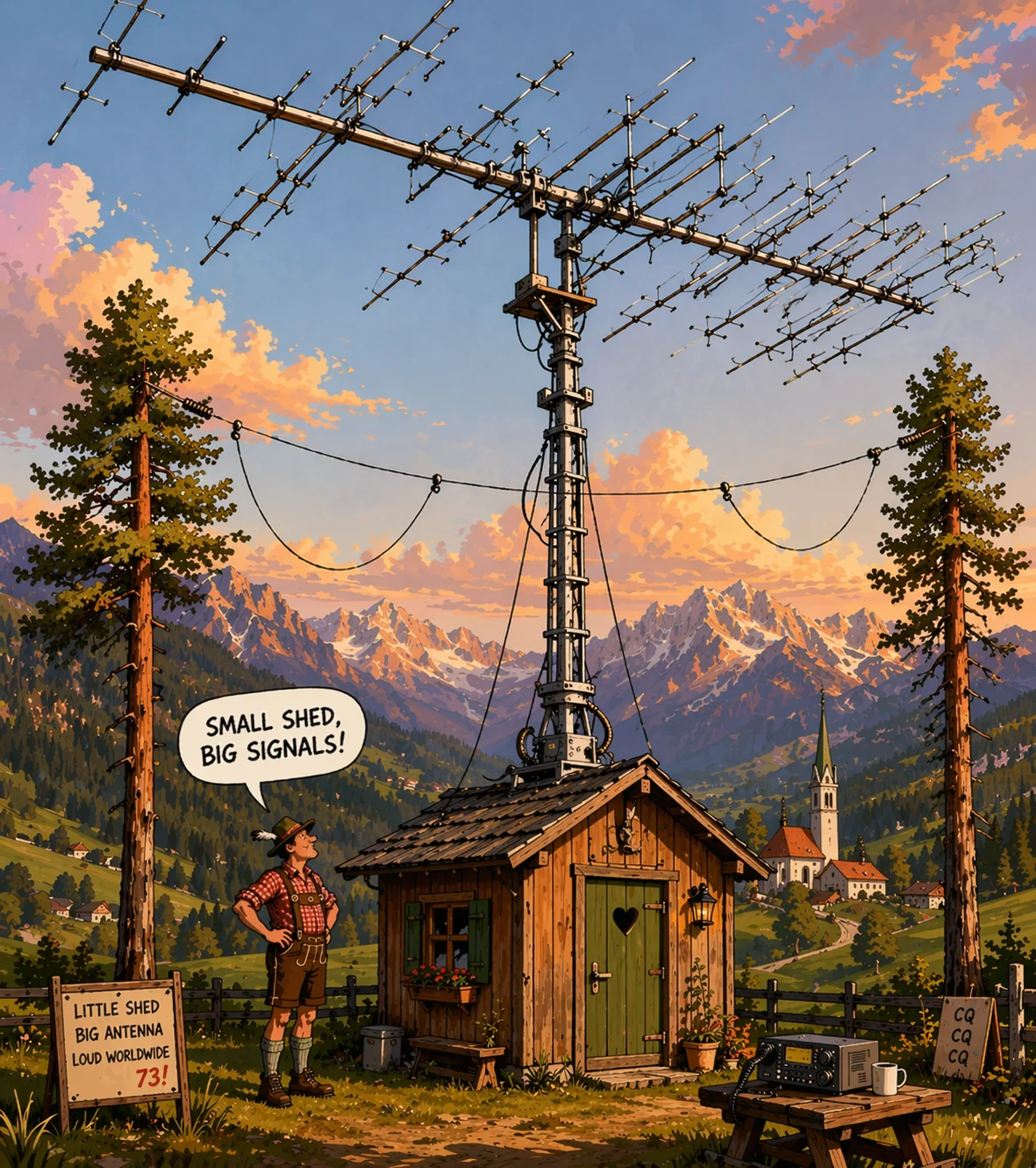
There are stations you hear on every band. Every day. Always the same frequency, always the same modulation report, always the same lengthy CQ call. And then there’s Rudi. He’s not just on every band — he IS every band. A portrait of a man who has been doing everything right for 40 years. At least that’s what he’ll tell you. Hi hi hi.
The Station: Three Flagships for One Operator
Let’s get this out of the way right at the start: Rudi Röhre — yes, that’s really what they call him, named after the vacuum tubes in his beloved amplifier — has not one, not two, but three flagship transceivers. A Yaesu FTDX101MP, an Icom IC-7851, and a Kenwood K4. All three sit on his operating desk, all three are connected, all three are ready to go at any time. Why three? “Well, you never know which band opens up, hi hi hi.” The fact that all three cover all bands is a detail Rudi prefers not to dwell on.
Above the house — a respectable property in rural Carinthia, Austria — rises a 30-metre lattice mast. On it: a 5-element Yagi for 20 metres, a 7-element Yagi for 15 metres, stacked 4-element Yagis for 10 metres, and a Butternut vertical for the low bands. Two rotators. One for the upper stack, one for the lower. “You need redundancy,” Rudi explains. “What if one breaks during a DXpedition opening? Then you’re stuck, hi.” In 40 years, neither has broken. But you never know.
“Just Very Little Power, Hi”
Behind the three transceivers sits Rudi’s crown jewel: an ACOM 2000A amplifier. Tubes. Real tubes. Rudi speaks about his tubes the way other people speak about their children. He knows their hours, their plate current, their colour when they glow. He has spare tubes in the cellar, wrapped in cloth, stored in a temperature-controlled cabinet he built himself. Well — he had someone build it for him. But more on that later.
The ACOM delivers 1,200 watts. When asked about his power, Rudi waves dismissively: “Ach, just very little power, hi hi hi. Barely enough to get out of the valley.” The valley in question is the Drau Valley in Carinthia. His signal can be heard in New Zealand. But it’s “just very little power.”
40 Years Licensed — And You Will Know About It
Rudi has been licensed for 40 years. This is a fact he works into every single QSO. Every. Single. One. It doesn’t matter if it’s a quick 59-73 exchange in a contest or a leisurely Sunday morning ragchew on 80 metres — at some point, the words will come: “Well, I’ve been licensed for 40 years now, and in all that time…” What follows is usually a monologue about how things used to be better, how the bands were quieter, how people still knew proper operating practice, and how nobody builds anything with their own hands anymore.
Which is ironic, because Rudi has never held a soldering iron in his life. Not once. Every cable, every adapter, every patch lead in his shack was made by someone else. His neighbour Kurt (not a ham, but handy with tools) has crimped more PL-259 connectors for Rudi than he can count. Rudi calls himself a “Betriebstechniker” — an operations engineer. Meaning: he pushes the buttons. Others do the rest. Hi hi hi.
He also owns a brand-new Fluke multimeter. Still in its original packaging. It’s been sitting on his shelf for 15 years. He’s not entirely sure what it does, but it was expensive, so it must be good. “For when I need it,” he says. He has never needed it.
The Voice: A Carinthian in Disguise
Rudi is from Carinthia, the southernmost state of Austria. Carinthians have a distinctive, melodic dialect — soft vowels, gentle cadences, a certain warmth that makes even complaints sound friendly. It’s one of the most recognisable dialects in the German-speaking world.
Rudi does not use it on the radio.
The moment he presses the PTT button, Rudi transforms into a man who speaks what he believes is flawless High German — the kind of formal, stiff, slightly theatrical German you might hear from a 1970s newsreader. Except it doesn’t quite work. The Carinthian vowels keep slipping through. The intonation is wrong. The emphasis lands in odd places. It sounds like a man doing an impression of someone he saw on television once. Everyone on frequency can hear that he’s Carinthian. Everyone knows he’s forcing it. Nobody says anything. Hi hi hi.
When the QSO is over and he picks up the phone to talk to his friend Sepp, the dialect flows back instantly, warm and natural. But on the radio? High German. Always. Because that’s how a proper operator sounds. Apparently.
Digital Modes: The Enemy
If you want to see Rudi’s face go red, mention FT8. Go on. Try it.
“That is NOT real ham radio!” His fist hits the desk. The IC-7851 wobbles slightly. “You sit there staring at a screen, and the COMPUTER makes the contact. Where’s the skill? Where’s the operating practice? Where’s the SOUL, hi?” He says “hi” even when he’s angry. It’s a reflex.
PSK31? “Computer stuff.” Winlink? “Email over radio — why? Just use email, hi.” VARA? He doesn’t even know what it stands for, but he knows it’s cursed. JS8Call? “Never heard of it. Don’t want to. Hi.” Any mode that involves a computer decoding a signal is, in Rudi’s world, an abomination against the amateur radio spirit.
He has, however, read extensively about all of them. He needs to know his enemy.
CW: The Weapon of Choice
Rudi CAN do CW. Let that be said. He learned it properly, back in the day when you still had to pass a Morse test for your licence. And he uses it — strategically. His favourite move: joining a 2-metre SSB roundtable that he wasn’t invited to and keying his callsign in Morse over the conversation. Just to make sure everyone knows he’s there. And that he can do CW. “Just checking the frequency, hi hi hi.”
On HF, his CW is competent but deliberate. Around 18 words per minute. He could go faster, he claims. He just chooses not to. “Speed isn’t everything. Accuracy is what counts, hi.” The fact that the DX station is sending at 32 WPM and has moved on to the next caller before Rudi finishes his exchange is — well, that’s the DX station’s loss.
The Modulation Inspector
Rudi gives unsolicited modulation reports. This is his calling. His purpose. His art form.
The process is always the same. First, the question: “What transceiver are you running?” Then: “And what antenna?” If the answer is something like “IC-7300 with a wire antenna,” a brief silence follows. Then: “Aaah. Well. Your modulation is a bit dull, hi. A bit flat. Not bad, but… you know. A bit dull. But with that radio, what can you expect, hi hi hi. Beginner radio.”
The IC-7300 — one of the most popular and capable transceivers ever made, beloved by thousands of operators worldwide — is, in Rudi’s universe, a “beginner radio.” If you have an EFHW antenna or a vertical? Rudi winces audibly. “No wonder your signal is a bit thin, hi. You’ll get there too. Give it time.” He says this to people who have been licensed for 30 years.
If, on the other hand, you report that you’re running an FTDX101MP with a stacked array, Rudi perks up. “Ah yes, NOW we’re talking. Good radio. Almost as good as mine, hi hi hi. Your modulation is quite nice, actually.”
280 DXCC — The Werner Method
Rudi has 280 DXCC entities confirmed. This is impressive. This is remarkable. This is also — if you look closely — slightly less remarkable than it first appears.
Because virtually every single one of those contacts is a pre-arranged sked with a German-speaking expat somewhere in the world. Rudi’s DX log reads like the membership list of a “Germans Abroad” social club:
- PY2WER — Werner, originally from Dortmund, now in São Paulo. Retired engineer. Available every Tuesday at 14:00 UTC on 20m.
- VK4HNS — Hans-Peter, from Hamburg, living in Queensland. Grows macadamias. Thursdays, 08:00 UTC, 15m.
- ZL2GBR — Günter, from Bavaria, sheep farmer in Wairarapa. Sundays, 07:00 UTC, 17m.
- JA3DKF — Dieter-Karl, from Freiburg, teaches German at a university in Osaka. Mondays, 10:00 UTC, 12m.
- W1AHG — Manfred, from Graz, software developer in Boston. Saturdays on 20m, always a bit weak but reliable.
- VU2GMN — Gerhard, from Munich, running an IT company in Bangalore. Erratic schedule, but always answers Rudi’s CQ.
- 5Z4KHN — Karl-Heinz, retired pilot from Stuttgart, now in Nairobi. Wednesday mornings, 18m. Always 57, sometimes 59.
The conversations are always in German. Always comfortable. Always predictable. “How’s the weather, Werner?” — “Hot, Rudi, very hot, hi.” — “Terrible. Here it’s raining. Well, 73 then, see you next Tuesday, hi hi hi.”
His favourite DX station is “Werner” in northern Germany. Not even far away — barely 700 kilometres. But Werner has a rhombic antenna and is available 24 hours a day on HF. If all else fails, there’s always Werner. “Werner is my most reliable DX,” Rudi says without a trace of irony. Werner is in Schleswig-Holstein.
The English Problem
Here we arrive at the heart of the matter. The crack in the armour. The one weakness in Rudi’s otherwise impenetrable fortress of self-confidence.
Rudi cannot speak English.
Oh, he knows the words. He can say “CQ DX” and “five nine” and “thank you” and “seventy-three.” But that’s about it. When Rudi calls CQ on 20 metres and someone answers in English — say, an American station, or a Japanese operator using English as a lingua franca — something remarkable happens. Rudi’s entire being goes into survival mode. His fingers freeze on the VFO knob. His eyes widen. And then, in approximately four seconds flat, he transmits: “Fifty-nine, thank you, seventy-three.” Click. Gone. QSO over. Logged. Next.
The American station is left staring at his radio, wondering what just happened. He had a question about Rudi’s antenna. He wanted to chat. He had time. But Rudi is already spinning the VFO, hunting for the next German-speaking expat on his sked list.
In his log, the QSO is recorded meticulously: callsign, RST 59, time, band, mode. Perfect. Another entity in the bag. The fact that the entire exchange lasted less time than it takes to sneeze is not reflected in the log.
The CQ Call: An Opera in Three Acts
Speaking of CQ calls: Rudi’s are legendary. Not for their effectiveness, but for their length. A typical Rudi CQ call lasts approximately four and a half minutes. It goes something like this:
“CQ CQ CQ, this is [callsign], [callsign], [callsign], station located in Carinthia, southern Austria, running an FTDX101MP into a 5-element Yagi at 30 metres on a lattice mast with two rotators, currently beaming towards South America, also available is the IC-7851 and the Kenwood K4, amplifier is an ACOM 2000A, tubes, real tubes, been licensed for 40 years, looking for any DX station, any DX station, preferably German-speaking, CQ CQ CQ…”
By the time he unkeys, the propagation has shifted, the DX station has gone QRT, and the frequency has been taken over by an Italian contest station calling CQ at 200 words per minute. But Rudi is satisfied. A proper CQ call. Like it’s supposed to be done. Hi hi hi.
The Best Ears in Carinthia
Rudi has the best hearing in Carinthia. He will tell you this himself. Repeatedly. His receiver — well, receivers, plural — are the finest money can buy. His antenna system is impeccable. His noise floor is low.
And yet, somehow, he can never quite hear the station that everyone else on frequency is working. “Terrible QRM today,” he announces. “Must be the solar panels next door. Or the LED street lights. Or the neighbour’s electric fence. Or the plasma TV two houses down.” The list of things that are to blame for Rudi’s inability to hear weak signals is endless and ever-growing.
On a good day, with all three receivers running and the rotator pointed at Germany, he can hear Werner perfectly. “See? Crystal clear. 59 plus 40. That’s what a proper station sounds like, hi.”
Night DX: The Evening Ritual
Every evening at 19:00 sharp, Rudi sits down at his operating position. The ACOM 2000A warms up. The tubes begin to glow. The rotator turns. Towards Germany. Always towards Germany.
The evening programme follows a strict schedule:
- 19:00–20:00: 80m roundtable with DL stations. Signal reports, weather, complaints about FT8.
- 20:00–20:30: Quick sked with OE stations on 80m. Same topics. Same complaints.
- 20:30–21:00: 80m sked with HB9 stations. Swiss German. Rudi switches to High German. The Swiss are amused.
- 21:00–21:30: 20m sked with Manfred (W1AHG), the Austrian in Philadelphia. The highlight of the evening. “How’s America, Manfred?” — “Still here, Rudi, hi.” Every single time.
- 21:30–22:00: Logging. Every QSO meticulously entered into Ham Radio Deluxe. RST, time, band, mode. Comments column: “Good QSO” for everyone. Even the four-second English ones.
At 22:00, Rudi powers down. The tubes cool. The rotator stays pointing towards Germany. Tomorrow it will be the same. It is always the same. And Rudi wouldn’t have it any other way.
The Sked Partners: Vertical Antenna Victims
Rudi has a circle of regular sked partners across Austria and Germany. Good operators, all of them. Decent stations. But most of them run — and this is where Rudi’s face takes on an expression of genuine pity — vertical antennas.
“Poor Franz,” Rudi sighs, shaking his head. “Still on that vertical. I keep telling him — you need a beam. A REAL antenna. But he says he hasn’t got the space. Or the permission. Or the money. Well.” He pauses. Looks at his 30-metre mast through the window. “You’ll get there too, Franz. Give it time, hi.”
Franz has been licensed for 35 years and has more SOTA activations than Rudi has had hot dinners. But he has a vertical antenna. So in Rudi’s world, he’s still a beginner. Hi hi hi.
The Self-Made Man (Who Never Made Anything Himself)
If you ask Rudi about his station, he’ll talk for an hour. Every component, every cable, every connector. He knows the specifications by heart. He can recite the third-order intercept point of the IC-7851 from memory. He knows the exact weight of his rotator.
What he cannot do is build, solder, crimp, measure, or repair any of it.
His neighbour Kurt (still not a ham) installed the mast. A local electrician wired the shack. A friend of a friend tuned the antennas. The coaxial cables were assembled by a retired broadcast engineer in the next village. Rudi supervised. He’s very good at supervising.
“I’m a Betriebstechniker,” he says proudly. An operations engineer. He operates. Others engineer. It’s a division of labour. Very efficient. Hi hi hi.
The Fluke multimeter, still sealed in its box, watches silently from the shelf. Fifteen years and counting.
The Best at Everything
If there’s one thing you have to admire about Rudi, it’s his constancy. His absolute, unwavering, rock-solid certainty that he is the best. The best station in Carinthia. The best modulation. The best antennas. The best ears. The best operating practice. The best 280 DXCC entities — all worked the proper way, with real contacts, real tubes, and real German-speaking operators on the other end.
Nobody has ever seen him doubt himself. Not once. When a new operator in the district worked 100 DXCC in six months using FT8, Rudi simply shook his head. “Doesn’t count, hi. Computer contacts. Not real ham radio.” When someone pointed out that the ARRL doesn’t distinguish between modes for DXCC, Rudi went quiet for exactly three seconds — a personal record — before saying: “Well, the ARRL doesn’t understand real ham radio either, hi hi hi.”
The Moral of the Story
Is Rudi a bad operator? No. His signal is clean, his logging is meticulous, his station is technically excellent (even if he didn’t build it), and he’s been a reliable presence on the bands for four decades. He respects band plans, identifies properly (at length), and has never intentionally caused interference.
But Rudi is a reminder that ham spirit isn’t just about having the best equipment or the most entities confirmed. It’s about curiosity. About learning new things. About talking to people who don’t speak your language. About building something with your own hands, even if it’s just a simple dipole. About understanding that a teenager with an IC-7300 and a wire antenna who works 100 countries in FT8 is just as much a “real” ham as a man with three flagships and a 30-metre mast.
Rudi will never see it that way. And that’s okay. Because every evening at 19:00, the rotator turns to Germany, the tubes begin to glow, and somewhere in Schleswig-Holstein, Werner is already waiting on frequency.
And that, in its own strange way, is also ham radio. Hi hi hi.
73 — Hansl Hohlleiter, your friendly neighbourhood Störsender columnist
Transparency Notice
This article was researched and written with the support of AI (Claude, Anthropic). All content has been reviewed, edited, and approved by our editorial team. The character of Rudi Röhre is entirely fictional — any resemblance to actual operators, living or stubbornly refusing to try FT8, is purely coincidental. Hi.
