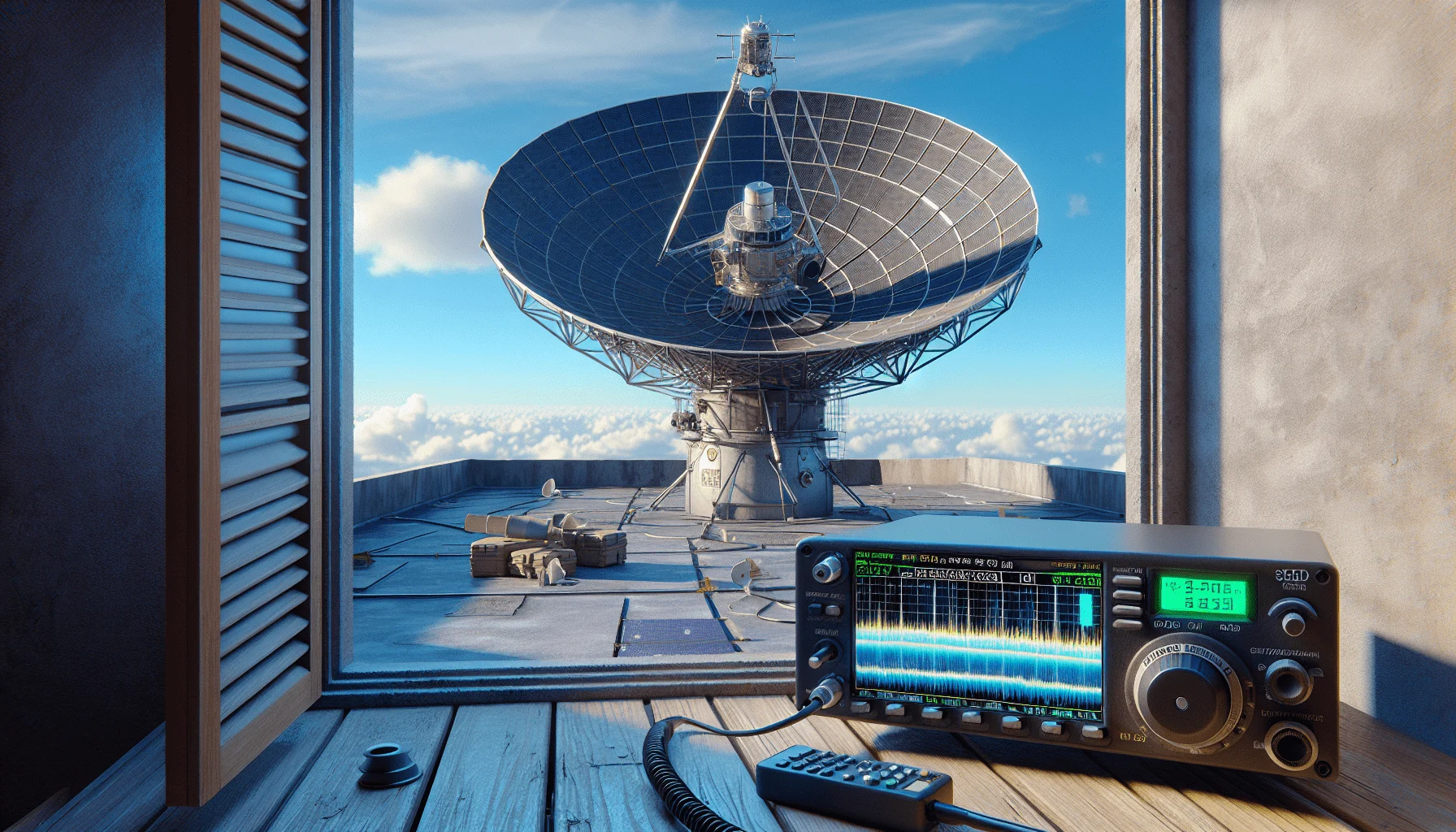
Imagine pressing the PTT button and your signal races 36,000 kilometres into space, hits a satellite and beams back to Earth — from Brazil to India, from Scandinavia to South Africa. Not just for a few minutes like a LEO satellite pass, but around the clock, 365 days a year. Welcome to QO-100, the world’s first and only geostationary amateur radio satellite.
What is QO-100?
QO-100 — officially Qatar-OSCAR 100 — is the amateur radio transponder on board the Qatari communications satellite Es’hail-2. The satellite was launched on 15 November 2018 aboard a SpaceX Falcon 9 and built by Mitsubishi Electric. It sits at geostationary position 25.9° East with a design lifetime of at least 15 years.
The special feature: alongside its commercial Ku- and Ka-band transponders, Es’hail-2 carries two amateur radio transponders developed by AMSAT-DL in cooperation with the Qatar Amateur Radio Society (QARS).
The two transponders
QO-100 offers two transponders for different applications:
- Narrowband transponder (NB): 500 kHz bandwidth for SSB, CW and digital modes. Uplink: 2400.050–2400.300 MHz (13 cm band), downlink: 10489.550–10489.800 MHz (3 cm band). This is where classic voice and CW operation takes place.
- Wideband transponder (WB): 8 MHz bandwidth for DATV (Digital Amateur Television) and high-speed data. Uplink: 2401.500–2409.500 MHz, downlink: 10491.000–10499.000 MHz.
Coverage: from Brazil to Thailand
As a geostationary satellite, QO-100 covers a vast area: all of Europe, Africa, the Middle East, the Indian subcontinent, the eastern part of Brazil and the Africa-facing part of Antarctica. From Austria the elevation angle is approximately 34 degrees — comfortable enough for balcony and garden antennas.
What do I need for a ground station?
Receiving QO-100 is surprisingly simple and affordable. Transmitting requires a bit more effort. Here is an overview:
Receive only (from ~50 EUR)
- Satellite dish: A standard SAT dish from 60 cm upwards is sufficient
- Modified LNB: A standard Ku-band LNB modified with an external 25 MHz reference oscillator (e.g. TCXO) for frequency stability
- RTL-SDR or SDRplay: As a receiver on the LNB’s IF output
- SDR Console: Simon Brown’s free software is the standard tool for QO-100 reception
Transmit and receive (from ~300–500 EUR)
- Parabolic antenna: 60–80 cm for SSB, 80–120 cm for DATV
- Upconverter or transverter: Converts the 2 m or 70 cm signal to 2.4 GHz (e.g. DX Patrol Upconverter, SG-Lab Transverter)
- Power amplifier: 2–5 watts at 2.4 GHz is enough for SSB
- Feed: The POTY (Patch of the Year) is the most popular feed antenna — it can simultaneously transmit (2.4 GHz) and receive (10 GHz)
- SSB transceiver: Any standard HF or VHF transceiver as the IF source
Operating modes on QO-100
The narrowband transponder is a busy place:
- SSB: The main mode — QSOs sound crystal clear, almost like a local repeater
- CW: In the lower segment of the transponder
- FT8/FT4: For weak signals and automatic DX
- FreeDV: Digital voice using the open-source Codec2
- HSModem: A high-speed modem developed by AMSAT-DL for image and data transfer over the narrowband transponder (up to 7200 bit/s)
The wideband transponder is primarily used for DATV — digital television in remarkable quality.
QO-100 without your own antenna: WebSDR
If you want to listen in first, you can monitor the QO-100 transponder via a WebSDR — no hardware needed. The best known is the WebSDR at Goonhilly Earth Station in Cornwall, England. Simply open it in your browser and listen!
QO-100 in Austria
Austria has an active QO-100 community. The ÖVSV launched an emergency communications project in the OE3 regional association, developing a rapidly deployable satellite ground station for disaster relief. The goal: even when all terrestrial infrastructure fails, communication via QO-100 remains available.
As part of the annual AOEE (All Austrian Emergency Exercise), the QO-100 transponder is regularly used for emergency drills, testing both the technology and operational procedures.
Tips for getting started
- Receive first: Start with an old SAT dish and an RTL-SDR. This lets you learn the transponder without spending much.
- Stabilise the LNB: A standard LNB drifts with temperature. A TCXO mod or LNB with external reference input (e.g. Bullseye 10 GHz LNB) is essential for stable reception.
- Follow the band plan: AMSAT-DL publishes a detailed band plan with CW, digi and SSB segments. Stick to it!
- Mind your power: QO-100 is a linear transponder — overdriving it disturbs everyone else. Monitor your signal level on the downlink waterfall.
Conclusion
QO-100 is one of the most fascinating opportunities in amateur radio. A transponder available around the clock, covering half a continent and usable with relatively modest equipment — that has never existed before. And with a planned lifetime until at least 2033, there is still plenty of time to experiment.
Further links:
73 – your oeradio.at editorial team
Transparency Notice
This article was researched and written with the assistance of AI (Claude, Anthropic). The editorial team has reviewed and edited all content. Despite careful review, occasional inaccuracies may occur — we welcome corrections via email to [email protected].
