Table of Contents
- What Is LoRa Mesh?
- Meshtastic: The International Open-Source Project
- MeshCom: The Austrian Amateur Radio Variant
- Comparison: MeshCom vs. Meshtastic
- The Hardware: Which Board for Which System?
- Use Cases
- Outdoor and Mountain Tours
- Emergency Communications and Disaster Preparedness
- Events and Field Days
- Range and Optimisation
- Setup Step by Step
- MeshCom or Meshtastic — Which Is Better?
- Getting Started for Under EUR 30
- Transparency Notice
Text messages without the internet, without mobile networks, without infrastructure — simply device-to-device across kilometres? What sounds like science fiction has long been reality with LoRa mesh networks. Two projects dominate the scene: Meshtastic, the international open-source project, and MeshCom, the Austrian variant from the amateur radio community. Both use affordable LoRa hardware but differ considerably in philosophy and features.
What Is LoRa Mesh?
LoRa (Long Range) is a radio technology that operates on ISM band frequencies (433 MHz and 868 MHz in Europe) and features extremely long range at minimal power. Typical ranges are 2–10 km in built-up areas and up to 30 km with line of sight — all at just 25–100 mW transmit power.
A mesh network connects these LoRa nodes into a self-organising network: each device receives messages and forwards them until they reach the recipient. Range grows with every additional node — without central infrastructure, without the internet, without mains power.
Meshtastic: The International Open-Source Project
Meshtastic is an open-source project started in 2020 with an active worldwide community. The software runs on affordable ESP32-based LoRa boards and offers:
- Text messages (direct and group chat) across the mesh network
- GPS position reports — every node shares its location
- Telemetry — temperature, humidity, battery voltage
- Encryption (AES-256) — messages are encrypted by default
- MQTT gateway — internet connectivity for global networking
- Smartphone app (Android, iOS) as user interface via Bluetooth
The hardware is extremely affordable: a Heltec LoRa 32 V3 or LILYGO T-Beam costs between EUR 25 and EUR 50. With built-in OLED display and GPS module, you have a complete mesh node the size of a matchbox. Popular ready-made devices like the Heltec Mesh Node T114 or RAK WisMesh Pocket cost EUR 30–60 and work straight out of the box.
MeshCom: The Austrian Amateur Radio Variant
MeshCom is a project that originated in the Austrian amateur radio community and specifically targets licensed radio amateurs. It’s based on Meshtastic-compatible hardware but uses modified firmware with important differences:
- No encryption — as required by amateur radio regulations, all transmissions are unencrypted
- Callsign identification — each node identifies with its amateur radio callsign
- 433 MHz amateur band — MeshCom uses the 70 cm amateur band instead of the ISM band, allowing higher power and better antennas
- Integration with HAMNET — MeshCom gateways connect the mesh to the amateur high-speed data network
- APRS gateway — position reports are automatically fed into the APRS network
MeshCom is already well established in Austria, with gateways on mountain peaks and in club rooms providing solid basic coverage.
Comparison: MeshCom vs. Meshtastic
Both systems use LoRa on ESP32 hardware but differ fundamentally in their approach:
- Licence: Meshtastic requires no amateur licence (ISM band), MeshCom requires a valid licence
- Encryption: Meshtastic encrypts by default (AES-256), MeshCom transmits openly (amateur radio regulation)
- Frequency: Meshtastic on 868 MHz (ISM, max 25 mW ERP), MeshCom on 433 MHz (amateur, higher power possible)
- Integration: Meshtastic connects via MQTT to the internet, MeshCom integrates with HAMNET and APRS
- Community: Meshtastic has a huge international community, MeshCom is rooted in the DACH region
- Firmware: Meshtastic is actively developed (monthly updates), MeshCom follows a more stable release cycle
The Hardware: Which Board for Which System?
Both systems run on similar hardware. The most popular boards:
- Heltec LoRa 32 V3 (~EUR 25): OLED display, compact, affordable — the classic for Meshtastic
- LILYGO T-Beam (~EUR 40): Built-in GPS, 18650 battery, ideal for portable use
- LILYGO T-Deck (~EUR 55): Keyboard, display, GPS, speaker — a complete communication device
- RAK WisMesh Pocket (~EUR 35): Ready-made device, works out of the box, robust case
- Station G2 (~EUR 70): High-performance gateway with Ethernet and PoE
If you’ve already built ESP32 projects, you’ll know the basics. Firmware is simply flashed via USB — with Meshtastic, even directly in the web browser via flasher.meshtastic.org.
Use Cases
Outdoor and Mountain Tours
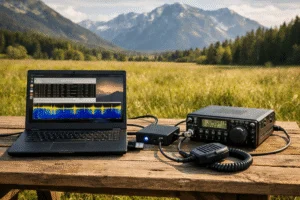
A Meshtastic node on a rucksack enables communication within a hiking group without mobile coverage. GPS tracking shows where each group member is. Ideal during SOTA activations where location data can be relayed to the base station.
Emergency Communications and Disaster Preparedness
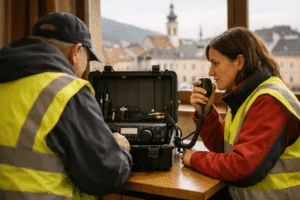
LoRa mesh networks function even when mobile and internet services have failed. For emergency communication planning, they offer an additional communication layer. MeshCom nodes on mountain peaks and at repeater sites form a basic infrastructure that’s immediately available in an emergency. They’re also interesting for blackout preparedness: a LoRa node runs for days on a small battery.
Events and Field Days
At radio events, a mesh network enables coordination between different stations — text messages, position display, and telemetry without additional infrastructure.
Range and Optimisation
Range depends heavily on the antenna and placement. Typical values:
- Urban area: 1–3 km with standard antenna
- Open/rural area: 5–15 km
- Mountain to mountain: 30–80 km with line of sight
- Record: Over 250 km has been documented
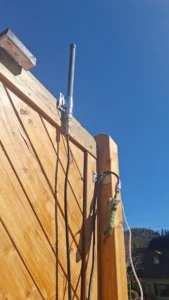
An external antenna (quarter-wave ground plane or Slim Jim) at an elevated location can triple the range. Solar-powered relay nodes on mountain peaks extend the network permanently.
Setup Step by Step
Getting started with Meshtastic takes just 15 minutes:
- Buy a board (e.g. Heltec LoRa 32 V3, ~EUR 25)
- Flash the firmware at flasher.meshtastic.org (Chrome/Edge only)
- Install the Meshtastic app on your smartphone (Android/iOS)
- Connect to the board via Bluetooth
- Set region to EU_868, assign a username
- Done — any other Meshtastic node in range is automatically discovered
For MeshCom, the MeshCom firmware is flashed instead of the standard firmware. Configuration is done via the MeshCom web interface, where callsign and HAMNET gateway settings are entered.
MeshCom or Meshtastic — Which Is Better?
The answer depends on your use case:
- Choose Meshtastic if: you want to communicate with unlicensed users, need encryption, prefer the larger international community, or simply want to experiment
- Choose MeshCom if: you’re a licensed radio amateur, seeking HAMNET/APRS integration, want to join the Austrian mesh network, or want to use higher power on 433 MHz
Many radio amateurs simply run both: a Meshtastic node for family and hiking groups, and a MeshCom node for integration into the amateur radio infrastructure.
Getting Started for Under EUR 30
A Heltec LoRa 32 V3 for around EUR 25 and the free Meshtastic firmware — that’s all you need to get started. No server, no subscription, no ongoing costs. The mesh lives from its participants: the more active nodes, the better the network works. In many Austrian regions, solid MeshCom infrastructure already exists that you can simply join.
LoRa mesh is the perfect bridge between the maker world and amateur radio — and a fascinating piece of autonomous communication.
73 – your oeradio.at editorial team
Transparency Notice
This article was researched and written with the assistance of AI (Claude, Anthropic). Any illustrations used were generated with AI (ChatGPT/DALL·E, OpenAI) unless otherwise noted. The editorial team has reviewed and edited all content. Despite careful review, occasional inaccuracies may occur — we welcome corrections via email to [email protected].