
Table of Contents
- What is QO-100?
- Technical specs at a glance
- The two transponders in detail
- Narrowband transponder (NB)
- Wideband transponder (WB)
- Video: Introduction to QO-100 (RSGB Tonight @ 8)
- Coverage: From Brazil to Thailand
- What do I need for a ground station?
- Receive only (from ~EUR 50)
- Transmit and receive (from ~EUR 300–800)
- Our OE build project on GitHub: oehamradiorepo/qo100
- Proof-of-Concept 1: IC-9700 setup at OE8PPL
- Bill of materials — total cost approx. EUR 780
- The QO-100 box in the wild
- Operating modes on QO-100
- Video: AMSAT-DL presentation on Es'hail-2
- QO-100 without your own antenna: WebSDR
- QO-100 in Austria
- Tips for getting started
- Cost reality check
- Conclusion
- Further reading
- Transparency Notice
Imagine this: you press the PTT button, your signal races 36,000 kilometres into space, is picked up by a satellite and beamed back to Earth — from Brazil to India, from Scandinavia to South Africa. And not just for a few minutes like with a LEO satellite, but around the clock, 365 days a year. Welcome to QO-100, the first and only geostationary amateur radio satellite in the world.

What is QO-100?
QO-100 — officially Qatar-OSCAR 100 — is the amateur radio transponder aboard the Qatari communications satellite Es’hail-2. The satellite was launched on November 15, 2018 on a SpaceX Falcon 9 and built by Mitsubishi Electric. It sits in geostationary orbit at 25.9° East and has a design lifetime of at least 15 years.
What makes it special: alongside the commercial Ku- and Ka-band transponders, Es’hail-2 carries two amateur radio transponders developed by AMSAT-DL in cooperation with the Qatar Amateur Radio Society QARS. It is the very first amateur radio payload in geostationary orbit — a technical first the community had been waiting for for decades.
Technical specs at a glance
| Satellite | Es’hail-2 (commercial name), QO-100 (amateur name) |
| Operator | Es’hailSat (Qatar), amateur payload: AMSAT-DL / QARS |
| Manufacturer | Mitsubishi Electric (DS2000 platform) |
| Launch | November 15, 2018, SpaceX Falcon 9 from Kennedy Space Center LC-39A |
| Orbit | Geostationary, 25.9° East |
| Design lifetime | ≥ 15 years (until at least 2033) |
| Coverage | Europe, Africa, Middle East, India, eastern Brazil, Thailand |
| Elevation (Austria) | approx. 34° (depending on QTH) |
| Azimuth (Austria) | approx. 160° (south-southeast) |
The two transponders in detail
QO-100 offers two transponders designed for very different uses:
Narrowband transponder (NB)
- Bandwidth: 250–500 kHz (depending on counting method)
- Uplink: 2400.050 – 2400.300 MHz (13-cm band)
- Downlink: 10489.550 – 10489.800 MHz (3-cm band)
- Polarisation: Uplink RHCP, downlink vertical
- Modes: SSB, CW, FT8/FT4, FreeDV, HSModem
- Ground station: from 75 cm dish and ~5 W at the feed
Wideband transponder (WB)
- Bandwidth: 8 MHz
- Uplink: 2401.500 – 2409.500 MHz (13-cm band)
- Downlink: 10491.000 – 10499.000 MHz (3-cm band)
- Modes: DVB-S2 (DATV), experimental digital formats
- Ground station: approx. 2.4 m dish and ~100 W EIRP
The NB transponder is the playground for the “normal” ham: SSB sounds clear, quiet and almost delay-free (signal travel time ~270 ms). The WB transponder, on the other hand, is a pure experimentation sandbox for DATV enthusiasts chasing self-built TV signals across half the planet.
Video: Introduction to QO-100 (RSGB Tonight @ 8)
Dom Smith M0BLF gave an excellent introduction to getting started on QO-100 during the RSGB webinar evening “Tonight @ 8”. Roughly 60 minutes of complete overview — from antenna to software. Required viewing for anyone serious about jumping in:
Coverage: From Brazil to Thailand
As a geostationary satellite, QO-100 covers a huge area: all of Europe, Africa, the Middle East, the Indian subcontinent, plus the eastern part of Brazil and the Africa-facing part of Antarctica. From Austria, the elevation angle is about 34 degrees — comfortable enough for balcony and garden antennas. Azimuth sits around 160° (south-southeast).
That means: from the Vienna Woods to Cape Town, from Reykjavík to Bangkok — you reach half a planet with a single QSO. DXpeditions from Zambia, Mauritius or Palestine are as normal here as ragchewing with OE stations on the next channel.
What do I need for a ground station?
Receiving QO-100 is surprisingly easy and cheap. Transmitting takes a bit more effort. Here’s an overview:
Receive only (from ~EUR 50)
- Satellite dish: A standard SAT dish of 60 cm or more is enough (used: EUR 5–20)
- Modified LNB: A standard Ku-band LNB, modified with an external 25 MHz reference oscillator (e.g. TCXO) for stable frequencies — or simply buy a Bullseye LNB with internal TCXO (~EUR 40)
- Bias-T: Feeds 13 V DC to the LNB over the coax (~EUR 10)
- RTL-SDR or SDRplay: As receiver on the LNB’s intermediate frequency output (~EUR 30)
- SDR Console: The free software from Simon Brown is the standard tool for QO-100 reception
Transmit and receive (from ~EUR 300–800)
- Parabolic antenna: 60–80 cm for SSB, 80–120 cm for DATV
- Upconverter or transverter: Converts the 2 m or 70 cm signal to 2.4 GHz (e.g. DX Patrol upconverter, SG-Lab 13-cm transverter)
- Power amplifier: 2–5 watts on 2.4 GHz is enough for SSB; 20 W for comfortable DX
- Feed: POTY (Patch of the Year) is the most popular antenna at the dish focus — it can transmit (2.4 GHz) and receive (10 GHz) simultaneously. Alternative: DC8PAT Helix (Ice Cone)
- SSB transceiver: A standard HF, VHF or satellite transceiver as IF source — especially popular: Icom IC-9700 in Sat mode or the Adalm-Pluto SDR
Our OE build project on GitHub: oehamradiorepo/qo100
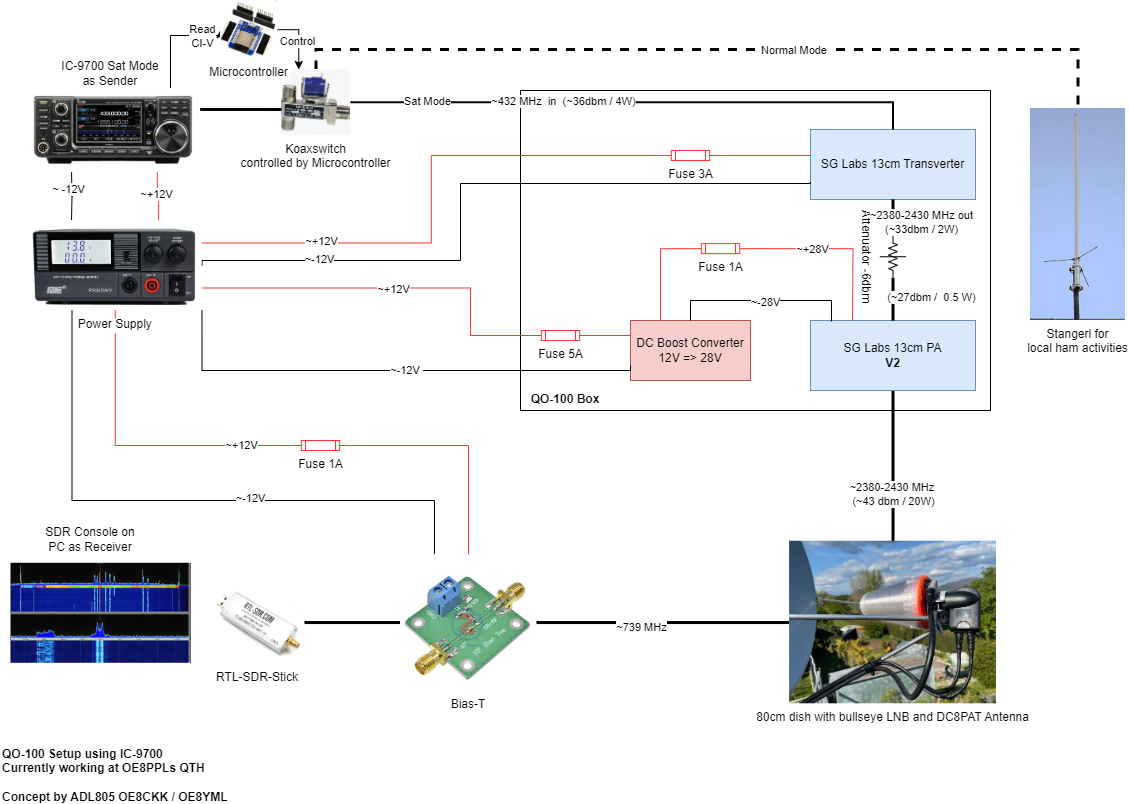
If you’re looking for a concrete, ready-to-build plan, the open oehamradiorepo/qo100 repository contains several proof-of-concept setups documented by Chris (OE8CKK) and Michael (OE8YML). The first variant was built and documented in Peter’s (OE8PPL) shack — complete with bill of materials, schematic and photos.
Proof-of-Concept 1: IC-9700 setup at OE8PPL
The first documented variant uses the Icom IC-9700 as the transceiver. The trick: when the IC-9700 is switched to Sat mode, an ESP32 microcontroller detects the state and automatically switches a coax relay that routes the 70-cm signal from the transceiver to the QO-100 box. There it is upconverted to 2.4 GHz by an SG-Lab transverter, attenuated by 6 dB and then amplified by a 20-watt PA. The amplified signal then runs over a short coax to a DC8PAT helix antenna (Ice Cone) at the focal point of the 80-cm SAT dish. In parallel, a Bullseye LNB feeds the downlink on 10 GHz via a Bias-T and an RTL-SDR stick — processed by SDR Console on the PC.
Bill of materials — total cost approx. EUR 780
| Component | Price | Note |
|---|---|---|
| ESP32 microcontroller | €3–5 | Arduino or similar also works |
| Coaxial relay | €110 | For sat/non-sat switching |
| SG-Lab 13-cm transverter | €190 | Heart of the uplink |
| SG-Lab 13-cm PA V2 | €140 | With V3 PA use a –15 dB attenuator |
| 6 dB attenuator | €6 | Protection between transverter and PA |
| DC boost converter | €6–10 | 35 V / 4700 µF capacitor in parallel for smoothing |
| Bias-T | €10–15 | Feeds LNB via coax |
| RTL-SDR stick | €40 | Any standard RTL stick |
| Bullseye LNB | €40–50 | Internal TCXO for frequency stability |
| DC8PAT Ice Cone Helix | €100 | Or DIY with 3D printer and copper wire |
| Weatherproof enclosure | €70 | Mountable near the antenna |
| Cables, fuses, accessories | ~€50 | Rough estimate |
| Total (new parts) | ~€780 | Less with junk box & DIY |
The QO-100 box in the wild
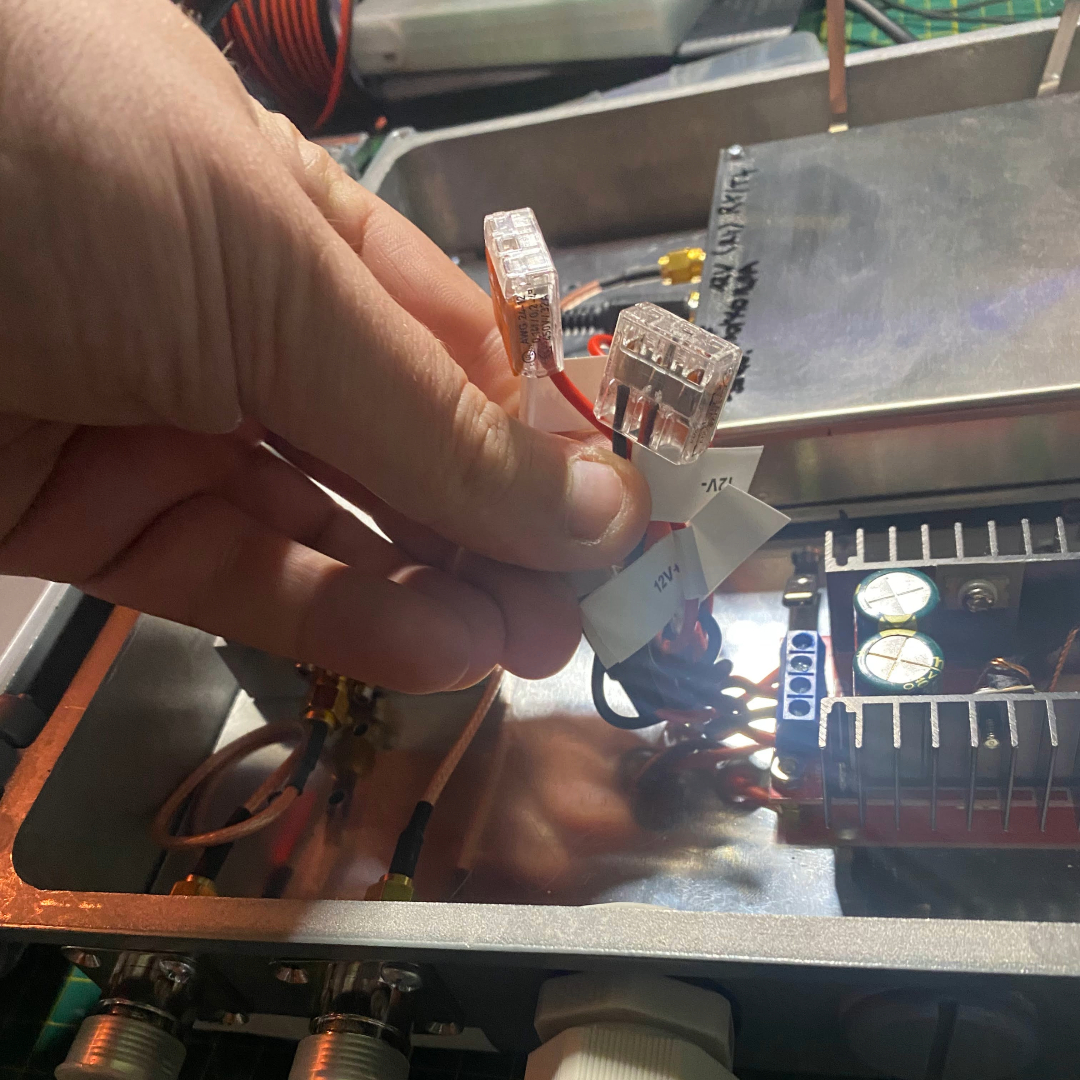
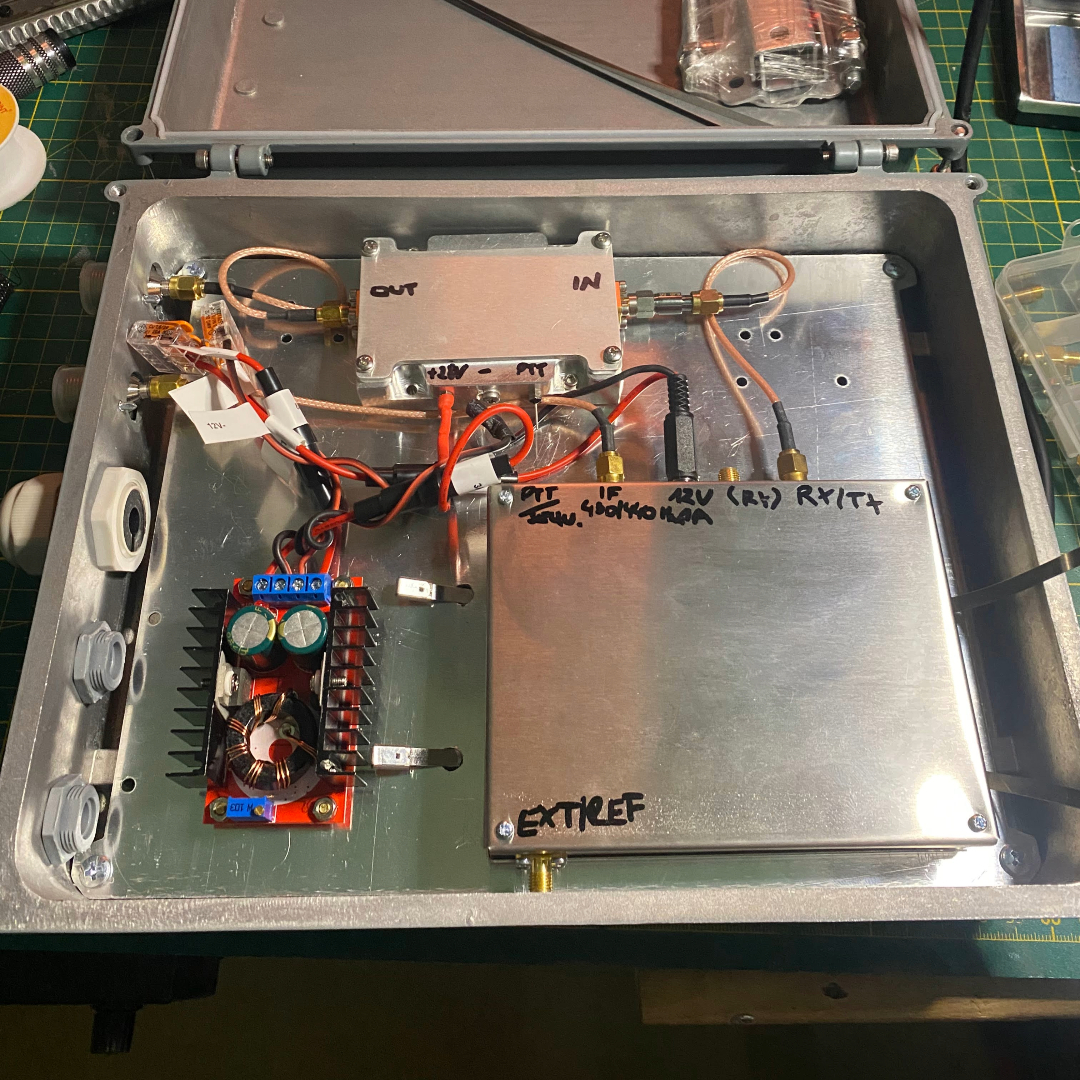
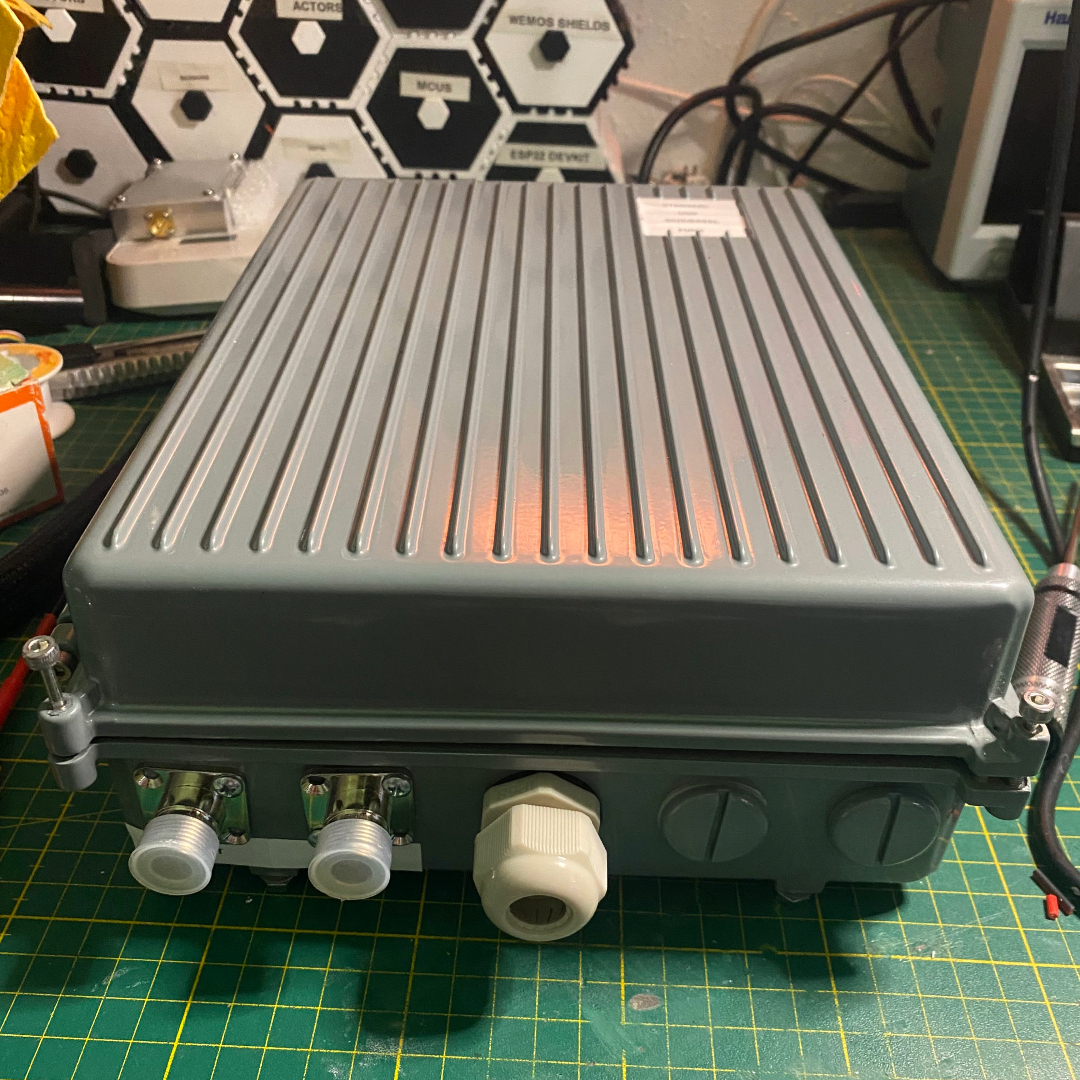
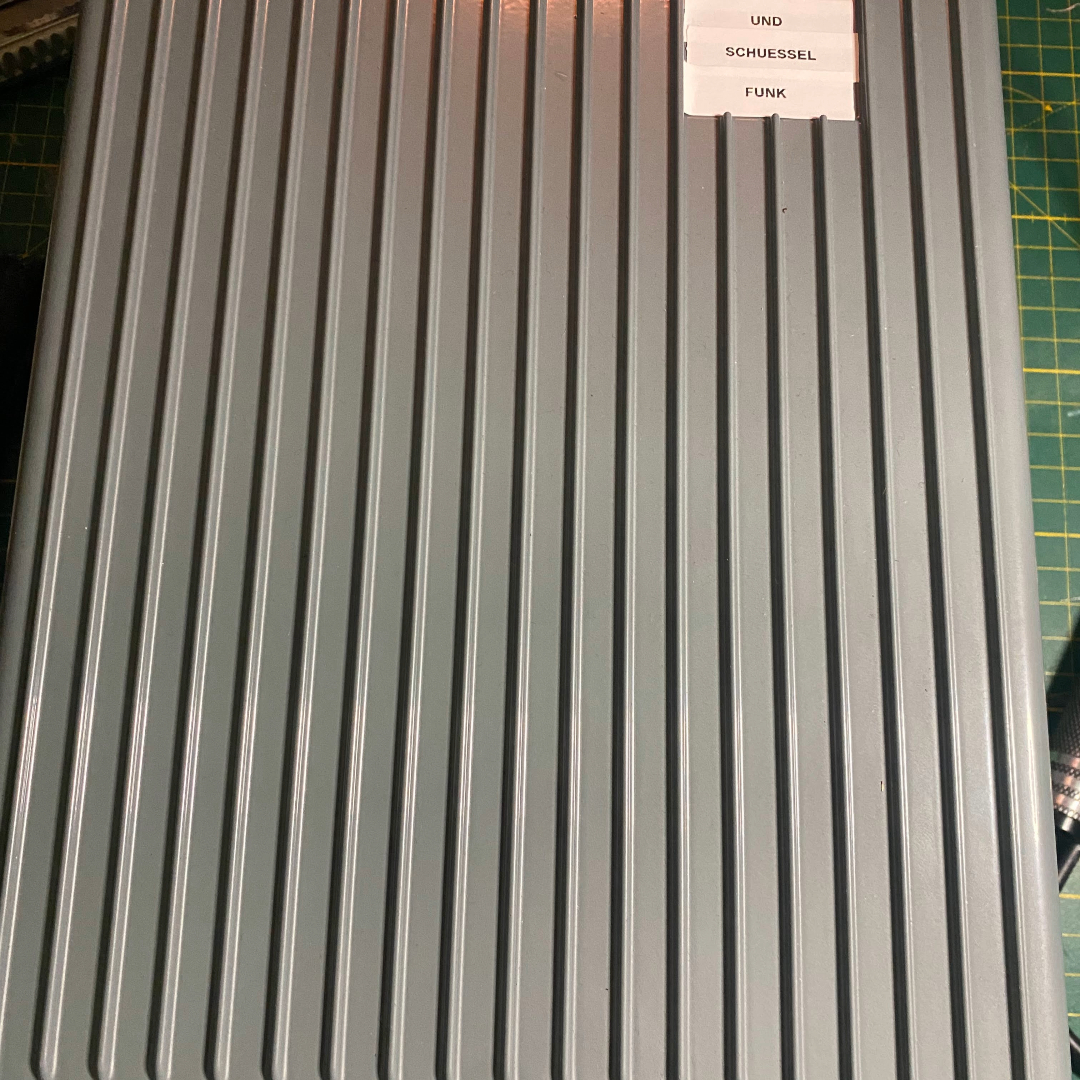
The repository is growing — Proof-of-Concept 2 (minimal portable build) and Proof-of-Concept 3 (Adalm-Pluto based) are in the works. Pull requests, issues and your own variants are explicitly welcome. The goal: a growing, publicly documented reference for OE hams who want to get on the geostationary satellite.
Operating modes on QO-100
The narrowband transponder is busy with a wide mix of activity:
- SSB: The main mode — SSB QSOs sound crystal clear, almost like on a repeater
- CW: In the lower part of the transponder, old-school style
- FT8/FT4: For weak signals, automated DX and logbook fillers
- FreeDV: Digital voice using the free Codec2
- HSModem: AMSAT-DL high-speed modem for image and data transfer on the narrowband transponder (up to 7200 bit/s)
The wideband transponder is primarily used for DATV — digital television at surprising quality. Once you’ve sat “live on camera” in a DATV QSO and seen yourself on screen in Mauritius, Kyiv or Cairo, you’ll never forget it.
Video: AMSAT-DL presentation on Es’hail-2
Achim Vollhardt DH2VA from AMSAT-DL presented the origin story and the technology behind QO-100 at the AMSAT-UK Colloquium 2019 — straight from the people who designed and built the project. A fascinating look at how an idea turned into a working geostationary amateur radio service:
QO-100 without your own antenna: WebSDR
If you want to dip a toe in first, you can listen to the QO-100 transponder through a WebSDR — no hardware required. The best known is the WebSDR at the Goonhilly Earth Station in Cornwall (England), operated by BATC. Open it in your browser, click “Narrowband” and follow the international SSB traffic. A separate wideband viewer is available for DATV.
It also lets you monitor your own uplink live while you transmit — a priceless advantage when calibrating your own station.
QO-100 in Austria
Austria has an active QO-100 community. In the OE3 district, a NOT-/KAT project is underway to develop a rapidly deployable satellite ground station for emergency communications. The goal: even if the entire terrestrial infrastructure fails, a communication link remains via QO-100.
During the annual AOEE (All Austrian Emergency Exercise), the QO-100 transponder is regularly used for emergency communication drills. This tests not only the technology but also the procedures under real conditions. In Carinthia (OE8), Peter (OE8PPL), Chris (OE8CKK) and Michael (OE8YML) actively experiment with the geostationary satellite and document their results in the oehamradiorepo on GitHub.
Tips for getting started
- Receive first: Start with an old SAT dish and an RTL-SDR. You’ll learn the transponder without investing much.
- Stabilize the LNB: A normal LNB drifts thermally. A TCXO mod or an LNB with external reference input (e.g. Bullseye 10 GHz LNB) is mandatory for stable reception.
- Respect the band plan: AMSAT-DL publishes a detailed band plan with CW, digi and SSB segments. Stick to it — the transponder is a shared resource.
- Keep power in check: QO-100 is a linear transponder — overdriving disturbs all other users. Monitor your own power on the downlink waterfall. Rule of thumb: never transmit stronger than the beacon.
- Waterproof the feed: If you mount the antenna outdoors, seal the feedpoint — 2.4 GHz signals are sensitive to water in coax connectors.
- Listen on WebSDR first: Before buying your station, listen on the BATC WebSDR for a few hours. You’ll get a feel for etiquette, modes and bandwidth.
Cost reality check
Contrary to popular belief, QO-100 is no more expensive than a decent HF station. For receive-only entry, EUR 50–80 is enough. A complete transmit/receive station runs EUR 400–800 depending on ambition — comparable to a mid-range smartphone or a halfway-decent HF amplifier. In return you get 24/7 worldwide DX that works regardless of sunspot number, season or time of day. For many OE hams living in narrow valleys or restricted by HOA rules, QO-100 is the only realistic chance for worldwide DX.
Conclusion
QO-100 is one of the most fascinating opportunities in amateur radio. A transponder available around the clock, covering half a continent and usable with relatively modest equipment — nothing like this has ever existed before. And with a design lifetime until at least 2033, there’s still plenty of time to experiment. If you’re looking at HF and feeling frustrated by poor conditions, give QO-100 a serious try — the dish on the balcony is aimed faster than you think.
Further reading
- oehamradiorepo/qo100 — Our OE build project on GitHub
- AMSAT-DL — QO-100 project page (transponder developers)
- AMSAT-UK — Es’hail-2 / QO-100 technical data
- QO-100 WebSDR (Goonhilly / BATC)
- SDR Console — configuration for Es’hail-2
- AMSAT-DL: NB transponder band plan & operating guidelines
73 – the oeradio.at editorial team
Transparency Notice
This article was researched and written with the support of AI (Claude, Anthropic), based on publicly available sources from AMSAT-DL, AMSAT-UK, BATC and the open project repository oehamradiorepo/qo100. The Es’hail-2 launch photo is from SpaceX and is released under CC0 (Public Domain). The project photos and concept diagram come from the oehamradiorepo and are reused with the authors’ consent (OE8CKK, OE8YML).