
Table of Contents
- What are CubeSats?
- Active Satellites with Amateur Radio Transponders
- FM Repeater Satellites – The Easiest Entry Point
- Linear Transponders – SSB and CW from Orbit
- Digital Satellites and Digipeaters
- Planned Missions: What's Coming Next?
- Receiving and Tracking CubeSats
- Tracking Software
- Doppler Correction
- Antennas: From Rubber Duck to Tracking Station
- Level 1: Handheld Radio with Stock Antenna
- Level 2: Portable Directional Antenna (Recommended for Beginners)
- Level 3: Omnidirectional Fixed Station
- Level 4: Complete Tracking Station
- Frequencies and Operating Modes
- FM Transponders (Easiest Entry)
- Linear Transponders (SSB/CW)
- Receiving Telemetry
- AMSAT: The Organization Behind It
- How to Get Started
- Conclusion
- Useful Links
A 10 cm cube racing across the sky at 27,000 km/h – and you can transmit through it. CubeSats have democratized amateur radio satellite communication: Where once huge budgets and years of development were necessary, today universities, schools, and amateur radio organizations worldwide enable their own satellite missions. In this article, you’ll learn which CubeSats are currently active, how to receive them and transmit through them – even with modest equipment.
What are CubeSats?
The CubeSat standard was developed in 1999 at California Polytechnic State University. One unit (1U) measures exactly 10 × 10 × 10 cm and weighs a maximum of 1.33 kg. Larger satellites are designated as 2U, 3U, or 6U – simply multiple cubes lined up together. The standardized form factor enables affordable launches as “rideshare” on larger rockets.
For radio amateurs, CubeSats are particularly interesting because many of them carry amateur radio transponders: FM repeaters for simple voice communication, linear transponders for SSB and CW, or digital payloads like APRS digipeaters. Some satellites transmit telemetry data that anyone can decode with a simple SDR receiver.
Active Satellites with Amateur Radio Transponders
The world of amateur radio satellites is surprisingly vibrant. Here’s an overview of the most important currently active satellites – from old-timers to newcomers:
FM Repeater Satellites – The Easiest Entry Point
SO-50 (SaudiSat-1C) – Launched in 2002 (!) and still active: the longest-serving FM amateur radio satellite in orbit. Uplink on 145.850 MHz (CTCSS 67.0 Hz for activation), downlink on 436.795 MHz. A reliable classic for beginners.
SO-124 (HADES-R) – Launched on January 14, 2025, built by AMSAT-EA (Spain). Active since February 2025 with FM repeater on 145.925 MHz (uplink) and 436.885 MHz (downlink). Additionally supports digital modes including APRS.
SO-125 (HADES-ICM) – The second Spanish satellite, launched on March 14, 2025. An SDR-based FM and digital repeater on 145.875 MHz (uplink) and 436.666 MHz (downlink).
ISS Cross-Band Repeater – The International Space Station features a Kenwood TM-D710GA operating as an FM repeater: uplink 437.800 MHz, downlink 145.800 MHz. Active when no scheduled ARISS school contacts are taking place. The ARISS program, by the way, is celebrating 25 years of continuous amateur radio operation on the ISS!
Linear Transponders – SSB and CW from Orbit
AO-7 (AMSAT-OSCAR 7) – The legend. Launched on November 15, 1974, AO-7 is the oldest still-functioning satellite ever – not just in amateur radio, but of all satellites in orbit! “Died” in 1981 due to a battery failure, miraculously came back to life in 2002 when a defective battery cell opened. Switches between Mode A (2m up / 10m down) and Mode B (70cm up / 2m down) depending on solar illumination. Contacts via AO-7 are logged daily.
RS-44 (DOSAAF-85) – Russian satellite in a high elliptical orbit (1175 × 1511 km). This means long passes and large footprints. Linear inverting transponder: uplink 145.935–145.995 MHz, downlink 435.610–435.670 MHz. One of the most popular SSB/CW satellites.
AO-73 (FUNcube-1) – Built by AMSAT-UK, in orbit since 2013 and still active in 24/7 transponder operation. Linear transponder: uplink 435.150–435.130 MHz LSB, downlink 145.950–145.970 MHz USB. Additionally transmits telemetry data on 145.935 MHz (BPSK, 1200 baud), which can be decoded with the FUNcube Dashboard software.
QO-100 (Es’hail-2) – The star in the amateur radio sky: the world’s only geostationary amateur radio satellite at 25.9° East. Accessible around the clock, from Brazil to India. Narrowband transponder (250 kHz) for SSB/CW/digital on 2.4 GHz up / 10.5 GHz down, plus an 8 MHz wideband transponder for DATV. Not a CubeSat, but the most important reference point in satellite radio.
Digital Satellites and Digipeaters
KNACKSAT-2 – The Thai CubeSat was deployed from the ISS on February 3, 2026 and is active. It operates as an APRS digipeater on 145.825 MHz with 9600 bps FSK/AX.25. 98% built in Thailand – an impressive project by King Mongkut’s University.
ISS APRS Digipeater – On 145.825 MHz, an APRS digipeater operates aboard the ISS, relaying position reports and short messages. A fascinating way to send APRS packets via the space station.
Planned Missions: What’s Coming Next?
The pipeline of planned amateur radio satellites is promising:
AMSAT GOLF-TEE – A 3U CubeSat with deployable solar panels, attitude control, and a V/U linear transponder. After NASA withdrew the launch opportunity through the CubeSat Launch Initiative (CSLI) in July 2025, AMSAT is independently seeking a launch opportunity. Construction continues.
futureGEO – The most ambitious project: AMSAT-DL and ESA are planning a successor to QO-100 with an expanded footprint to North America. Two transponders on 5.6 GHz up / 10 GHz down are planned – 250 kHz narrowband and 1 MHz wideband. ESA has provided 250,000 EUR for a feasibility study. Planned workshop at HAM RADIO 2026 in Friedrichshafen. Time horizon: approximately 2029–2030.
JAMSAT “Blueberry JAM” – The Japanese AMSAT organization is developing an open-source multimode transponder for CubeSats. Goal: deployment on up to 10 spacecraft. The engineering model is expected to be ready in mid-2026.
ESA Fly Your Satellite! – As part of this ESA program, European students build CubeSats that transmit on UHF. Radio amateurs are invited to receive the first signals after launch – a great introduction to satellite reception.
Receiving and Tracking CubeSats
To work a satellite, you need to know when it flies over your location. Satellites in low Earth orbit (LEO) circle the Earth in about 90 minutes – a pass typically lasts 5 to 15 minutes.
Tracking Software
- GPredict (Linux/Windows/macOS, free) – The all-rounder: tracking, pass prediction, rotor control, and automatic Doppler correction via CAT
- SatPC32 (Windows) – Specifically developed for satellite radio, with maps, rotor control, and radio interface
- N2YO.com – Real-time tracking in the browser, no installation required
- Look4Sat (Android, free) – Open-source app with 5000+ satellites, pass prediction, and polar diagram
- ISS Detector (Android/iOS) – Simple app that alerts 5 minutes before a pass
All programs require current TLE data (Two-Line Elements) – orbital data from which the satellite position is calculated. The most important source is CelesTrak, supplemented by the AMSAT Keplerian Elements.
Doppler Correction
At 27,000 km/h orbital velocity, LEO satellites cause significant Doppler shift – several kHz during a pass. For FM satellites, it’s sufficient to manually adjust the frequency in 5 kHz steps. For SSB/CW satellites, continuous tuning is necessary – here tracking software like GPredict or SatPC32 helps, automatically correcting the transceiver via CAT.
Antennas: From Rubber Duck to Tracking Station
The good news: you don’t need a huge antenna to receive or transmit through CubeSats. There are different levels:
Level 1: Handheld Radio with Stock Antenna
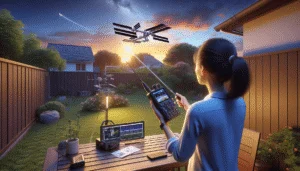
Yes, it actually works! With a simple handheld radio (e.g., Baofeng UV-5R or Kenwood TH-D72) and the included antenna, you can receive and work strong FM satellites like SO-50 and the ISS repeater during passes near zenith. Upgrading to a Nagoya NA-771 antenna significantly improves results.
Level 2: Portable Directional Antenna (Recommended for Beginners)
The Arrow II Antenna (ab 132 USD) is the most popular satellite antenna for beginners: a dual-band handheld Yagi with 3 elements for 2m and 7 elements for 70cm on a common boom. Light enough to manually track during a pass. With this antenna, most FM and many SSB satellites are easily reachable.
Level 3: Omnidirectional Fixed Station
Those who don’t want to chase the satellite with the antenna every time install an eggbeater antenna: circularly polarized, omnidirectional for overhead passes, without tracking. Two full-wave loops in quadrature create a hemispherical radiation pattern upward. Can be built for about 50 EUR per band as a DIY project.
Level 4: Complete Tracking Station
The ultimate setup: Yagi antennas on an azimuth/elevation rotor (e.g., Yaesu G-5500DC, approx. 800–1000 USD). Separate or cross-polarized Yagis for 2m and 70cm, controlled by software like SatPC32 or GPredict. This makes even weak satellites and SSB operation comfortable.
Frequencies and Operating Modes
Amateur radio satellites primarily use the 2-meter and 70-centimeter bands:
FM Transponders (Easiest Entry)
FM satellites operate as cross-band repeaters in space. Typically, transmission is on 2m and reception on 70cm (or vice versa). You need a dual-band handheld with full-duplex capability – or two separate radios. Important: For some satellites (e.g., SO-50), a CTCSS tone must be transmitted to activate the transponder.
Linear Transponders (SSB/CW)
Linear transponders translate an entire frequency band from uplink to downlink. Multiple QSOs can occur simultaneously – like on a regular band, just in space. Most are “inverting” (LSB in becomes USB out). The trick: If you tune the downlink to a station and keep it stable, the uplink automatically tunes correctly.
Receiving Telemetry
Even without a transmitting license, you can receive satellites! Many CubeSats transmit telemetry data (battery voltage, temperature, solar panel current) as BPSK or FSK signals. With an RTL-SDR and software like SatDump, FUNcube Dashboard, or FoxTelem, you can decode this data. The SatNOGS network even allows you to operate your own automated ground station and contribute telemetry data to the global database.
AMSAT: The Organization Behind It
Behind most amateur radio satellites is AMSAT (Radio Amateur Satellite Corporation), founded in 1969 in Washington D.C. There are national chapters worldwide:
- AMSAT-NA – The original organization. Builds the Fox series and the GOLF program, operates the Live OSCAR Satellite Status Page
- AMSAT-DL – The German chapter. Responsible for AO-40, the Bochum ground station, and the futureGEO project
- AMSAT-OE – The Austrian chapter, active in QO-100 operations and DXpeditions
- AMSAT-UK – The FUNcube project and excellent beginner guides
- AMSAT-EA – Spain, builds the HADES series (SO-124, SO-125)
How to Get Started
Getting started in satellite radio is easier than most people think. Here’s a concrete roadmap:
- Install a tracking app: Look4Sat or ISS Detector on your smartphone – you’ll immediately know when the next satellite passes over your location.
- Listen: With a handheld radio or RTL-SDR, receive the downlink frequency of an FM satellite (e.g., SO-50 on 436.795 MHz). You’ll hear QSOs!
- First contact: With a dual-band handheld, transmit on the uplink while simultaneously receiving the downlink. Brief exchanges – callsign, grid square, signal report – that’s it.
- Improve your antenna: Buy or build an Arrow II or comparable handheld Yagi. This makes even weaker satellites accessible.
- Join the community: Become a member of AMSAT-OE or AMSAT-DL, regularly visit the AMSAT Status Page, and report your own observations.
Conclusion
CubeSats have revolutionized satellite radio. From the 50-year-old AO-7 that simply refuses to die, through the new Spanish HADES satellites, to the geostationary QO-100 – the selection of amateur radio satellites has never been greater. And with the futureGEO project, a new era may be dawning.
The best part: you don’t need special equipment. A handheld radio and a free app are enough to start. When that first SSB signal from RS-44 comes through your speaker – a signal that has just traversed space – you’ll be hooked. Literally.
Useful Links
- AMSAT Live OSCAR Status – Real-time status of all amateur radio satellites
- AMSAT Two-Way Satellites – List of all satellites with transponders
- AMSAT-UK: Working FM satellites – Step-by-step guide
- AMSAT-UK: Working SSB satellites – For advanced users
- CelesTrak – TLE data for satellite tracking
- SatNOGS – Open network for satellite telemetry
- AMSAT-OE – AMSAT Austria
- AMSAT-DL – AMSAT Germany (futureGEO project)
73 – your oeradio.at editorial team
Transparency Notice
This article was researched and written with the assistance of AI (Claude, Anthropic). Any illustrations used were generated with AI (ChatGPT/DALL·E, OpenAI) unless otherwise noted. All facts have been verified to the best of our knowledge — for current technical details, we recommend consulting the linked original sources.