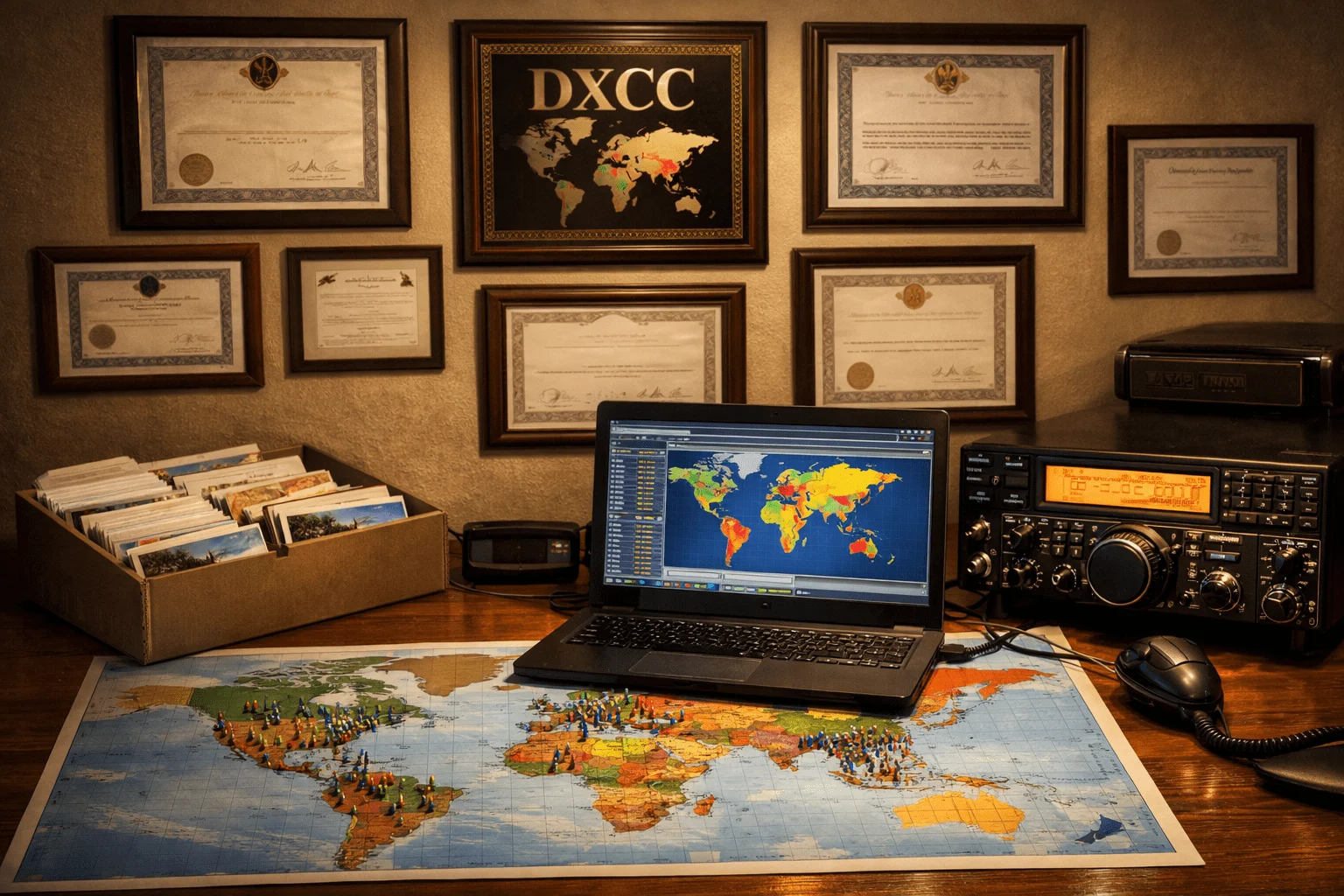
Introduction: The Fever for the Certificate
You just made your first DX QSO on 20 meters — Japan, with only 100 watts and a wire in the garden. Your heart is still pounding. You checked the log three times to make sure JA1XYZ is really there. And then you wonder: is there actually a certificate for that?
The answer is: Yes. And not just one. Amateur radio has a rich award system that has motivated radio amateurs around the world for almost 90 years. You collect countries, zones, prefixes, islands, states, cantons — basically anything that can be counted. It’s like a stamp album, except you worked each individual stamp yourself over the airwaves.
In this article, I’ll explain the major international awards, the Austrian awards, and everything you need to know as a beginner to start collecting. Don’t worry, you don’t need an antenna tower or a kilowatt amplifier. Just some patience and the willingness to occasionally get up at 6 a.m.
What are Amateur Radio Awards?
Amateur radio awards (also called “awards”) are certificates you receive for proven radio achievements. You worked 100 countries? There’s an award for that. All 40 CQ zones of the world? That too. All nine Austrian states? Absolutely.
The beautiful thing about it: awards give structure to the hobby. Instead of just calling CQ aimlessly, you suddenly have a mission. You specifically search for ZL (New Zealand) or VU (India) because you’re missing exactly those countries. It’s addictive — in the best sense.
The three major international awards that practically every DXer knows are DXCC (countries), WAZ (zones), and WPX (prefixes). Besides these, there are hundreds more — from island awards to continental awards to local awards like the Grossglockner Award. Let’s look at the most important ones in detail.
DXCC — The Classic Since 1937
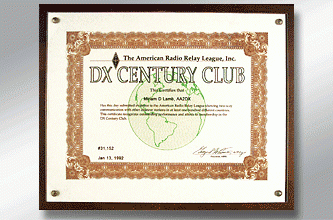
If there’s one award that defines amateur radio, it’s the DXCC — the DX Century Club Award from the ARRL. It was created in 1937, paused during World War II, and resumed in its current form on November 15, 1945. Since then, it has been the gold standard in DX operation.
The Basic Rule
You need confirmed contacts with at least 100 different DXCC entities from the current list of 340 active entities. A DXCC entity is not always a country in the political sense — it can also be a remote island, an overseas territory, or an area that qualifies as independent according to specific geographical and political criteria. For example, the Canary Islands (EA8) count as their own entity, even though they belong to Spain. Or Ceuta and Melilla (EA9) on the North African coast.
Endorsements and Special Classes
DXCC doesn’t stop at 100 entities. There are endorsements (confirmation levels) in various categories:
| Endorsement | Description |
|---|---|
| Mixed | Any modes and bands |
| CW | Morse code only |
| Phone | Voice modes only (SSB, AM, FM) |
| Digital | Digital modes only (FT8, RTTY, etc.) |
| Satellite | Via amateur radio satellites only |
| Single-Band | All 100 on a single band (e.g., 20m only) |
| 5-Band DXCC | 100 entities on each of the 5 classic bands (80, 40, 20, 15, 10m) |
| DXCC Challenge | 1,000 or more band-entity combinations |
| 10-Band DXCC (new 2025) | 100 entities on all 10 bands from 160m to 6m (excluding 60m) |
| DXCC Trident (new 2025) | 100 entities on Phone AND CW AND Digital — triple delivery |
The two new additions, 10-Band DXCC and DXCC Trident, were introduced by the ARRL in 2025. The Trident is particularly appealing: you must prove 100 entities on each of the three main modes (Phone, CW, Digital) — effectively achieving DXCC three times. Anyone who has that can rightfully hang a plaque on the wall.
Honor Roll — The Elite Class
You reach the DXCC Honor Roll when you’re missing at most 9 entities from the total number. With currently 340 entities, that means you need at least 331 confirmed. That’s already a life’s work. And then there’s the #1 Honor Roll — those are the truly dedicated who have confirmed all 340 entities. Hats off.
The Top 10 Most Wanted
Some entities are extremely difficult to work because they’re politically inaccessible, geographically remote, or simply dangerous. The current Most Wanted list has had P5 (North Korea) in first place for over ten years — there has simply never been licensed amateur radio activity there. Other perennial favorites include BS7H (Scarborough Reef), CE0X (San Felix), BV9P (Pratas Island), KH7K (Kure Island), KH3 (Johnston Island), and 3Y/B (Bouvet Island). Every time a DXpedition departs for one of these entities, the amateur radio world goes wild.
Costs and Confirmation Path
The cheapest method is via LoTW (Logbook of the World): a DXCC application costs 5 USD for ARRL members or 10 USD for non-members, plus 0.12 USD per QSO. Paper QSLs are considerably more expensive when you factor in postage and card costs.
For beginners: 100 entities sounds like a lot, but with FT8 and the current sunspot maximum, you can definitely achieve that in a year. On 20 meters alone, you can comfortably reach 80 to 100 entities from OE. And when 10 and 15 meters open up, new countries literally rain down. Believe me, it goes faster than you think.
All details: ARRL DXCC Award
WAZ — All 40 Zones of the World
The Worked All Zones Award (WAZ) from CQ magazine requires confirmed contacts with all 40 CQ zones of the world. Unlike DXCC, here you don’t count countries but geographical zones into which CQ magazine has divided the globe. Austria, by the way, is in CQ Zone 15 — together with Germany, Switzerland, and some other European countries.
40 zones sound doable? It is, except for a few stubborn ones. Zone 23 (Central Asia, Mongolia) is notoriously difficult to work, as are Zone 26 (Eastern Siberia) and Zone 34 (Central Africa). That requires some patience and the right propagation.
WAZ is available in Mixed, CW, SSB, and Digital categories. Particularly ambitious is 5-Band WAZ: here you must have all 40 zones confirmed on each of the five classic bands (80, 40, 20, 15, 10m) — that’s 200 confirmations. You can spend a few years on that.
The fee is about 5 USD plus LoTW costs (8 USD for the first 40 confirmations). Details and application forms can be found here: CQ WAZ Awards
WPX — The Hunt for Prefixes
The CQ WPX Award is the prefix award par excellence. Here you don’t count countries or zones, but different call sign prefixes. The prefix is everything up to and including the last digit in the call sign: K6, OE2, DL60, 9A800 — each counts as its own prefix.
Why is this exciting? Because there are virtually infinite prefixes, especially when special call signs are involved. During a major international event, suddenly DL60CHILD, 8J1RL, or HB2025 appear — all new prefixes for your collection. WPX is closely linked to the popular CQ WPX Contest, which annually brings thousands of stations to the bands and is a real prefix gold mine.
The entry threshold is 300 prefixes for CW or SSB and 400 for Mixed. For the WPX Honor Roll, you need at least 600 different prefixes. Sounds like a lot — it is, but it’s incredibly fun because you’re constantly finding new ones.
All rules: CQ WPX Award
WAS — All 50 US States
The Worked All States (WAS) from the ARRL requires confirmed contacts with all 50 US states. Sounds easy? It is — mostly. From Europe, you can reach most states without problems on 20 or 40 meters. But then you’re missing Wyoming, Montana, or North Dakota, and you realize: the sparsely populated states in the Midwest are real challenges.
Particularly noteworthy is Triple Play WAS (since 2009): all 50 states on CW, Phone, AND Digital — a total of 150 confirmed contacts, exclusively via LoTW. This is the modern variant that combines all three mode worlds.
All info: ARRL WAS Award
WAE — Work All Europe
The Worked All Europe (WAE) is an award from the DARC (Deutscher Amateur-Radio-Club) and is based on the WAE country list with currently 68 European entities. What’s special: the WAE list counts differently than the political map. Gibraltar, the Åland Islands, the Vatican — all separate WAE countries.
There are three classes:
- WAE III: 40 countries + 100 band points
- WAE II: 50 countries + 150 band points
- WAE I: 60 countries + 200 band points
Beyond that, there’s WAE-Top (70 countries, 300 band points) and the elite class, the WAE Trophy: all WAE countries on five bands with 365 band points. WAE is closely linked to the annual WAE DX Contest, which specifically highlights European stations.
Rules and country list: DARC WAE Award
IOTA — Islands of the World
If you love islands, you’ll love IOTA (Islands on the Air). This award program, managed by the British RSGB, catalogs about 1,200 island groups worldwide and assigns each a unique number: EU-047 is, for example, the Isle of Man, AF-001 the Canary Islands, OC-001 Australia as a continent-island.

You get the basic award for 100 confirmed island groups, with at least one from each continent. There are then levels for 200, 300, and more groups, as well as the IOTA Honour Roll for particularly dedicated island hunters. IOTA activations are a major driver for DXpeditions — some radio teams travel specifically to remote islands just to activate them for the program.
Website: Islands on the Air
DACH Neighbors: DARC and USKA Awards
A quick look over the fence is worthwhile. The DARC (Germany) offers, among others, the DLD (Deutscher Locator Diplom), where you must prove various Maidenhead locator fields in Germany. The USKA (Switzerland) has the legendary Helvetia 26 — all 26 Swiss cantons must be worked. Sounds harmless, but try finding a ham in Appenzell Innerrhoden who’s not currently on a mountain.
From OE, German and Swiss stations are naturally easy to reach, so grab these awards on the side. Proximity has its advantages.
QSO Confirmations: How to Prove Your Contacts
You only get an award if you can prove your QSOs. In the past, that meant: sending paper QSL cards back and forth and then presenting them to a checker. Today, fortunately, there are more elegant ways. Here’s an overview:
LoTW — Logbook of the World
The ARRL’s LoTW is the gold standard for QSO confirmations. You register, get a digital certificate via the TQSL software, upload your QSOs, and when the other station does the same, a “match” is automatically created — a mutual confirmation. LoTW is accepted for all ARRL awards (DXCC, WAS) and also by CQ for WAZ and WPX.
eQSL
eQSL.cc offers electronic QSL cards with pretty designs. Caution: eQSL is not accepted for ARRL awards (DXCC, WAS), but it is for CQ awards (WAZ, WPX). Many DXers use both systems in parallel.
QRZ.com Logbook
QRZ.com offers a free online logbook with basic QSO confirmation and LoTW import. For some beginners, it’s the easiest entry point, even though it’s not sufficient alone for major awards.
ClubLog OQRS
ClubLog is especially popular with DXpeditions. Via the OQRS system (Online QSL Request Service), you can directly request a QSL card from a DXpedition — via direct QSL or bureau. ClubLog also maintains the official DXCC Most Wanted list.
Paper QSL Cards
The good old paper QSL is still alive and well. There are two ways: via the QSL bureau (slow but cheap) or direct by mail (fast but expensive). For rare DX stations, a direct QSL with return envelope and dollars (yes, real dollar bills) is often the only way.
What’s Accepted Where?
| Confirmation Method | DXCC (ARRL) | WAZ/WPX (CQ) | IOTA |
|---|---|---|---|
| LoTW | Yes | Yes | No |
| eQSL | No | Yes | No |
| Paper QSL | Yes | Yes | Yes |
| ClubLog | No (tool only) | No (tool only) | Yes |
My tip: Set up LoTW. Yes, the registration process is a bit cumbersome with the digital certificates and TQSL software. But afterward, your QSOs confirm themselves almost automatically. Every time you upload your log and a match appears, it’s a little moment of joy. And you save yourself a mountain of paper QSL cards.
FT8: The Game-Changer for Award Hunters
There’s no avoiding it: FT8 has revolutionized award hunting. The digital mode developed by Joe Taylor (K1JT) and Steve Franke (K9AN) works at signal strengths down to -24 dB below the noise — meaning your counterpart hears you even though your signal is completely buried in the noise. About 40 percent of all HF QSOs now run via FT8.
What does this mean for you as a beginner? Simple: DXCC with 100 watts and a wire in the garden is absolutely realistic. In the past, you needed a proper antenna and lots of patience with CW or SSB. Today, a modest setup via FT8 reaches stations you never would have heard in SSB. This has democratized award hunting — suddenly even stations from third-floor apartments can seriously compete.
Of course, there’s also criticism: “The computer is talking to the computer, that’s not real radio anymore.” You’ll hear this phrase in every local club. And yes, a 73-second exchange of call signs and signal reports is not the same as a nice conversation about the weather on SSB. But as a tool for award hunting, FT8 is unbeatable. You can still do CW anyway — the morse key doesn’t rust.
Practical Tips for Beginners
You’re convinced and want to get started? Here are my recommendations for getting into award hunting from OE:
- Start collecting immediately. Every QSO counts — even the boring one with the DL from the neighboring locator. You never know which QSO you’ll need for an award someday.
- Set up LoTW. Preferably today. The sooner you start, the more confirmations will accumulate automatically.
- Use a good logging program. Wavelog (free, web-based), Log4OM, or Logger32 show you in real-time which entities you’re still missing.
- Set realistic expectations. From OE, 50 to 100 DXCC entities in the first year is realistic. If you’re active and participate in contests, even more.
- Know your bands. 20 meters always works — it’s the workhorse for DX. During the current sunspot maximum, 15 and 10 meters are a real gold mine. 40 meters is excellent in the evening toward North America. And 80 meters brings surprisingly much in winter.
- Contests are gold mines. During a single CQ WW Contest weekend, you can work more new entities than in an entire normal month. The IARU HF Contest, the WAE contests, and CQ WPX are also excellent for award hunters.
- Join the local club. The experienced OMs there have tips that aren’t in any book. And it’s incredibly motivating when you tell each other about new countries.
- Upload your log to LoTW regularly. Once a week is enough. The more often you upload, the faster the matches come. Nothing is more annoying than a QSO you made months ago but never uploaded.
Conclusion: Your Path to the First Award
The world of amateur radio awards is huge, and there’s something for every taste. Whether you collect countries, chase islands, check off cantons, or operate from mountain summits — there’s always a next goal. And that’s exactly what makes it appealing.
You don’t need a tower or an amplifier. What you need is curiosity, a bit of patience, and the willingness to occasionally get up at 6 a.m. because gray-line propagation is calling to Oceania. And maybe the occasional free afternoon when another CQ WW Contest is running.
Just start. You already have your Japan QSO on 20 meters. Only 99 more entities, and you’ll hold your first DXCC in your hands. And I promise you: it won’t be your last award.
73 and good DX from OE!
Sources and Further Links
- ARRL DXCC Award — Rules, fees, entity list
- DXCC Endorsements — All categories and special classes
- DXCC Trident Award — The new triple-mode award (2025)
- ARRL WAS Award — Worked All States including Triple Play
- CQ WAZ Awards — Worked All Zones rules and application
- CQ WPX Award — Worked All Prefixes
- DARC WAE Award — Worked All Europe
- IOTA — Islands on the Air — RSGB island program
- Logbook of the World (LoTW) — Digital QSO confirmation
- eQSL.cc — Electronic QSL cards
- ClubLog — Logbook analysis and OQRS
- ClubLog Most Wanted — Current DXCC Most Wanted list
Transparency Notice
This article was researched and written with the assistance of artificial intelligence (AI). All facts, rules, and fee information have been taken to the best of our knowledge from the official sources of the respective organizations (ARRL, CQ, DARC, RSGB). Since rules and fees may change, it is recommended to check the current conditions on the linked websites before applying for an award.