Table of Contents
- What's Inside? The Software in Detail
- Digital Modes
- Winlink & Email by Radio
- Packet Radio & APRS
- SDR & Aircraft Tracking
- Maps & Navigation
- The Modular System: QRV Modules
- The Concept: Simplicity Beats Complexity
- Plug & Play with Digirig Mobile
- Emergency Communications: Operational in Three Minutes
- Comparison: arcOS vs. Other Ham Radio Distributions
- System Requirements
- Current Version: Xanadu (22.2)
- Who Is arcOS For?
- Try It Out
- Videos
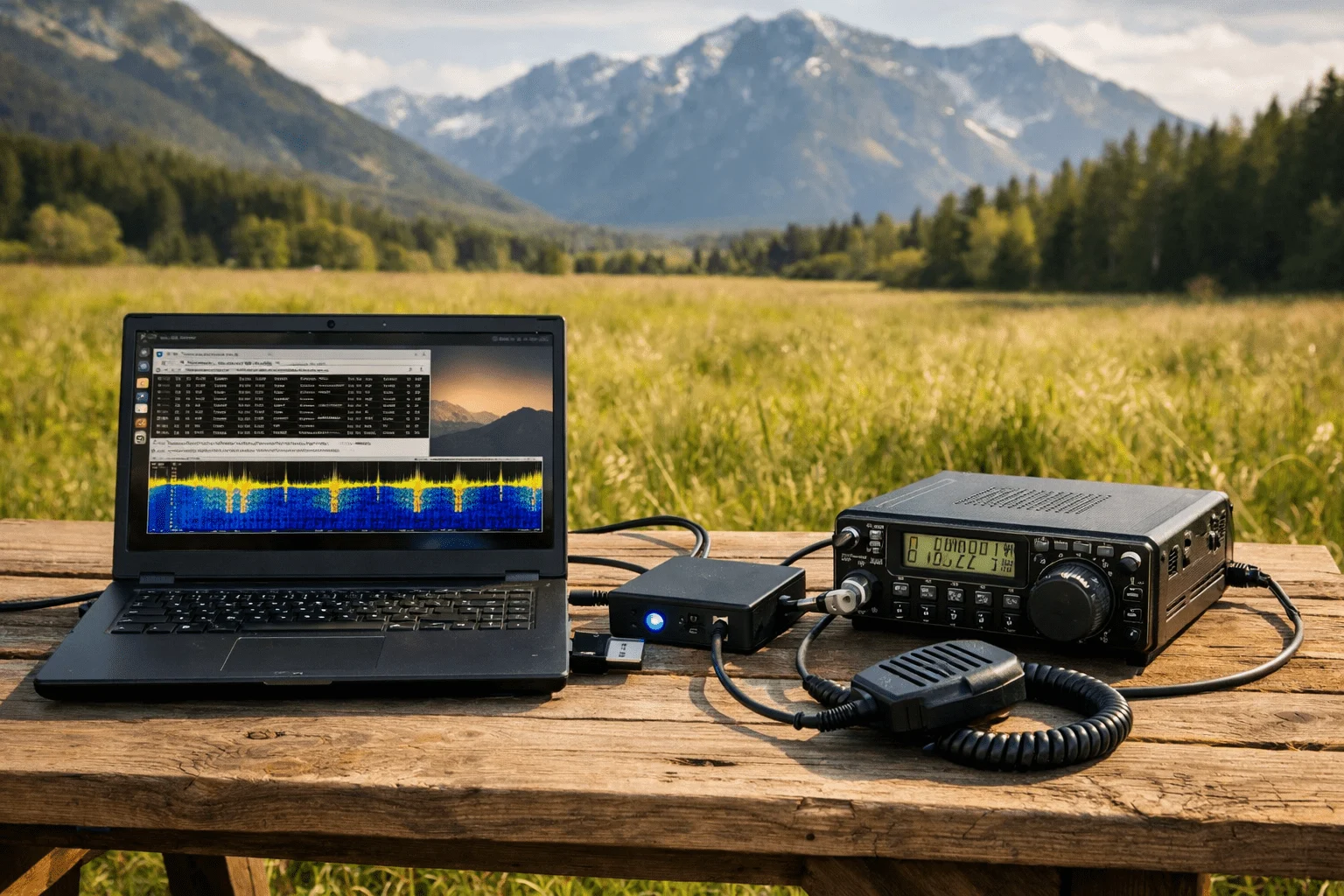
USB stick in, boot the laptop, connect the radio – done. What sounds like a pipe dream is reality with arcOS. The Amateur Radio Community Operating System is a Linux distribution developed specifically for amateur radio. No driver hunting, no hours of configuration, no “it doesn’t work on my machine”. Just turn on and operate.
arcOS is based on Linux Mint 22.1 “Xia” with the Cinnamon desktop and boots as a live system directly from USB. Nothing needs to be installed – the system runs entirely from the stick. The free space on the USB stick is automatically used as a persistent partition called “arcHIVE” (exFAT) – where configurations, log files and personal data are stored and survive reboots. You can also test arcOS in a virtual machine, boot it from a Ventoy USB, or run it entirely in RAM.
What’s Inside? The Software in Detail
arcOS comes with a carefully curated selection of amateur radio software that works right away. No bloat, no 200 programs you’ll never use. Instead, exactly the tools that matter for everyday operation and emergency communications – preconfigured and coordinated.
Digital Modes
- Fldigi – The classic for digital modes. PSK31, RTTY, Olivia, MFSK, Thor, Contestia and many more. Anyone wanting to communicate digitally on HF can’t avoid Fldigi. Also included: FLAMP (Amateur Multicast Protocol) for file transfer over radio and FLARQ for error-corrected point-to-point transfers – together the NBEMS package (Narrow Band Emergency Messaging System) for emergency communications.
- JS8Call – Keyboard-to-keyboard communication on weak signals. Based on the FT8 protocol but allows real conversations – even when the signal barely emerges from the noise. In arcOS, JS8Call is configured by default for automatic heartbeat and query responses – so the system responds even when you’re away from the screen.
- WSJT-X – FT8, FT4, JT65, JT9, WSPR and more. The standard for weak-signal communication. Around the world with just a few watts – WSJT-X has been doing this reliably for years. Never tried FT8? arcOS is the easiest way to get started.
Winlink & Email by Radio
Winlink is amateur radio’s email system – send and receive messages completely without internet. In disaster situations, often the only way to communicate with the outside world. arcOS includes everything needed:
- Pat – A modern, cross-platform Winlink client with web interface. Compose, send and receive emails – via HF, VHF or UHF. Pat supports Telnet, ARDOP, VARA and AX.25 as transport methods. Essential for emergency communications.
- VARA – The fast HF modem for Winlink. Significantly higher transfer rates than ARDOP. In arcOS from version Xanadu, directly activatable in the station setup. The full version costs $49.99 per callsign – but when booting without persistent storage, VARA is automatically unlocked, ideal for testing.
- ARDOP – The proven, free HF modem for Winlink. If no Digirig is available, ARDOP automatically uses the computer’s speaker and microphone as fallback – handy for quick tests.
Packet Radio & APRS
- Direwolf – Software TNC for Packet Radio and APRS. Completely replaces traditional hardware TNCs and runs stable with the Digirig interface. Direwolf turns the computer into a full AX.25 node.
- APRS – Position reports, short messages and telemetry via radio. With an optional GPS receiver (e.g., u-blox7 VK-162 or VK-172), your position is automatically transmitted. Ready to use in arcOS – gpsd handles the connection.
SDR & Aircraft Tracking
Since version “Foxtrot” (21.3), arcOS includes SDR software (Software Defined Radio) directly in the ISO. And through community modules, even more can be added:
- ADS-B Tracker – With the community module dump1090-fa/piaware, the computer becomes an aircraft tracking station. Simply connect an RTL-SDR stick and watch flight movements in your area live. Not directly amateur radio, but fascinating for any radio enthusiast.
- Kiwix – Offline Wikipedia and other reference works, completely without internet. Ideal for field days, portable operations or emergency situations where no network is available. Knowledge when you need it.
Maps & Navigation
arcOS includes Viking as GPS mapping tool with OpenStreetMap maps and offline map support – essential for portable operation without internet. In the Xanadu version, the offline map hierarchy was completely redesigned.
The Modular System: QRV Modules
A concept that sets arcOS apart from other distributions: QRV Modules. These are extension packages that can be installed as needed – either from the CORE repository (officially maintained) or from the COMMUNITY area (user-developed).
Each user has their own QRV directory, organized by callsign. Configurations are saved there – via right-click on the app launcher and “SAVE CONFIG”. On next boot, saved settings are automatically loaded. System updates don’t affect your personal settings.
Best of all: modules can even be shared over the air. Anyone with a specific configuration or community module can transmit it directly to other stations – e.g., via FLAMP or Winlink. In an emergency communications situation, this can be decisive.
The Concept: Simplicity Beats Complexity
Behind arcOS is Mike Fisher, KG4VDK – a radio amateur who also deals with Linux and motorcycles (a man of taste, then). His philosophy: digital communication in amateur radio should be accessible to everyone – regardless of license class or experience. That’s why arcOS is intentionally lean. No 50 programs getting in each other’s way, but a clean, coordinated selection.
arcOS isn’t meant as a replacement for a full desktop system. It’s a tool. Plug in the USB stick when you want to operate – and take it out afterwards. This has a major advantage: if something goes wrong, just reboot. The system resets to its original state. No broken configurations, no orphaned packages, no Linux frustration. You can’t break anything – and that’s exactly the point.
Plug & Play with Digirig Mobile
arcOS was specifically optimized for the Digirig Mobile interface – a small, affordable USB sound card interface connecting radio to computer. PTT, audio in, audio out – all through one cable. No SignaLink, no CAT cable chaos, no driver headaches.
The Digirig costs around $50 USD and works with a long list of transceivers – from Baofeng to Yaesu FT-817/818, Icom and Kenwood. Connect Digirig, boot arcOS – and the configuration is ready. Anyone who has ever had to set up a virtual COM port under Windows knows how to appreciate this difference.
Radios with built-in sound cards are also supported – you’re not strictly dependent on the Digirig. But the out-of-the-box experience is best with it.
arcOS also optionally supports a GPS receiver for APRS and position data. Just plug in a gpsd-compatible USB GPS stick – the rest happens automatically.
Emergency Communications: Operational in Three Minutes
One of arcOS’s great strengths lies in emergency communications (EmComm). A complete digital radio station can be operational in under three minutes – including Winlink, APRS and Packet Radio. No other system makes this so easy.
This makes arcOS particularly interesting for:
- Emergency communications groups that need standardized stations
- Radio clubs conducting EmComm exercises
- Disaster relief organizations that need to respond quickly
Mike Fisher even developed a dedicated Amateur Radio Challenge Course module – a training environment where groups can practice working with digital modes. Installation in under three minutes, immediately ready. Perfect for field days and club evenings.
And thanks to Kiwix, you still have access to technical references and encyclopedias even when the internet has long been down.
Comparison: arcOS vs. Other Ham Radio Distributions
arcOS isn’t the only Linux distribution for radio amateurs. How does it compare?
- Andy’s Ham Radio Linux (AHRL) – Based on Xubuntu with a huge amount of software: Fldigi, WSJT-X, JS8Call, GNU Radio, Gpredict, xnec2c, SDRangel and much more. Even runs on 10-year-old machines with 2 GB RAM. AHRL is the “everything included” solution – great for experienced users, potentially overwhelming for beginners.
- DigiPi – Developed specifically for the Raspberry Pi. Turns the Pi into an APRS/Winlink hotspot controlled from your phone via WiFi. Perfect for portable operations with minimal hardware – but limited to the Pi.
- HamPi – Also for the Raspberry Pi, with a large software selection. More of a classic desktop system on the Pi.
- arcOS – The middle ground: focused, portable, immediately operational. Boots on any x86_64 computer, optimized for a specific interface (Digirig), intentionally lean. No Pi needed, no installed system needed. Power on and operate.
Want maximum software selection? Go with AHRL. Want a Pi hotspot? Take DigiPi. Looking for a portable, immediately working solution for digital modes? That’s arcOS.
System Requirements
arcOS runs on most x86_64 computers with Intel or AMD processors. Hardware requirements are modest:
- 64-bit processor (Intel or AMD)
- 8 GB RAM (16 GB recommended for RAM-only boot)
- USB stick with at least 16 GB (USB 3.0 recommended – tested with Samsung BAR Plus and Samsung FIT Plus)
- Display, keyboard, network and audio must be supported by the Linux kernel
- Optional: Digirig Mobile Interface, GPS receiver, RTL-SDR stick
Not supported: ARM processors (Raspberry Pi) and Apple Silicon Macs (M1/M2/M3/M4). Pi users need to look at DigiPi or HamPi.
Current Version: Xanadu (22.2)
The latest version arcOS 22.2 “Xanadu” (November 2025) brings numerous improvements:
- VARA can be activated/deactivated directly in the station setup
- VARA now available for RAM/ISO/Ventoy boot sessions
- Pat configuration for VARA HF via Digirig works reliably
- Integrated manual as Markdown (keyboard shortcut F1)
- Redesigned offline map hierarchy
- Viking default map switched to OSM Mapnik
- QRV Report as new CORE module
- Improved offline support for Winlink standard forms
- Bugfixes in FLAMP and JS8Call info fields
The ISO is about 4.5 GB and available for download on SourceForge.
Who Is arcOS For?
- Beginners who want to try digital modes without fighting through Linux configuration
- Emergency communications groups that need a standardized, immediately ready solution
- Portable operators who want to be on the move with just a USB stick and laptop
- Clubs and local chapters wanting to offer their members an easy entry into digital modes
- Everyone who simply wants to try FT8, Winlink or JS8Call – without sacrificing three evenings for installation
Try It Out
arcOS is free and open source (GPL-3.0). Simply download the ISO from SourceForge, write it to a USB stick with Balena Etcher or Rufus – and boot. Nothing to install, nothing to configure, nothing to break. When you pull the stick out, your computer is exactly as it was before.
If you know Linux Mint, you’ll find your way around immediately. If you don’t know Linux – that’s exactly who arcOS is made for.
Support is available via GitHub Discussions and IRC on Libera.chat in channel #arcOS-Linux.
For an in-depth experience report, check out the podcast Linux in the Ham Shack, Episode 597 which covers arcOS in detail – from installation to philosophy to software. Highly recommended.
Videos
Sources & Links
- arcOS – Official Website
- arcOS – Documentation (RTFM)
- arcOS on SourceForge (Download)
- arcOS QRV Modules on GitHub
- arcOS Community Discussions on GitHub
- KG4VDK – Developer Blog
- KG4VDK – YouTube Channel
- Digirig Mobile Interface
- Linux in the Ham Shack – Episode 597: arcOS Deep Dive
- LinuxLinks – arcOS Review
- DistroWatch – arcOS
73 de Michael, OE8YML