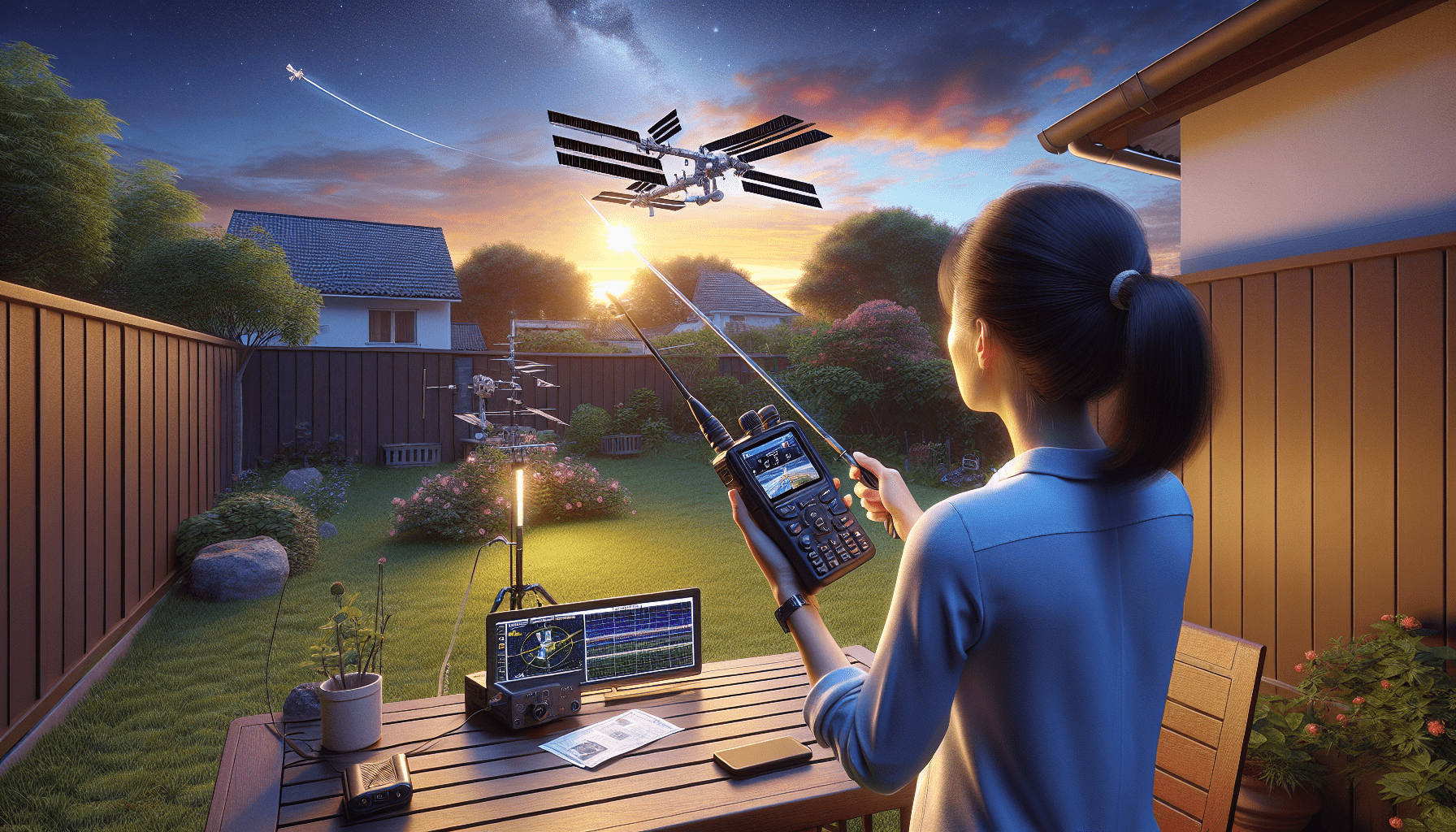
Who wouldn’t want to make contact with an astronaut orbiting Earth at 28,000 km/h? The International Space Station ISS makes exactly that possible – and you probably already have the equipment for it in your shack. For over two decades, the ISS has been not only a scientific laboratory in orbit but also a flying amateur radio station with the callsigns NA1SS, OR4ISS, and RS0ISS. Thanks to the ARISS (Amateur Radio on the International Space Station) initiative, radio amateurs worldwide can make direct contact with the crew – or at least receive and decode the station’s signals.
The appeal is obvious: with comparatively simple technology, you bridge the gap between Earth and space. Whether you’re in Vienna, Graz, or a small village in the Mühlviertel – when the ISS flies over Austria, you have about ten minutes to receive its signals or even be heard. And the best part: you don’t even need a license to receive, just a scanner or a 2m handheld and a simple antenna.
In this article, we’ll show you step by step how to receive the ISS, which frequencies are relevant, when the station flies over Austria, and how to maximize your chances of a real QSO with an astronaut. We’ll also take a look at APRS digipeaters in space, school contacts, and the technical details of the amateur radio equipment on board.
What is ARISS and why does the ISS operate amateur radio at all?
Amateur Radio on the International Space Station (ARISS) is an international project supported by amateur radio organizations from the USA, Russia, Europe, Canada, and Japan. Since 2000 – shortly after the first permanent stay of astronauts on the ISS – there have been functioning amateur radio stations in various modules of the station. The purpose is multifaceted: education and public outreach are at the forefront, but the crew also occasionally uses the equipment for personal QSOs during their free time.
Particularly spectacular are the school contacts, where students can speak live with astronauts. These contacts are organized by ARISS and planned months in advance. Austrian schools have had several such events in the past, coordinated through the ÖVSV and ARISS Europe. The enthusiasm among young people is enormous every time – and not infrequently, such a contact leads to lasting interest in amateur radio.
But even outside these organized events, licensed radio amateurs worldwide can try to reach the ISS. Whether this works depends heavily on the crew’s current schedule – and whether someone has the desire and time to get on the microphone.
The most important ISS frequencies
The ISS operates mainly in the 2m band (VHF) and the 70cm band (UHF). Depending on the operating mode and module, different frequencies are active. Here are the most important frequencies you should know (as of 2026):
Voice contacts (FM)
- Downlink: 145.800 MHz (2m) – this is where the ISS transmits
- Uplink: 144.490 MHz (2m) – this is where you send your calls
These frequencies are used for voice QSOs, both during school contacts and spontaneous connections with the crew. Operation is in FM (frequency modulation), the same modulation type you use on terrestrial repeaters. The ISS operates here in simplex mode with split frequencies – so you receive on a different frequency than you transmit.
APRS digipeater
- Downlink: 145.825 MHz
- Uplink: 145.825 MHz (same frequency, simplex)
The ISS occasionally operates an APRS digipeater (Automatic Packet Reporting System) that receives data packets from ground stations and retransmits them. This enables the distribution of position data, short messages, and telemetry data via the station. This mode is particularly interesting because it works fully automatically and requires no crew involvement. The digipeater doesn’t run continuously, but when it’s active, you can route your own APRS packet via the ISS – a special achievement!
Packet Radio and SSTV
Occasionally, the ISS also transmits Slow Scan Television (SSTV) on 145.800 MHz. These transmissions are usually time-limited and announced in advance on the ARISS website. With a simple 2m receiver and an SSTV decoder app (e.g., Robot36 for Android or MMSSTV for Windows), you can receive images from space – they often show the crew, experiments, or views of Earth.
You can always find a current overview of frequencies and operating modes on the official ARISS page and in bulletins from the ÖVSV.
When does the ISS fly over Austria?
The ISS orbits Earth approximately every 90 minutes on a trajectory with an inclination of about 51.6 degrees. This means it regularly flies over Central Europe – though not on every orbit. The exact flyover times change daily and depend on your location.
To find out when the ISS is visible (and workable) at your location, there are several useful tools:
- Heavens-Above (www.heavens-above.com) – free website and app with precise predictions for your location
- ISS Detector (Android/iOS) – user-friendly app with push notifications before flyovers
- Gpredict (Linux/Windows/Mac) – open-source software for satellite tracking, ideal for ambitious operators
- AMSAT websites – lists of current Keplerian Elements (TLE data) for precise tracking
For successful reception, the ISS should be at least 10 degrees above the horizon – 30 degrees or more is better. The maximum elevation (highest point in the sky) determines how long you can hear the station: during a pass with 80-degree elevation, you have up to ten minutes; with low passes, only a few minutes.
Important: Your best chances for a voice contact are during passes over densely populated areas during European evening hours – that’s when the crew is often awake and might have time for the radio. School contacts usually take place in the morning.
Equipment: What do you need for ISS reception?
The great thing about ISS operation is that you can get started with minimal equipment. For reception only (without a transmitting license), the following setup is sufficient:
Minimum configuration for reception
- Receiver: Any 2m-capable handheld (e.g., Baofeng UV-5R from about 25 EUR, better: Yaesu FT-60 about 200 EUR) or a wideband scanner
- Antenna: The supplied rubber duck antenna already works, better is a 1/4-lambda groundplane or a simple Yagi antenna (3-5 elements, from about 50 EUR)
- Tracking software: Smartphone app for predicting flyover times
With this setup, you can listen to voice transmissions, receive SSTV images, or decode APRS packets. Reception often works even indoors – however, a clear view of the sky without tall buildings or mountains in the direction of the pass is ideal.
Recommended setup for QSO attempts
If you want to try reaching the ISS yourself (you need a valid amateur radio license for this!), you should invest a bit more:
- Transceiver: A modern 2m handheld with 5 watts transmit power (e.g., Yaesu FT-70D about 180 EUR, Icom ID-52 about 400 EUR) or a mobile unit with 50 watts (e.g., Yaesu FTM-300D about 450 EUR)
- Antenna: A directional antenna makes the difference – a 7-element Yagi for 2m (about 80-120 EUR) or a crossed Yagi (circular polarization) significantly increases your chances of success
- Antenna rotator: Optional but helpful – to track the antenna during the pass (simple models from about 150 EUR, e.g., Yaesu G-5500)
- Doppler compensation: Modern transceivers (e.g., Kenwood TM-D710 or Icom IC-9700) can automatically compensate for Doppler shift
The Doppler shift is quite noticeable with the ISS: due to the high speed, the receive frequency shifts by several kHz during the pass. As it approaches, the frequency is higher; as it recedes, lower. Many modern radios can correct this automatically; otherwise, you must tune manually – good training for the ear!
Step by step: How to receive the ISS
Let’s get practical. Here’s a simple guide for your first ISS reception:
- Determine flyover time: Use one of the mentioned apps or websites to find out when the ISS next flies over your location with good elevation. Note the start, maximum elevation, and end of the pass.
- Set frequency: Program 145.800 MHz into your radio (FM mode, no CTCSS tones). Set the squelch so it opens on weak signals.
- Take position: Go outside or to a window with a clear view in the direction of the pass. Hold your antenna as vertical as possible (vertical polarization).
- Listen: You should be ready to receive about one minute before the predicted start. Often you’ll first hear faint noise, then the signal gets stronger. During voice contacts, you may hear other stations calling the ISS, or – with some luck – an astronaut’s reply.
- Adjust frequency: Due to Doppler shift, it may be necessary to adjust the frequency slightly during the pass (usually ±3 kHz).
The first time, you’ll probably mainly hear the characteristic noise and crackling caused by the constantly changing signal strength. You may also hear other stations trying to reach the ISS. A real QSO with the crew is rare – but possible!
APRS via the ISS: Digital radio in space
The ISS APRS digipeater offers a particularly fascinating possibility. APRS (Automatic Packet Reporting System) is a digital protocol widely used in amateur radio – mainly for transmitting GPS position data, weather data, and short messages.
The ISS receives APRS packets on 145.825 MHz and retransmits them on the same frequency. The digipeater’s callsign is ARISS. Since the station flies very fast and covers large areas, your packets can be received by stations hundreds of kilometers away – true long-distance communication in the 2m band!
How APRS via the ISS works
- Hardware: You need an APRS-capable device (e.g., Kenwood TM-D710, Yaesu FTM-400, or a homebrew tracker with TinyTrak or an Arduino-based system) or a computer with a sound card interface and software like Dire Wolf or UI-View.
- Configuration: Set the frequency to 145.825 MHz and configure the digipeater path to ARISS or RS0ISS. Send your position packet just before the ISS is overhead – the station receives it and retransmits it.
- Timing: Since the ISS is only overhead for a few minutes, you have only a narrow time window. Send your packet about every 2 minutes, but no more often (to avoid overloading the digipeater).
- Verification: On aprs.fi or other APRS tracking sites, you can check whether your packet was received via ISS – a great moment when your callsign suddenly appears on the map with the comment “via ARISS”!
APRS operation via the ISS requires some practice but is very rewarding. Some Austrian OMs have already sent hundreds of successful packets via the station and collect these successes like QSL cards.
QSO with the crew: Realistic or wishful thinking?
The honest answer: A spontaneous QSO with an astronaut is rare, but not impossible. The crew has an extremely full schedule with scientific experiments, maintenance work, and press conferences. Amateur radio is a hobby they pursue in their scarce free time – and not all astronauts are even licensed radio amateurs.
Nevertheless, there are always periods when individual crew members are active. In recent years, for example, cosmonauts Sergei Ryazansky (callsign R4SKY) and astronaut Shannon Walker (KD5DXB) were very active. When someone at the station sits down and calls CQ, a pile-up can quickly develop – dozens of stations calling simultaneously, and only the strongest signals get through.
Tips for a successful QSO
- Timing: Watch for announcements in ARISS mailing lists or on www.ariss.org. Sometimes there are hints about when a crew member will be active.
- Short and concise: If you get the chance, call with your callsign and location: “NA1SS this is OE3XYZ in Vienna, over.” Keep the QSO short – many others are waiting too.
- Good antenna: With a handheld and a rubber duck antenna, you’ll hardly get through. A Yagi antenna with at least 5 elements is almost mandatory.
- Uplink power: 50 watts is significantly better than 5 watts. Many successful QSOs have been made with mobile units and directional antennas.
- Correct frequency: Uplink 144.490 MHz, downlink 145.800 MHz – set both frequencies in your radio (cross-band operation).
Some OMs have tried for years and finally experienced their personal highlight: a 30-second QSO with the ISS. Even if it doesn’t work out, the attempt itself is exciting – and you’ll hear many other stations along the way and improve your skills in VHF satellite operation.
School contacts and public events
A great way to experience the ISS live is through ARISS school contacts. An astronaut speaks via radio with students who may ask pre-selected questions. These events are public and often live-streamed – so you can listen even if you’re not present on-site.
Several such school contacts have already been conducted in Austria, organized by the ÖVSV in cooperation with ARISS Europe. Schools can apply for such events – selection is highly competitive as hundreds of schools worldwide are interested, but only a few dates are available.
If a school contact takes place near you, it’s worth stopping by or at least listening on the designated frequency. The children’s enthusiasm is infectious, and the astronauts’ answers are often exciting and humorous.
Technical details: The ISS radio equipment
The amateur radio equipment aboard the ISS has evolved over the years. Currently (as of 2026), there are several stations in different modules:
- Columbus Module (ESA): This houses the main station with Ericsson handhelds, later supplemented by more modern Kenwood units. This station is primarily used for school contacts.
- Zvezda Module (Russia): The Russian section has its own radios, often Kenwood mobile units (e.g., TM-D710 or TM-V71) with external antennas.
- Packet radio station: A dedicated system for APRS and packet radio, consisting of an Ericsson handheld and a packet controller.
The antennas are mounted externally on the station and must withstand extreme conditions: temperatures from -150 to +150 degrees Celsius, micrometeoroids, and intense UV radiation. Despite this, the systems have functioned reliably for years.
Transmit power is about 10-25 watts – not particularly much, but due to the station’s altitude (about 400 km) and the free line of sight, the signals are strong enough on the ground for good reception.
SSTV events: Images from space
A special highlight is the ISS SSTV transmissions. Several times a year – often on special occasions such as the anniversary of the first manned spaceflight or ISS anniversaries – the station transmits images in Slow Scan Television format on 145.800 MHz.
SSTV is an analog image transmission technique where a still image is transmitted in about 2-3 minutes. You hear characteristic tones and whistles – these are the encoded image information. With appropriate software, you can decode these tones and see the image on your screen.
How to receive SSTV from the ISS
- Install software: Download an SSTV decoder app. For Android, Robot36 is suitable; for Windows, MMSSTV is very popular; Mac users use MultiScan.
- Wait for flyover time: SSTV events usually last several days, and the ISS transmits continuously in a loop. Find a good pass during the event period.
- Route audio to device: Hold your smartphone to the radio or connect the transceiver’s audio output to your computer’s sound card.
- Start reception: As soon as you hear the SSTV tones, the software automatically starts decoding. After about 2-3 minutes, you’ll have a complete image – often showing the crew, experiments, or views of Earth from the cupola windows.
SSTV images from the ISS are a wonderful souvenir and are often shared in amateur radio forums and on social media. Many operators collect these images and proudly display them in their shack.
Conclusion: The ISS – an accessible adventure
Amateur radio with the International Space Station is one of the most fascinating aspects of our hobby. With simple means, you can receive signals from space, decode digital data, or even make personal contact with an astronaut. The ISS shows that amateur radio is far more than an earthbound hobby – it’s a bridge between people, continents, and even space.
Whether you’re a beginner just starting with 2m or an experienced operator looking for a new challenge – the ISS offers something for everyone. Start simple: listen to a pass, decode an APRS packet, receive an SSTV image. Each of these experiences is special and will leave a lasting impression.
And who knows – maybe one day you’ll be among the lucky ones who have their callsign logged in the ISS logbook. Until then: Keep your antennas pointed skyward and your radios ready!
73 – your oeradio.at team
Transparency Notice
This article was researched and written with the assistance of AI (Claude, Anthropic). The editorial team has reviewed and edited all content. Despite careful review, occasional inaccuracies may occur — we welcome corrections via email to [email protected].
