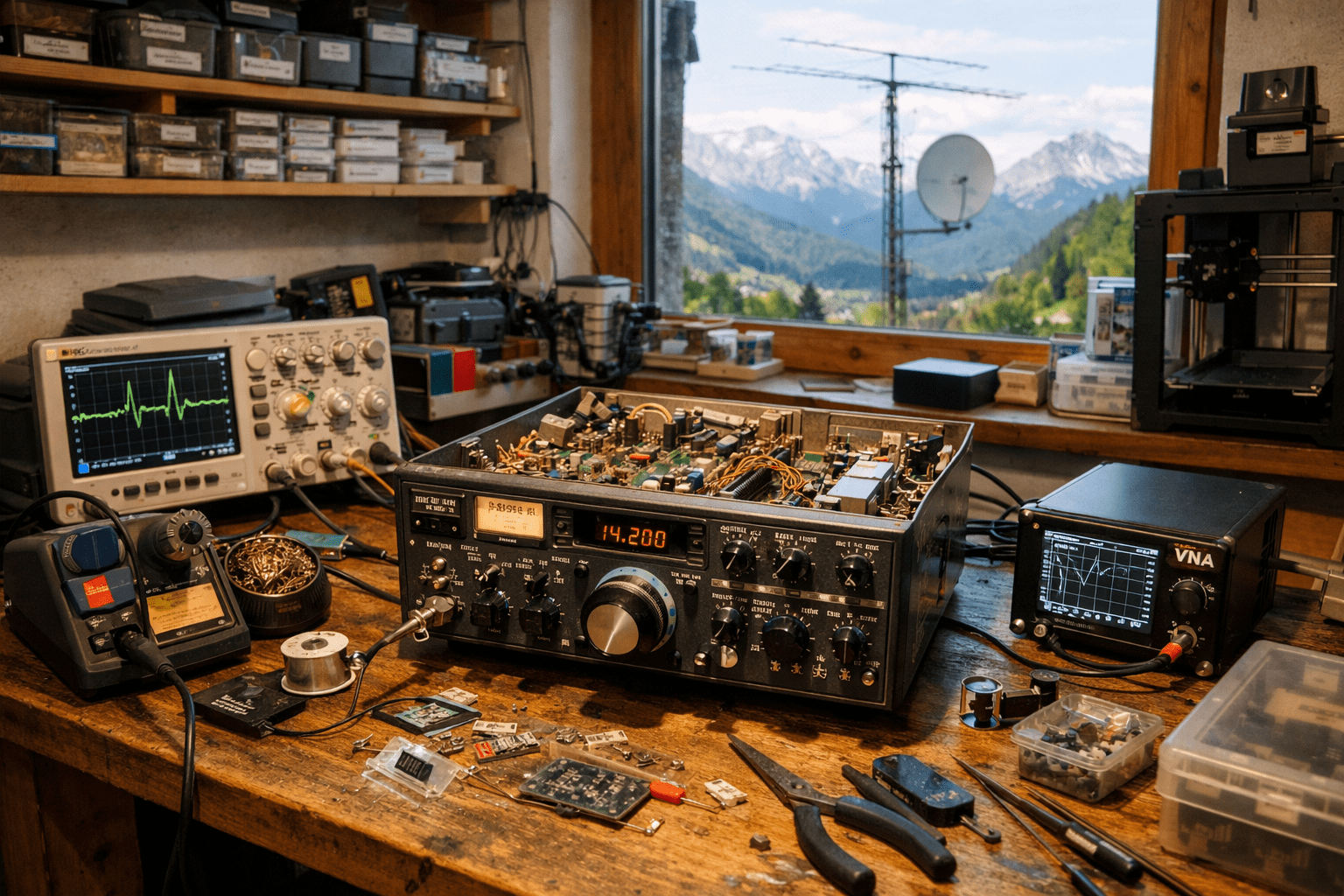
There are radio amateurs who operate. And there are radio amateurs who build, measure, solder, mill, program, repair – and then document it all properly. Karl from Tretram, OE8JHK, clearly belongs to the second category.
Auf seiner Seite wiki.echtcool.net Karl collects his projects – from a church tower clock to a satellite station, from a chicken coop to an SWR measurement bridge. And anyone who clicks through will quickly notice: this isn’t just tinkering, this is done properly. With test equipment, datasheets and the necessary respect for physics.
He who measures, measures rubbish – as the saying goes. With Karl, that’s exceptionally not the case.
Radio: From repairs to satellites
Karl has been licensed since 1987, was inactive for a long time and started again in 2022 – properly. New antennas on the roof, an end-fed 10-80m with 49:1 ferrite transformer, cable lengths measured via VNA and TDR, 80mm wall feedthrough with PVC conduit. No makeshift solutions, done right.
He also repairs classic radios: an ICOM IC-240, a Yaesu FT-767 (multi-year project), an FT-757 and an ICOM IC-781. Anyone who has ever opened up a 30-year-old radio knows: it’s no walk in the park. But Karl doesn’t just repair his own equipment – if you have a sick transceiver, he’s the right person to talk to. You can learn a lot from him.
SWR measurement bridge with ESP32
Conventional SWR meters are quite inaccurate at low power levels. Karl’s solution: an AD8307 logarithmic amplifier (0.1–500 MHz), a 16-bit ADS1115 ADC, an ESP32 with web server and MQTT – and a Nextion touch display on top. Measurement data is sent via MQTT to a broker, SWR displayed in real time. Really well thought out.
Transmitter location via TDOA
Multiple receiving stations with GPS synchronisation, Raspberry Pi, ESP32 and ICOM IC-9700 receive the FM carrier of a transmitter. The time difference of the signals is evaluated via triangulation – server with SQL database, ASP.NET Core API, REST interface. Locating transmitters the technically clean way.
QO-100 satellite station
A complete QO-100 station: Bullseye LNB with PLL-TCXO for reception, helix antenna with 100W PA for uplink on 2.4 GHz, 95cm dish, CI-V Bluetooth interface for controlling IC-7300 and IC-9700. Plus 3D-printed weather protection parts. From reception to transmission, everything self-built.
Morse key – completely self-built
Because Karl also wanted to build something purely mechanical: a classic Morse key, designed from scratch. Multiple prototypes, documented with photos and videos. Some people buy one on Amazon – Karl builds one in his workshop.
Not just radio: DIY on all channels
What makes the site special: Karl doesn’t just build radio gear. The range is impressive.
Church tower clock
Die örtliche Kirche hatte ein Zifferblatt ohne Zeiger. Karls Reaktion: selber bauen. CNC-gefräste Zahnräder aus Sperrholz, Schrittmotoren für Stunden- und Minutenzeiger, ESP32-Steuerung mit DCF77, GPS und NTP-Synchronisation, Webinterface zur Fernsteuerung. Eine Church tower clock. Selbst gebaut. Respekt.
ChickenGate
An automatic chicken door with ESP32, OLED display, light and temperature sensors, automatic door based on sunrise and sunset, web server for remote control and HomeMatic integration. Version 2.0 is even portable. IoT in the chicken coop – the chickens probably have better WiFi than some neighbours.
LoRa data link (Roofmatic)
Eight DHT22 sensors on an ESP32 with SX1276 LoRa module, binary packet transmission on 868 MHz with spreading factor 12, receiver with MQTT bridge, MySQL database and Pushover notifications. Tested at 7.5 km range. Battery operation for 4–6 months.
And even more…
Solar system with weather data logging, lightning detection station in Köttmannsdorf, six different multicopter projects (2011–2017), a propeller balancing machine, a virtual pinball, a Schnapsomat (indispensable for calibration after measuring), smart home – the list goes on. Everything documented, everything reproducible.
Worth a look
Besides all these projects, Karl is also regularly QRV on the OE8XNK repeater and happy to help out. If you have a question about one of his projects or just want to talk shop – just call in.
Karl’s wiki is not a polished showcase – it’s an honest workshop documentation. Photos of the build process, schematics, measurements, mistakes and solutions. Exactly what you need when you want to build something yourself. No marketing, no fluff – just projects that work.
73 de Michael, OE8YML