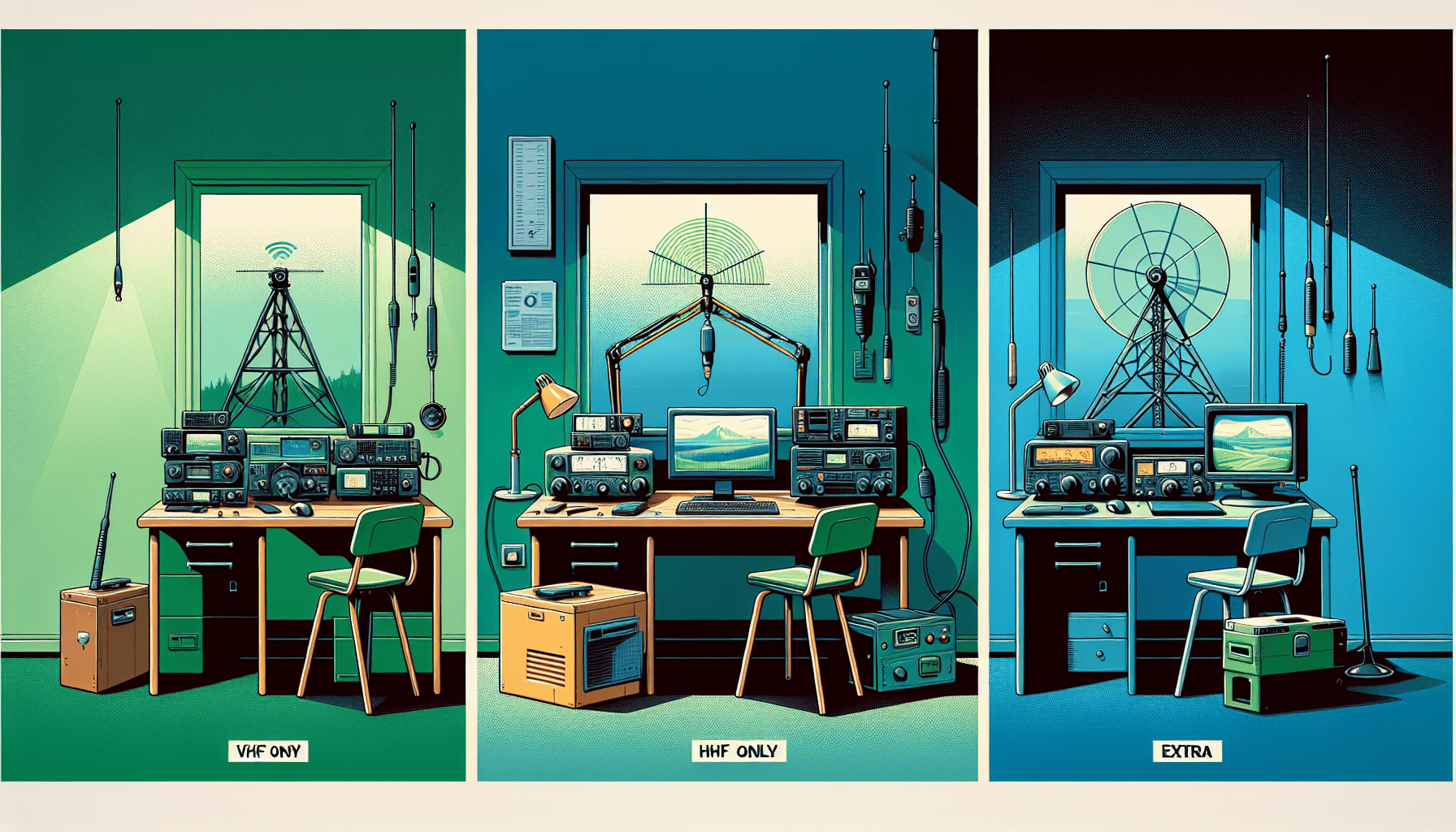
Getting started in amateur radio in Austria begins with an important decision: which license class should you choose? The Austrian system has three authorization classes — Class 1, Class 3 and Class 4. Each offers different options in terms of frequencies, transmit power and international recognition. This article explains the differences and helps you make your choice.
Overview of the Austrian License System
In Austria, the Amateur Radio Ordinance (AFV) together with Annex 4 of the Frequency Usage Ordinance (FNV) regulate access to the amateur radio service. The telecommunications authority issues the amateur radio authorization after passing the exam. The three exam categories differ in scope and each cover three subject areas:
- Legal regulations (full in all classes)
- Technical fundamentals (full in Class 1, simplified in Classes 3 and 4)
- Operating procedures and skills (full in Classes 1 and 4, simplified in Class 3)
The exam fee is 71 euros per exam category, with a 21 euro certificate fee. Exams are held several times a year — since 1 January 2020, you can register at any exam location regardless of your place of residence.
Class 3 — The National Entry-Level License
Class 3 is the simplest and most accessible license class. It offers a quick entry into amateur radio but is limited to local VHF/UHF operation.
Frequencies and Power
- 2 m (144–146 MHz)
- 70 cm (430–440 MHz)
- Maximum transmit power: 100 watts PEP (power level A)
- No access to shortwave, 6 m or microwave bands
- Higher power levels are not available
Exam (Exam Category 3)
- Legal regulations — full
- Technical fundamentals — simplified
- Operating procedures — simplified
This is the easiest of all three exams and ideal for anyone who wants to get on the air quickly.
Important Restrictions
- Valid only in Austria — no international recognition (no CEPT, no CEPT Novice)
- Self-building and modification of transmitters is not permitted — only commercially available, unmodified equipment
- At a club station under the supervision of a Class 1 holder, you may practice on additional frequencies
Upgrade Path
From Class 3 to Class 4: supplementary exam in operating procedures (full scope). From Class 3 directly to Class 1: supplementary exam in operating procedures and technical fundamentals (both full scope).
Class 4 — CEPT Novice License
Class 4 corresponds to the European CEPT Novice License (ECC/REC 05-06). It offers significantly more possibilities than Class 3 — in particular, access to six bands including shortwave.
Frequencies and Power
- 160 m (1,810–1,950 kHz)
- 80 m (3,500–3,800 kHz)
- 15 m (21,000–21,450 kHz)
- 10 m (28,000–29,700 kHz)
- 2 m (144–146 MHz)
- 70 cm (430–440 MHz)
- Maximum transmit power: 100 watts PEP (power level A)
- Higher power levels are not available
Important: No access to 40 m, 20 m, 17 m, 12 m, 30 m, 6 m or 23 cm. This means some of the most popular DX bands are not available.
Exam (Exam Category 4)
- Legal regulations — full
- Technical fundamentals — simplified
- Operating procedures — full
The difference from Class 3: operating procedures are tested in full scope (including international operating practices, Q codes, phonetic alphabet). In return, you receive international recognition.
International Recognition
Class 4 is recognized in all CEPT countries that have implemented the Novice recommendation. You may operate in these countries under their applicable Novice conditions — without a guest license.
Restrictions
- Self-building and modification of transmitters is not permitted
- No higher power levels available
Upgrade Path
From Class 4 to Class 1: supplementary exam in technical fundamentals (full scope). This is the usual and recommended upgrade path.
Class 1 — CEPT Full License (HAREC)
Class 1 is the highest Austrian license class and corresponds to the international HAREC standard (Harmonised Amateur Radio Examination Certificate) as per CEPT Recommendation T/R 61-02. It provides unrestricted access to all amateur radio bands.
Frequencies
Class 1 permits operation on all amateur radio bands authorized in Austria:
- Shortwave: 160 m, 80 m, 60 m, 40 m, 30 m, 20 m, 17 m, 15 m, 12 m, 10 m
- VHF: 6 m (50–54 MHz), 2 m (144–146 MHz)
- UHF: 70 cm (430–440 MHz), 23 cm (1,240–1,300 MHz)
- Microwave: 13 cm, 9 cm, 6 cm, 3 cm and higher
Power Levels
A key advantage of Class 1 is access to higher transmit power through the power level system:
| Power Level | Max. Power (PEP) | Requirement |
|---|---|---|
| A | 100 W | Default power after passing the exam |
| B | 200 W | Application to the telecommunications authority |
| C | 400 W | 1 year of interference-free operation at level B at the station location |
| D (High Power) | 1,000 W | 1 year of interference-free operation at level B; available since March 2023 on selected HF bands; 6.54 euros/month |
High Power (power level D) has been available since the FNV amendment of 13 March 2023 on the 80 m, 40 m, 20 m, 17 m, 15 m, 12 m and 10 m bands. Classes 3 and 4 only have access to power level A.
Exam (Exam Category 1)
- Legal regulations — full
- Technical fundamentals — full
- Operating procedures and skills — full
The Class 1 exam is the most comprehensive and covers advanced electrical engineering, RF engineering, circuit design, antenna technology, wave propagation, measurement techniques and EMC.
Special Privileges
- Self-building and modification of transmitters is permitted
- CEPT license: Operate in over 40 countries worldwide without a guest license
- Access to all power levels (A through D)
- Operation of all modes on all bands
Comparison Table
| Class 3 | Class 4 | Class 1 | |
|---|---|---|---|
| Bands | 2 m, 70 cm | 160 m, 80 m, 15 m, 10 m, 2 m, 70 cm | All bands |
| Max. Power | 100 W (level A) | 100 W (level A) | 100–1,000 W (levels A–D) |
| Self-build | No | No | Yes |
| International | No (Austria only) | CEPT Novice | CEPT HAREC (worldwide) |
| Technical Exam | Simplified | Simplified | Full |
| Operating Exam | Simplified | Full | Full |
| Exam Fee | 71 euros | 71 euros | 71 euros |
Changes from the FNV Amendment 2023
On 13 March 2023, an important amendment to the Frequency Usage Ordinance came into force (Federal Law Gazette II No. 63/2023), which significantly enhanced the amateur radio spectrum in Austria:
- High Power (1 kW): Class 1 holders can apply for up to 1,000 W PEP on selected HF bands
- 40 m band: 7,100–7,200 kHz — power restriction lifted, amateur radio now has primary status
- 160 m band: 1,810–1,850 kHz now primary status (max. 200 W); extension to 1,850–2,000 kHz
- 6 m band: Extended to 50–54 MHz (temporary until 31 December 2030)
- 70 cm band: High Power for EME and meteor scatter with directional antennas possible
- 23 cm band: Severely restricted to only 10 W (was up to 200 W)
- UHF/Microwave: Max. 200 W now permitted (was 100 W), except 10 GHz
Which Class Is Right for Me?
Class 3 is ideal if you …
- … want to get on the air quickly and easily
- … are mainly interested in local radio operations (FM repeaters, DMR, D-Star, C4FM)
- … want to try out amateur radio before diving deeper
- … are a young person looking for a gentle introduction
Class 4 is ideal if you …
- … also want to operate on shortwave (DX on 80 m, 15 m, 10 m)
- … want to operate in other European countries (CEPT Novice)
- … are looking for a good balance between effort and possibilities
- … want to upgrade to Class 1 later — then only the full technical exam is needed
Class 1 is ideal if you …
- … want to use all frequencies (40 m, 20 m, 17 m, 12 m — the best DX bands!)
- … want to operate worldwide and participate in contests
- … need higher transmit power (up to 1 kW with High Power)
- … want to build or modify your own transmitters
- … want to engage deeply with radio technology
- … aim directly for the highest class
Upgrading Between Classes
The Austrian system is flexible — you can take a supplementary exam at any time:
- Class 3 to Class 4: Supplementary exam in operating procedures (full)
- Class 4 to Class 1: Supplementary exam in technical fundamentals (full)
- Class 3 to Class 1: Supplementary exam in operating procedures + technical fundamentals (both full)
Previously passed exam components are credited.
Recommendation
If you have the time and motivation, start directly with Class 1. The CEPT full license offers the greatest possibilities, is recognized worldwide and gives you access to the most important DX bands (20 m and 40 m), which are not available with Classes 3 and 4.
If the Class 1 exam seems too extensive, Class 4 is an excellent compromise: you get six bands including shortwave and international recognition. The later upgrade to Class 1 then only requires the full technical exam.
Class 3 is suitable for everyone who wants to get on the air as quickly as possible and focus initially on local VHF/UHF operation.
Frequently Asked Questions
Do I need Morse code skills? No, since 2003 Morse code skills have not been mandatory for any license class. However, CW is a popular mode that many learn voluntarily.
Is there an age limit? No, there is no minimum age for the amateur radio exam in Austria.
Can I use repeaters with Class 3? Yes, all VHF/UHF repeaters in Austria operate on 2 m or 70 cm and are accessible with Class 3.
How long does preparation take? For Class 3, often just a few weeks; for Class 4, a few more weeks (due to full operating procedures); for Class 1, several months. OVSV courses help with preparation.
What does the license cost in total? Exam: 71 euros + certificate: 21 euros + annual frequency usage fee. OVSV membership (optional but recommended): approx. 65 euros/year.
Further Links
- OVSV — Austrian Amateur Radio Society
- Telecommunications Office — Amateur Radio Exams
- Telecommunications Office — High Power Information
- RIS — Amateur Radio Ordinance (current version)
- OVSV — FNV Band Plan (PDF)
- Amateur Radio Exam in Austria 2026 — The Complete Guide
- Amateur Radio as a Hobby — What to Expect?
73 — your oeradio.at editorial team
Transparency Notice
This article was researched and written with the assistance of AI (Claude, Anthropic). The information on license classes is based on the current Amateur Radio Ordinance (AFV) and the Frequency Usage Ordinance (FNV) Annex 4, as of March 2023. All content has been reviewed by the oeradio.at editorial team.
