
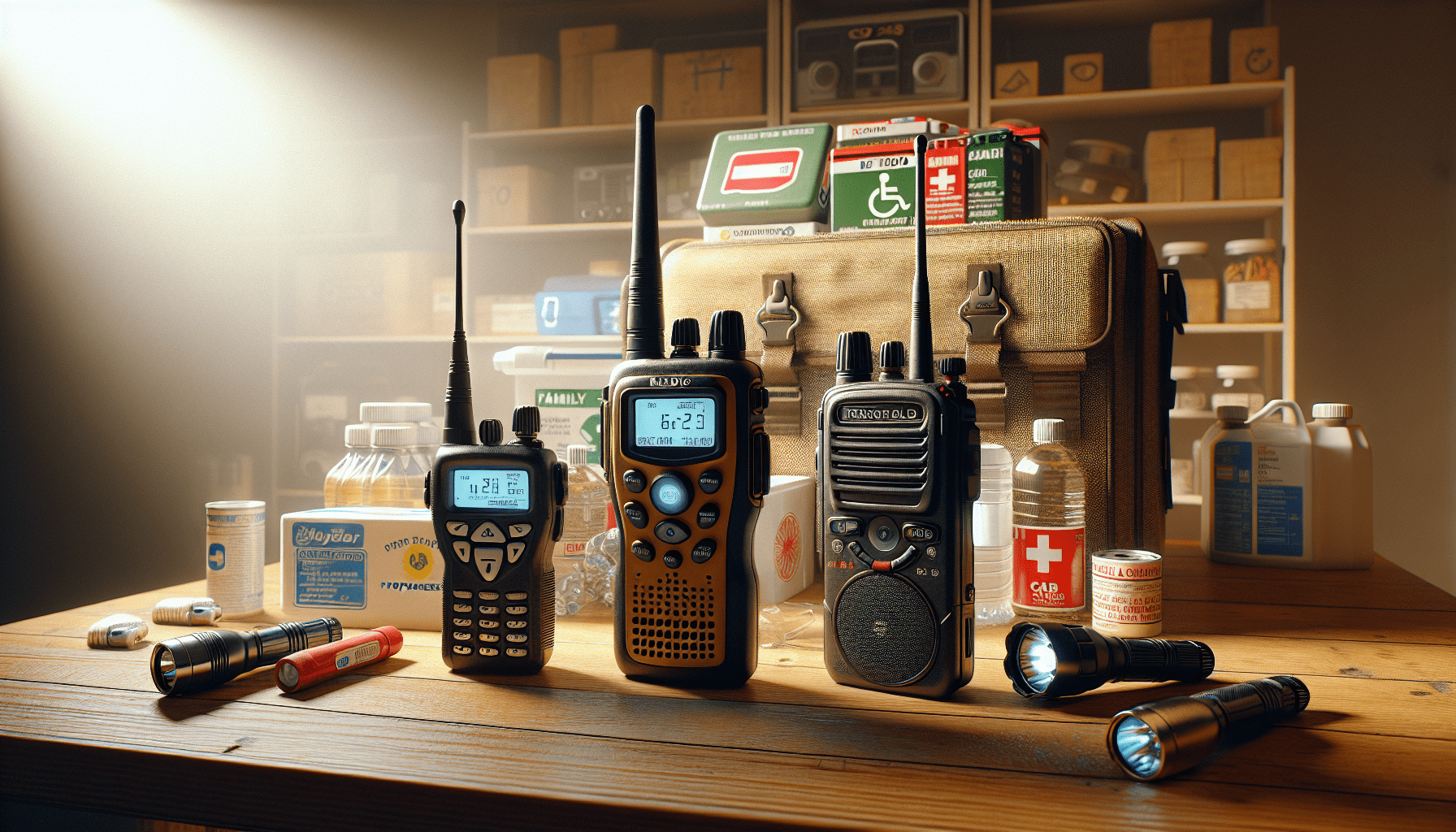
Not everyone has an amateur radio licence – and that’s perfectly fine. Yet there are situations where radio communication is practical, useful, or even life-saving: on a hike in the mountains, skiing with the family, organising events, at the campsite, in a convoy on the motorway – or in an emergency when the mobile phone network goes down. That’s exactly what licence-free radio is for: PMR446 and CB radio, available to everyone without a licence.
This article is for anyone interested in radio – whether licensed or not. We introduce the two most important licence-free radio services in Austria, explain the technical basics, show typical use cases, and give concrete equipment recommendations.
PMR446: Small, affordable, and always with you
PMR446 (Private Mobile Radio on 446 MHz) is the most widely used licence-free radio service in Europe. The small handheld radios fit in any jacket pocket and are available from as little as 20 euros for a twin pack. No registration, no exam, no fees – unbox, switch on, start talking.
How PMR446 works
PMR operates in the UHF band at 446 MHz and offers 16 analogue and 16 digital channels. The maximum transmit power is 0.5 watts ERP – enough for local communication, but not for long-range contacts. The radios use FM modulation and usually support CTCSS/DCS codes (often marketed as “subcodes” or “privacy codes”), which allow groups on the same channel to be acoustically separated. Important: this is not encryption – anyone on the channel can listen in.
Since 2018, PMR devices may also have detachable antennas – an improvement over the previously mandated fixed antennas. The frequencies range from 446.00625 MHz (channel 1) to 446.19375 MHz (channel 16 digital), with 12.5 kHz channel spacing for analogue and 6.25 kHz for digital.
Range: expectation vs. reality
The packaging promises “up to 10 km range” – in practice, it looks like this:
- In the city: 500 metres to 2 kilometres – buildings, vegetation, and obstacles quickly absorb the UHF signal.
- In open terrain: 3 to 5 kilometres with good line of sight.
- In the mountains: With line of sight between two summits, 8 to 10 kilometres is quite possible – alpine topography can help or hinder.
- Inside buildings: Concrete walls cause significant attenuation, but 2–3 floors are usually no problem.
Typical use cases
PMR446 is more versatile than you might think:
- Hiking and mountaineering: When the group splits up, you stay in touch via PMR – even where there’s no mobile phone coverage. Especially in Austria’s mountains, there are still many dead zones.
- Skiing: On the slopes, it’s the perfect communication tool for families. Children and parents can coordinate without burning through expensive phone tariffs.
- Camping and outdoors: From the tent to the washroom, from the pitch to the lake – PMR makes it possible.
- Events: Village fairs, sporting events, club activities – PMR is affordable and simple for coordinating volunteers.
- Construction sites and agriculture: Quick coordination between tractor and farmhouse, between excavator and foreman.
- Neighbourhood communication: In rural areas or housing estates, PMR can be a simple alternative to the telephone.
- Emergency preparedness: When mobile networks fail (blackout, natural disaster), PMR is immediately ready – no network needed, no infrastructure required.
Equipment recommendations
The PMR market has something for every budget:
- Entry level (20–40 €): Motorola TLKR T80, Retevis RT628 – solid basic radios, often sold in twin packs.
- Mid-range (60–90 €): Midland G9 Pro, Kenwood PKT-23E – more robust build, better audio quality, longer battery life.
- Professional (100–160 €): Hytera PD365 (digital), Motorola XT420 – waterproof, durable, professional features.
Tip for emergency preparedness: Look for radios with an AA battery adapter. Rechargeable batteries are convenient for everyday use, but when the power is out for days, standard batteries are worth their weight in gold.
CB radio: The classic with greater range
CB radio (Citizen Band) is the veteran among licence-free radio services. In the 1970s and 1980s, it was a genuine subculture – with its own language, its own codes, and a vibrant community. Today CB has become quieter, but it’s far from dead. On the contrary: for certain applications, CB is clearly superior to the more modern PMR.
How CB radio works
CB operates on the 11-metre band around 27 MHz – in the shortwave range. In Europe, 40 channels are available, with a maximum transmit power of 4 watts AM or 12 watts PEP on SSB (single sideband). FM operation is also permitted.
Important channels:
- Channel 9 (27.065 MHz): International emergency channel – should be kept clear.
- Channel 19 (27.185 MHz): The classic trucker channel, often busy.
- Channels 1–8, 10–18, 20–40: For general communication, used differently by region.
The big advantage: range
This is where CB shows its strengths. The longer wavelength of about 11 metres has tangible advantages over PMR’s UHF signal:
- Better penetration: Shortwave signals penetrate buildings, vegetation, and terrain obstacles better than UHF.
- Greater ground wave range: With a good antenna, 10 to 20 kilometres via ground wave is realistic.
- Skip propagation possible: Under favourable atmospheric conditions (sporadic E layer), the CB signal can suddenly travel hundreds or even thousands of kilometres – a fascinating natural phenomenon!
In practice, this means: where PMR gives up after 2 kilometres, CB keeps going easily. Especially in rural areas, in Austria’s valleys, or for convoys on the motorway, CB remains the first choice.
Typical use cases
- Vehicle convoys: Whether a motorhome trip, classic car rally, or motorcycle tour – CB in the car is a classic. A magnetic mount antenna on the roof, a small mobile unit on the dashboard, and the entire convoy is connected.
- Agriculture and forestry: On large areas where PMR no longer reaches, CB plays out its range advantage.
- Truck drivers and professional drivers: Even in 2026, many truck drivers use CB on channel 9 or 19 – for traffic reports, warnings, and a chat on long hauls.
- Outdoor and expeditions: On multi-day tours, hunting parties, or alpine operations, CB offers more reserve than PMR.
- Emergency communication: Channel 9 is the international emergency channel – in a crisis, a real option for reaching help.
- Hobby and nostalgia: CB has a loyal fan base. Many enjoy the uncomplicated exchanges on the band, without the formalities of an amateur radio licence.
Equipment and antennas
CB equipment falls into three categories:
- Handheld radios (70–120 €): Albrecht AE 31H, Midland Alan 42 DS – compact, with built-in antenna, ideal for on the go. Range is limited with the short antenna, but still better than PMR.
- Mobile radios (90–200 €): President Bill II, Albrecht AE 6110, Midland Alan 48 Plus – for installation in vehicles. With a good magnetic mount antenna on the roof, you achieve the full CB range.
- Base station use: With a ground plane antenna (e.g. Sirio Performer 5000, from approx. 40 €) on the roof or balcony and a 12 V power supply, the mobile radio becomes a base station.
Tip: With CB radio, the antenna makes the difference. Invest in a good antenna rather than an expensive radio – a decent antenna doubles the range of an affordable transceiver.
Legal framework in Austria
Both PMR446 and CB radio are completely licence-free and registration-free in Austria. The legal basis is the Frequency Usage Regulation, which is based on European CEPT regulations.
What is permitted:
- Use of approved devices with CE marking
- Private and commercial use (e.g. on construction sites, at events)
- Operation without a callsign – but you may use a nickname or “handle”
What is not permitted:
- Modifications, power increases, or use of unauthorised frequencies
- Interference with other radio services
- Use of devices without CE marking
PMR or CB – which is the better fit?
The choice depends on the intended use:
- For short distances and simplicity: PMR446. Small, light, affordable, incredibly easy to use.
- For greater range: CB radio. Wherever PMR reaches its limits.
- For families and leisure: PMR – the radios are so simple that even children can use them.
- For vehicles and convoys: CB – with a magnetic mount antenna, the best choice.
- For emergency preparedness: Ideally both. PMR for local communication, CB for greater distances.
Comparison at a glance
- Frequency: PMR 446 MHz (UHF) | CB 27 MHz (shortwave)
- Power: PMR 0.5 W | CB 4 W AM / 12 W SSB
- Range: PMR 0.5–5 km | CB 5–20 km
- Channels: PMR 16+16 | CB 40
- Entry cost: PMR from 20 € | CB from 70 €
- Portability: PMR very high | CB medium (handheld) to low (mobile)
- Licence required: No | No
Licence-free radio and amateur radio: no contradiction
Those who start with PMR or CB may discover a fascination with radio – and eventually want more. Amateur radio offers far more possibilities with its licence: higher transmit power, more frequency bands, worldwide contacts, experiments with antennas and operating modes, digital modes like WSPR or DMR, and an active community. Many of today’s radio amateurs started with CB radio!
But the reverse is also true: as a radio amateur, it’s worth having a few PMR radios in the shack. For the family, for unlicensed friends, for the hiking group, or for emergencies. Licence-free radio and amateur radio are not competitors – they complement each other perfectly.
Tips for getting started
- Buy a PMR twin pack – starting from 20 euros. Simply try it out on a hike or on holiday.
- Agree on a channel and subcode – so you can find each other within the group and aren’t disturbed by others.
- Speak briefly and clearly – press the button, wait briefly, then speak. Say your name, your message, done. No endless monologues.
- Pack spare batteries – anyone heading into the mountains should bring spare batteries.
- CB for the more adventurous – if you want more, move up to CB. Magnetic mount antenna on the car, mobile unit inside, and your range multiplies.
- Find a community – listen in on CB channel 9 or 19, find local radio groups, share experiences. Radio is all about community!
Conclusion
PMR446 and CB radio are vibrant, practical, and completely legal means of communication that anyone can use without a licence. Whether hiking, skiing, on the construction site, in a convoy, or for emergency preparedness – licence-free radio is more useful than most people think. And anyone who has experienced the thrill of staying in touch with their family via radio on a mountain tour while their mobile phone shows “no signal” will understand why radio still has its place in the age of the smartphone.
73 – your oeradio.at editorial team
Transparency Notice
This article was researched and written with the support of AI (Claude, Anthropic). The editorial team has reviewed and edited all content. Despite careful review, occasional inaccuracies may occur — we welcome feedback and corrections by email to [email protected].
