Introduction
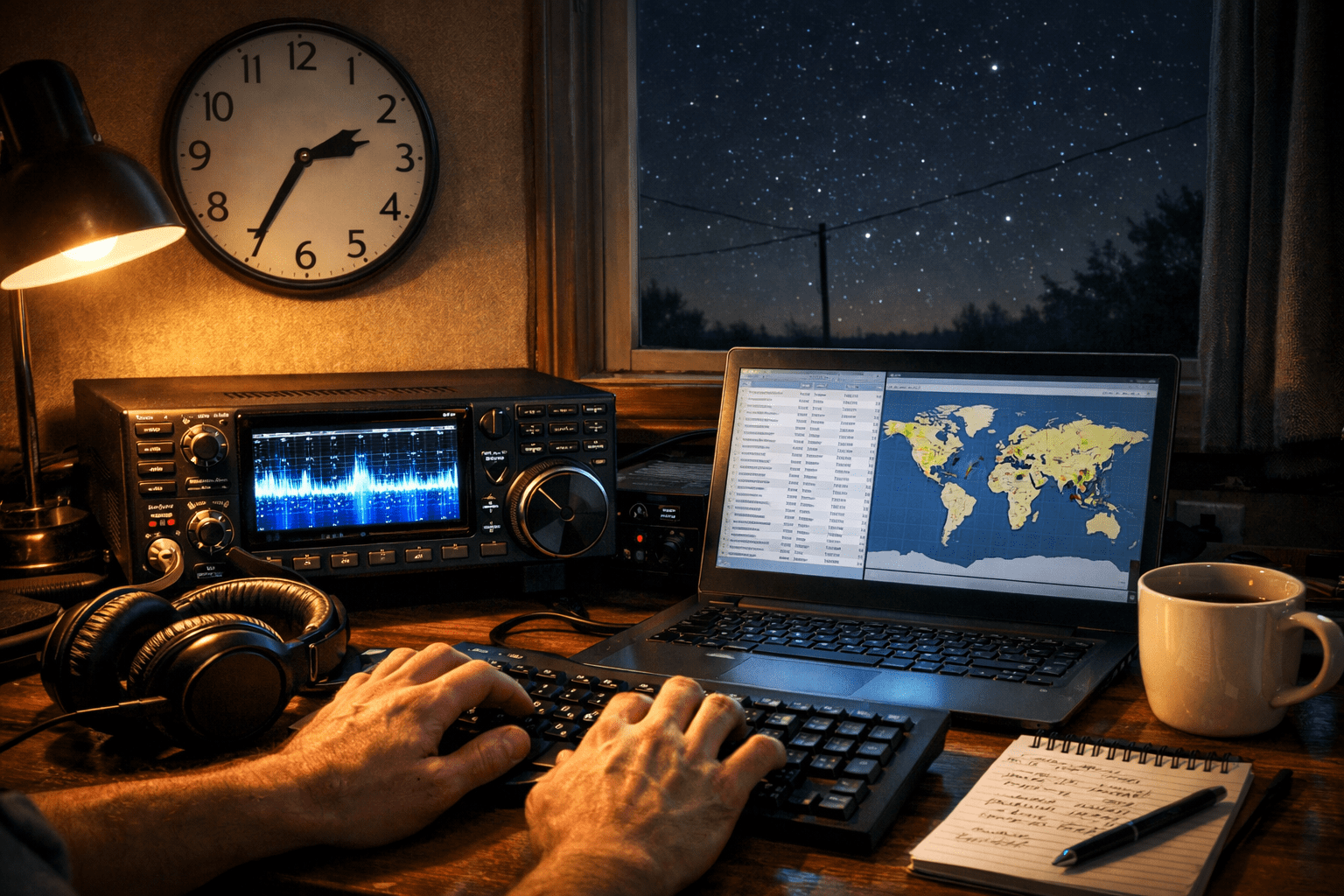
You’re sitting in the shack, turning the VFO, and suddenly on 14 MHz you hear a tangle of callsigns, lightning-fast exchanges, and cryptic numbers. “CQ Contest, CQ Contest, OE2S, Oscar Echo Two Sierra.” Then someone answers, a few numbers are exchanged, and after six seconds the QSO is over. Welcome to the world of amateur radio contests.
If until now you’ve always kept turning the VFO the moment you heard the word “Contest,” you’re like many newcomers. Contests seem hectic, elitist, and somehow unapproachable from the outside. But I promise you: behind the apparent chaos lies an incredibly exciting hobby within the hobby — and you need neither a four-element Yagi nor a kilowatt amplifier to participate.
This article explains everything you need to know for your first contest. And in a way that will actually make you dare to press the transmit button.
What is a Contest Anyway?
An amateur radio contest is a time-limited competition where the goal is to make as many radio contacts (QSOs) as possible within a given timeframe. Most contests last 24 or 48 hours and run on weekends.
Each QSO earns points, and so-called multipliers — which can be countries, CQ zones, prefixes, or other geographical units — multiply your score. The final formula usually looks like this: Total score = QSO points x Multipliers. Whoever has the most points at the end wins in their category.
But — and this is the crucial point — it’s not just about winning. A contest is like a city marathon: There are top runners going for world records, but the vast majority run because it’s fun, because the atmosphere is unique, and because you can be proud of yourself afterwards. In the CQ WW DX Contest, over 35,000 stations submit their logs. Very few of them have a realistic chance of winning — and yet they come back every year.
Major Contests Overview
Throughout the year there are dozens of contests on shortwave. Some are huge international events, others cozy regional competitions. Here’s an overview of the most important ones you should know:
| Contest | 2026 Date | Mode | Special Feature |
|---|---|---|---|
| CQ WW DX SSB | October 24-25 | SSB | World’s largest contest, 35,000+ logs |
| CQ WW DX CW | November 28-29 | CW | Same as above, but in telegraphy |
| CQ WPX SSB | March 28-29 | SSB | Prefixes as multipliers — every new prefix counts |
| CQ WPX CW | May 30-31 | CW | Prefix hunting in Morse telegraphy |
| ARRL DX CW | February 21-22 | CW | DX works US/VE stations — and vice versa |
| ARRL DX SSB | March 7-8 | SSB | Same, just in phone |
| IARU HF Championship | July 11-12 | CW/SSB | HQ stations of national societies, WRTC 2026 in UK! |
| WAE DX CW | August (2nd weekend) | CW | Unique QTC system from DARC |
| WAE DX SSB | September (2nd weekend) | SSB | QTCs: forwarding collected QSO data |
| WAG (Worked All Germany) | October 17-18 | CW/SSB | DOK as exchange, many German stations active |
| EUDX Contest | February 7-8 | CW/SSB | European countries as multipliers |
| WW Digi (FT4/FT8) | August 30-31 | FT4/FT8 | Digital major contest, grid squares as multipliers |
Don’t Forget Austrian Contests!
The ÖVSV organizes its own competitions that you should definitely keep on your radar. The AOEC 160m (All Austrian 160m Contest) traditionally takes place in autumn and is a good opportunity to operate on the top band among OE stations. The AOEE (All Austrian Exercise) on May 1st is actually an emergency and disaster radio exercise on 80m and 40m, but is simultaneously evaluated as a contest — a nice occasion to practice operating technique and emergency radio capabilities at the same time.
Beyond that, there’s the ÖVSV HF Championship, where your results from various international contests are added up over the entire year. If you participate regularly, you automatically collect points. And for UHF/VHF enthusiasts there’s the VHF Championship with its own competitions on 2m and 70cm.
Austria in Contests: CQ Zone 15, ITU Zone 28
As an OE station you’re well positioned in the contest scene. Austria is in CQ Zone 15 and ITU Zone 28 — both are multipliers needed by stations worldwide. This means: When you call CQ in the CQ WW DX Contest, you’ll be sought by DX stations because you give them a multiplier. Zone 15 isn’t a rare multiplier, but especially for stations in the USA or Asia you’re a welcome point on the list.
Austria has some impressive contest stations. OE2S, the contest callsign of the OE2DX group from Salzburg, has been a fixture in the results lists since the late 1980s. OE6Z regularly appears in CW contests. And in the IARU HF Championship, OE0HQ competes as the Austrian headquarters station — a true community project.
By the way: The WRTC 2026 (World Radiosport Team Championship) takes place this year in the United Kingdom, simultaneously with the IARU HF Championship on July 11-12. The WRTC is like the Olympics of contesting — teams from around the world compete under identical conditions. Austrian operators have also participated in the WRTC in the past. It’s worth following the event!
The complete contest calendar with all ÖVSV-relevant dates can be found at oevsv.at/contestkalender.
Understanding Contest Categories
Every contest has categories, and as a beginner you should understand what they are — because the right category makes the difference between frustration and fun.
Single Operator vs. Multi Operator
Single Operator (SO) means: You alone at the radio. Multi Operator (MO) means: Multiple operators share the station, often with multiple radios simultaneously. As a beginner you’ll be Single Operator, and that’s perfectly fine. If you know a contest-experienced ham in your local club, feel free to ask if you can participate in a Multi-Op station — that’s the best school there is.
All Band vs. Single Band
All Band means you may operate on all contest bands (160m to 10m, excluding WARC). Single Band means you limit yourself to one band. My tip for the beginning: If you only have a dipole or wire antenna that works particularly well on one band, then enter the Single Band category on exactly that band. You’ll then only compete with other stations on the same band and have a much better basis for comparison.
Power Classes
- High Power: up to the legally permitted maximum power (in Austria typically 1 kW PEP)
- Low Power: maximum 100 watts — the standard output of most transceivers
- QRP: maximum 5 watts — for the die-hards
Most beginners will compete in the Low Power category, simply because the transceiver delivers 100 watts out of the box. And that’s perfectly sufficient. Never underestimate what 100 watts and a decent wire can do.
Assisted vs. Unassisted
“Assisted” means you may use external aids like DX clusters, the Reverse Beacon Network (RBN), or skimmer spots. “Unassisted” means: just you and your receiver. For beginners I clearly recommend the Assisted category. It’s no disgrace to use the DX cluster — on the contrary, it helps you find rare multipliers you might have otherwise missed.
What is a “Contest Exchange”?
In every contest, stations exchange an “exchange” in addition to the callsign — this is the information you give and receive to make the QSO valid. The exchange differs from contest to contest:
| Contest | Exchange | Example (for OE station) |
|---|---|---|
| CQ WW DX | RST + CQ Zone | 59 15 |
| CQ WPX | RST + serial number | 59 001 |
| ARRL DX | RST + power (DX) / RST + state (W/VE) | 59 100 |
| WAG | RST + DOK (DL) / RST + serial number (DX) | 59 001 |
| IARU HF | RST + ITU Zone (or IARU society) | 59 28 or 59 OEVSV |
Write down the exchange on a piece of paper before the contest and stick it to your monitor. In the heat of the moment you can easily forget which zone you’re actually in.
Search and Pounce: The Perfect Beginner Strategy
In contests there are two basic strategies: “Running” (calling CQ and waiting for callers) and “Search and Pounce” (S&P — tuning across the band and calling stations). For your first contest there’s only one right choice: Search and Pounce.
Why? Because with S&P you control the pace yourself. You tune slowly across the band, listen to a station, note the callsign and exchange, and then call when you’re ready. No stress, no pressure. If a pile-up is too heavy, you simply tune on — the next station is five kHz away.
How to S&P Step by Step
- Tune slowly across the band (e.g., 14.000 to 14.350 kHz).
- Listen to a CQ-calling station. Wait at least one complete cycle.
- Note the callsign and exchange (your logging software does this automatically when you enter the call and it recognizes the data).
- Wait until the station says “QRZ?” or calls CQ again.
- Call with your complete callsign: “Oscar Echo One Alpha Bravo Charlie” — clear and distinct, not too fast.
- If you’re heard, the station gives you a report. Give your exchange. Done.
- Tune on, next station.
A little pro tip: “Tail-ending” is when you call directly after a station’s last QSO — before they call CQ again. This saves time and shows the station you’re listening. But don’t overdo it, and never call in the middle when a QSO is still in progress.
Running — calling CQ Contest yourself — you can try when you feel more confident. Find a clear frequency, call “CQ Contest” with your callsign and wait. Especially on 40m in SSB this can work well as an OE station, because European stations need you for a multiplier. If after a few CQ calls nobody answers, no problem — back to S&P.
The 5NN Phenomenon
When you listen to a contest for the first time, you’ll wonder: Everyone gives 59 (in SSB) or 599 (in CW), regardless of how the signal actually sounds. Your neighbor could be scratching out of the noise at S3, and still gets 59. Isn’t that cheating?
No. It’s efficiency. In contests the RST report has lost its original meaning and become a pure formality. Every second counts, and if you had to honestly read the S-meter with every QSO, it would unnecessarily slow down the process. Everyone knows that 59 isn’t meant literally — it’s simply the standard response.
In CW this is taken even further: There they use so-called “cut numbers”. Instead of digits, letters are sent that are faster to morse. The most common are: A stands for 1, N for 9, and T for 0. “599” is thus morsed as “5NN”. “15” (our CQ zone) is sometimes sent as “A5”. Yes, this is confusing at first, but after a few dozen QSOs it becomes second nature.
Contest Software: Your Digital Co-Pilot
Contesting without logging software is like driving without navigation — theoretically possible, practically insane. Good contest software logs your QSOs, immediately shows you if you’ve already worked a station (dupe check), calculates your score in real time, and generates the Cabrillo file for log submission at the end.
Here are the most important programs you should know:
| Software | Platform | Price | Special Feature |
|---|---|---|---|
| N1MM+ | Windows | Free | Most used worldwide, supports nearly 300 contests |
| SD (EI5DI) | Windows | Free | Extremely simple, manual is only 17 pages |
| WSJT-X | All | Free | Essential for FT4/FT8 contests |
| SkookumLogger | macOS | Free | The best option for Mac users |
| TLF | Linux | Free | Console-based, fast, for CW purists |
| Not1MM | Linux | Free | Graphical interface, modern Linux program |
My recommendation for beginners: N1MM+. Yes, it only runs on Windows, but it’s free, extremely powerful, and used by the overwhelming majority of the contest community. The software supports CAT control for virtually every transceiver, automatic CW generation, DX cluster integration, SO2R (operating two radios simultaneously), and generates the Cabrillo file for log submission at the push of a button.
If N1MM+ seems too complex, check out SD by EI5DI. The program is so simple that the entire manual is 17 pages. That’s perfectly sufficient for your first contest.
Mac users turn to SkookumLogger, and those working on Linux have two solid options with TLF (console) or Not1MM (GUI). For FT4/FT8 contests, WSJT-X is mandatory anyway.
And if you really want to log on paper (yes, that still exists): At b4h.net/cabforms you’ll find web forms to convert your paper log into a Cabrillo file.
Your First Contest: Step by Step
Enough theory — let’s get concrete. Here’s my suggestion for how to approach your very first contest. I recommend the CQ WW DX SSB on October 24-25, 2026, because it’s the world’s largest contest, the exchange is extremely simple (RST and CQ zone, so simply “59 15”), and the bands are buzzing with activity.
- Two weeks before: Install N1MM+ (or your chosen software) and familiarize yourself with the interface. Set up CAT control for your transceiver. Play a few test QSOs into the database.
- One week before: Read through the contest rules. This takes five minutes. Remember: Your exchange is “59 15” (RST 59 plus CQ Zone 15).
- The day before: Synchronize your computer’s time via NTP. In contests, exact UTC time counts — even one minute deviation can cause problems with log checking. On Windows, a right-click on the clock and “Synchronize time” is enough.
- Set yourself a realistic goal: 50 QSOs for your first contest is excellent. Not 500, not 5,000 — simply 50 clean contacts.
- Contest start (Saturday 00:00 UTC): You don’t have to start at midnight. Start calmly on Saturday morning when you’re well rested. Begin on 20m (14 MHz) — that’s the most active band during the day.
- Work in S&P mode: Tune slowly across the band, listen, call. If a pile-up is too big, move on.
- Try other bands: In the afternoon 15m and 10m, evenings and nights 40m and 80m. Follow the propagation.
- After the contest: Export your log as a Cabrillo file and submit it at cqww.com. This takes two minutes. Submit your log even if you only have 20 QSOs — every submitted log helps with the evaluation and cross-checking.
That’s it. Not rocket science. And I guarantee you: After your first contest weekend you’ll already be waiting for the next one.
Why a Contest is Fun — Even if You Don’t Win
Let me give you a few reasons why contest weekends are among the highlights of the amateur radio year — even if you don’t land on the podium.
Rare DX that never appears otherwise. During major contests, stations are active that you’d never hear in everyday operation. Small islands, exotic prefixes, rare DXCC entities — they all need multipliers and call CQ. A good CQ WW day can add 50 to 100 new DXCC entities to your log. Some DXers work half their DXCC only on contest weekends.
Equipment testing under real conditions. Want to know if your new dipole really works? If your transceiver stays stable under continuous operation? A contest weekend shows you ruthlessly where your station’s weak points are. Afterwards you know what you can improve — and that’s priceless.
Operating technique you can’t learn from books. After a contest weekend with 200 QSOs you’re a better operator than after a year of leisurely rag-chewing. You learn to recognize callsigns in the noise, work efficiently, and stay calm even under pressure.
Community and competition. Many clubs compete as a club in contests. The individual results of members are added together — every QSO really counts, yours too. This strengthens the sense of community and gives you the feeling of being part of something bigger.
Not participating in CQ WW is like a mountain hike without a summit — you can do it, but you miss the best part.
Clean Log: Accuracy Counts
In contests it’s not just about speed. A “clean log” — meaning a log with as few errors as possible — is at least equally important. And there are solid reasons for this.
Contest organizers cross-check all submitted logs against each other after the competition. If you logged a callsign incorrectly (“busted call”), for example OE6XYZ instead of OE6XYG, and the real station OE6XYG has no QSO with you in their log, then your QSO is removed. Worse still: In CQ WW you not only get the points for this QSO deducted, but a triple penalty. A wrongly logged callsign thus costs you four QSOs — the one invalid one plus three as penalty.
Then there’s “NIL” (Not In Log): You logged a station, but the other station doesn’t have you in their log. This also gives deductions. Possible cause: You didn’t give your own callsign clearly enough, or the other station confused you with someone else.
After the evaluation you receive a “Log Checking Report” (LCR) that shows you exactly where your errors were. This is no reason to panic — even experienced contesters have errors in their logs. But the best stations keep their error rate under 2 percent. For the beginning: Better ask for a callsign twice than log it wrong once.
Contest Frequencies and Band Plans
Not every amateur radio band is designated for contests. The WARC bands — 30m (10 MHz), 17m (18 MHz), and 12m (24 MHz) — are contest-free by international agreement. This means: No serious contest counts QSOs on these bands. The reason is simple: The WARC bands are narrow, and without contests they remain a haven for relaxed DXing and rag-chewing.
The typical contest bands and their approximate frequency ranges in Region 1 (Europe) are:
| Band | CW Range (kHz) | SSB Range (kHz) | Remarks |
|---|---|---|---|
| 160m | 1810–1838 | 1840–1870 | Nighttime, difficult propagation, lots of QRM |
| 80m | 3500–3570 | 3600–3800 | Evenings and nights, lots of Europe |
| 40m | 7000–7040 | 7060–7200 | Day and night active, best all-round band |
| 20m | 14000–14060 | 14125–14300 | Daytime DX band number 1 |
| 15m | 21000–21070 | 21150–21350 | With good propagation lots of DX |
| 10m | 28000–28070 | 28300–28600 | Sunspot maximum = paradise |
Observe the IARU Region 1 band plans — CW has its place at the lower band edge, SSB above it. In practice the contest segments within these ranges are well filled, and you find the activity simply by tuning the VFO. Your logging software also shows you which band you’re on and whether the frequency is in the valid range.
Digital Contests: FT4 and FT8
The digital revolution has also reached the contest world. The WW Digi Contest (August 30-31, 2026) is the major international competition for FT4 and FT8. Here Maidenhead grid squares count as multipliers, and the mode is ideal for stations with modest antennas — FT4 and FT8 work even when SSB has long since disappeared in the noise.
FT4, by the way, was developed specifically for contests. While FT8 works with 15-second sequences, FT4 only needs 7.5 seconds per cycle. A complete QSO is done in under 30 seconds — that’s contest-ready.
WSJT-X offers its own contest mode that automatically uses the correct exchange formats. But beware: Fully automatic QSOs — meaning operation without human control — are explicitly prohibited in most contests. The ARRL has clearly stated this in their rules: The operator must actively trigger or confirm every transmission. The software may assist, but not operate independently.
Digital contests are an excellent entry point because the computer helps you with decoding and you can calmly decide who you want to call. If you’re already doing FT8, the step to digital contesting is tiny.
Contest Ethics and Fair Play
As in every competition, there are rules in contesting that go beyond purely technical regulations. Fair play is the foundation of the contest community.
- No self-spotting: Posting yourself on the DX cluster is forbidden. Period. This also applies to detours via friends or anonymous spots.
- Observe power limits: If you enter the Low Power category, then maximum 100 watts. This is rarely directly monitored, but the community has a good memory.
- Rubber-clocking: This means retroactively shifting QSO times in the log to circumvent band change rules. Detected by evaluators and penalized.
- No AI-supported automation: The ARRL clarified in 2025 that AI-based tools that independently recognize callsigns and handle QSOs are not permitted in contests. Humans must remain in control.
- Spirit of contesting: Be fair, be polite, don’t trash the frequency space. If someone is on a frequency before you, find another one. Deliberate QRM — intentional interference — is not only unsportsmanlike but illegal in most countries.
Practical Tips for Contest Day
A contest is a marathon, not a sprint. Especially with 48-hour contests like CQ WW, proper planning away from the radio is just as important as operating technique.
- Ergonomics: Adjust chair properly, monitor at eye level, keyboard comfortably positioned. After 12 hours at the desk you’ll be grateful.
- Headphones: Closed headphones with good comfort. Open headphones let in ambient noise and fatigue faster. Some contesters swear by a headset with microphone — it keeps your hands free.
- Food and drink: Prepare light meals you can eat at the desk. Drink plenty of water. Coffee in moderation. An empty stomach makes nervous fingers, a full stomach makes you tired.
- Sleep strategy: In 48-hour contests nobody sleeps through. Experienced contesters use 90-minute sleep cycles — that corresponds to a complete sleep cycle, and you wake up refreshed instead of groggy. Plan your sleep breaks during times when propagation on your bands is poor.
- Room temperature: Not too warm, not too cold. An overheated shack makes you tired. Fresh air helps.
- “Smile when you talk”: Sounds banal, but it works. When you smile while speaking, your voice automatically sounds friendlier and clearer. The station on the other end hears the difference.
- For the first contest: Don’t plan to operate for 48 hours straight. Four to six hours at a stretch is perfectly sufficient for the beginning. Quality over quantity.
Contest Calendar and Resources
You don’t need to reinvent the wheel — the contest community has excellent resources to make your entry easier:
Calendars and Dates
- WA7BNM Contest Calendar — the most comprehensive contest calendar worldwide, with filter options and reminder function
- ÖVSV Contest Calendar — all contests relevant to Austria at a glance
- DARC Contest Department — information on WAE, WAG and other DARC contests
DX Clusters and Spots
- DX Summit — the classic among DX clusters
- DXHeat — modern interface with maps and filters
- Reverse Beacon Network (RBN) — automatic CW and FT8 spots, shows you who’s currently calling CQ
Results and Live Scores
- Contest.RUN — live scores during the contest, you can track your progress in real time
- 3830 Scores — result reports right after the contest, with participant comments
Learning and Education
- Contest University — lectures and materials from top contesters (English)
- WRTC 2026 — the website of the World Radiosport Team Championship 2026 in the United Kingdom
Conclusion
You don’t need to be a super operator. You don’t need a four-element Yagi or a kilowatt amplifier. A simple transceiver, a wire in the air, and a bit of curiosity are enough to dive into the world of contests.
Contests are the most intensive, exciting, and educational thing amateur radio has to offer. In a single weekend you make more QSOs than you would normally in a month. You work DX you would never have heard otherwise. You improve your operating technique under conditions no textbook can simulate. And yes, it’s simply damn fun.
My suggestion: Mark October 24, 2026 on your calendar. CQ WW DX SSB. The world’s largest contest. Install N1MM+ beforehand, read the five pages of rules, and then sit down and tune the VFO. Your exchange is “59 15” — two numbers, that’s all you need.
And when you submit your log after your first contest weekend — whether with 30 or 300 QSOs — you’ll understand why so many hams wait impatiently every year for the last October weekend.
73 and good luck in the contest — we’ll hear you on the bands!
Sources
- CQ WW DX Contest — Official Website
- CQ WPX Contest — Official Website
- ARRL DX Contest
- WRTC 2026 — World Radiosport Team Championship
- WAE DX Contest (DARC)
- WAG Contest — Rules (DARC)
- EUDX Contest
- WW Digi Contest — Rules
- ÖVSV HF Contests
- ÖVSV HF Championship
- N1MM Logger Plus
- WSJT-X
- SD by EI5DI
- SkookumLogger
- TLF — Contest Logger for Linux
- Not1MM — Linux Contest Logger
- Cabrillo Web Forms (b4h.net)
- WA7BNM Contest Calendar
- IARU Region 1 HF Band Plan (PDF)
- Reverse Beacon Network
- Contest University
Transparency Notice
This article was researched and written with the assistance of AI (Claude, Anthropic). All facts have been checked to the best of our knowledge — for current contest rules, the official announcements of the respective organizers always apply.